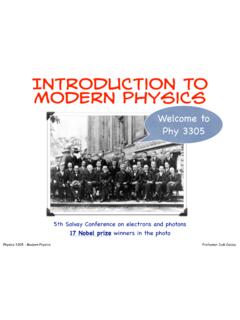
Introduction to Modern Physics
Newtonian Physics Developed in the 1800’s, extended forward 200 years. Force and acceleration are related to each other through inertial mass. -Kepler’s laws (accurate for many objects) -Energy is a fundamental quantity that can not be created or destroyed, only transferred. -Mass was recognized as a body’s tendency to resist changes
Download Introduction to Modern Physics

Information
Domain:
Source:
Link to this page:
Documents from same domain

A Close Look at Therapeutic Touch - PHYSICS @ SMU
www.physics.smu.eduA Close Look at Therapeutic Touch Linda Rosa, BSN, RN; Emily Rosa; Larry Sarner; Stephen Barrett, MD Context.— Therapeutic Touch (TT) is a widely used nursing practice rooted in mysticism but alleged to have a scientific basis. Practitioners of TT claim to treat
Free Electron Fermi Gas (Kittel Ch. 6) - SMU Physics
www.physics.smu.eduFree Electron Fermi Gas (Kittel Ch. 6) Role of Electrons in Solids ... Density of states • Key point - exactly the same as for vibration waves • We need the number of states per unit energy to find the total energy and the thermal properties of the electron gas.
The Force Table - SMU Physics
www.physics.smu.edu4 The angle will always be measured as above, with zero pointing along the positive x-axis and increasing in a counter-clockwise direction. Procedure: Part One: 1. Level the force table and put one of the pulleys at the angle 0°.
Chapter II: Reciprocal lattice - SMU
www.physics.smu.eduChapter II: Reciprocal lattice Read chapter 2 of Kittel. How can we study crystal structure? • Need probe that can penetrate into crystal • X-rays, neutrons, (high energy electrons) • X-rays discovered by Roentgen in 1895 - instant sensation round the world - view of his wife’s hand
Instruction of Parallel Plate Capacitor Experiments
www.physics.smu.edufrom Gauss’s Law in Electricity. The Instrument and Types of Experiments The instrument consists of a parallel plate capacitor with variable d (the distance between the plates) and A (the area the plates face each other), as shown in the figure below, another parallel plate capacitor with fixed d and A, plus a digital capacitance meter and a
Chapter 9 Center of Mass & Linear Momentum - SMU
www.physics.smu.eduNext note that the combination of disk S and plate P is composite plate C. Thus, the position x S+P of com S+P must coincide with the position x C of com C, which is at the origin; so x S+P =x C ... total linear momentum is conserved. (2) The collision is one-dimensional in the sense that
Rotational Equilibrium - SMU
www.physics.smu.edumeter stick. Balancing the meter stick in this manner will make it possible to determine its weight. Procedure: Part One 1. Place the fulcrum knife-edge on the meter stick and clamp it at the 50 cm mark. Place the fulcrum base on the corner of your table …
The Acceleration Due to Gravity - SMU Department of Physics
www.physics.smu.eduOur Equation (4) equates the total force to the gravitational force, and therefore neglects the effects of air friction. We must now try to discover a quantitative method for determining the gravitational acceleration, g. We first look to the equation for one-dimensional motion (motion in one direction) under constant acceleration.
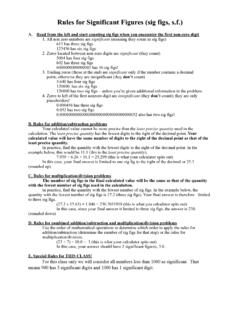
Rules for Significant Figures (sig figs, s.f.) - SMU
www.physics.smu.eduRules for Significant Figures (sig figs, s.f.) A. Read from the left and start counting sig figs when you encounter the first non-zero digit 1. All non zero numbers are significant (meaning they count as sig figs) 613 has three sig figs 123456 has six sig figs 2. Zeros located between non-zero digits are significant (they count)

Reference Frames - SMU
www.physics.smu.eduReference Frames To describe a physical event, we need to establish a 3-dimensional coordinate system associated with measurement. ... If you plug in the value for Earth’s orbital velocity, you get a relative difference in time of 5x10⁻⁹. This is too small to measure directly.
Related documents

Lecture Notes on Special Relativity
physics.mq.edu.au3 Newtonian Relativity 15 ... world is very old: it certainly predates Newton and seems to have been first stated concisely by Galileo, though some of the ideas were already around at the time of Aristotle (who apparently did not believe in the principle). What the principle of relativity essentially states is the following:

THE SPECIAL THEORY OF RELATIVITY
physics.mq.edu.authe properties of the physical world is very old: it certainly predates Newton and Galileo, but probably not as far back as Aristotle. What the principle of relativity essentially states is the following: The laws of physics take the same form in all frames of reference moving with constant velocity with respect to one another.

Lecture Notes on General Relativity Columbia University
web.math.princeton.edudi er from each other and lead to radically di erent perspectives for the physical world and its laws. We begin by listing the key assumptions about spacetime in Newtonian physics and then proceed by replacing these assumptions with the postulates of special relativity. 1.1 Newtonian Physics Main assumptions

General Relativity
www.math.toronto.eduthe physical world and its laws. We begin by listing the key assumptions about spacetime in Newtonian physics and then proceed by replacing these assumptions with the postulates of special relativity. 1.1 Newtonian Physics Main assumptions The primary assumptions in Newtonian physics are the following 1.There is an absolute notion of time.

8 Lorentz Invariance and Special Relativity
www.phys.ufl.eduthe Newtonian kinetic energy is obtained at low momentum and that mis the Newtonian mass. At p = 0 we have Einstein’s famous E= mc2! We can easily solve for p in terms of v: v2 c2 = p2 p2 +m2c2, E= mc2 p 1−v2/c2 = γmc2, p = vE c2 = γmv (420) As we shall soon see this modification of the relation between momentum and velocity is
CHAPTER ONE - NCERT
ncert.nic.inNewtonian mechanics, till then a very successful theory, could not explain some of the most basic features of atomic phenomena. Similarly, the then accepted wave picture of light failed to explain the photoelectric effect properly. This led to the development of a radically new theory (Quantum Mechanics) to deal with atomic and molecular phenomena.
MATHEMATICAL MODELING A Comprehensive Introduction
www.math.colostate.educoncrete conclusions concerning the world, both natural and artificial, that we live in. 1.1 EXAMPLES OF MODELING Here we do a quick tour of several examples of the mathematical process. We present the models as finished results as opposed to attempting to develop the models. 1.1.1 Modeling with Difference Equations

Fluid Mechanics 1 034013 Exercise Booklet
cdn1.sph.harvard.edu1. Ordinary Differential Equations, Differential Operators and Newtonian fluids Ordinary Differential Equations In the last two years of your studies you have taken many basic courses in Mathematics, from Calculus to Partial Differential equations and more. In all of these courses you learned Lemmas and rules and many techniques on

Classical Dynamics - DAMTP
www.damtp.cam.ac.uk1.2 Newtonian Mechanics: A Single Particle In the rest of this section, we’ll take a ying tour through the basic ideas of classical mechanics handed down to us by Newton. More details can be found in the lectures on Dynamics and Relativity. We’ll start with a single particle.. A particle is de ned to be an object of insigni cant

Mass, Energy, the Speed of Light— It’s Not Intuitive!
www2.lbl.govNewtonian Physics (pre-Einstein) gives good results if the object is moving pretty slowly—less than about 10% of the speed of light (the speed of light is 300,000,000 meters/sec or 186,000 mi/sec). • The mass of an object does not change with speed; it changes only if we cut off or add a piece to the object.