
Introduction to spectroscopy
spectroscopy to find out the chemical constitution of known and unknown gases. The same procedure is used for starlight, telling us what its source is composed of. ... and is called “emission spectrum”. When we separate the colors of such light, only a few bright “emission” lines appear, each in its own color (and wavelength). ...
Download Introduction to spectroscopy

Information
Domain:
Source:
Link to this page:
Documents from same domain
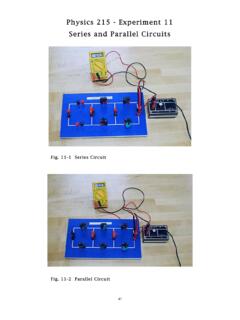
Physics 215 - Experiment 11 Series and Parallel …
www.phy.olemiss.eduPhysics 215 - Experiment 11 Series and Parallel Circuits 43 + V - Advance Reading Urone, Chapter 20, sections 20-1 & 20-4. Appendix B Computers and Software

Experiment 16: Series and Parallel Circuits
www.phy.olemiss.eduExperiment 16: Series and Parallel Circuits 85 Advance Reading Text: Resistors in series, parallel, combination. LabManual: AppendixC Appendix??-DMM Objective The objective of this lab is to study circuits with re-

Experiment 26 Reflection and Refraction
www.phy.olemiss.eduReflection and Refraction Advanced Reading: (Serway) Chapter 35, sections 35-4, ... Objective: The object of this experiment is to study the laws of reflection and refraction. Theory: The Law of Reflection states that the angle of incident ray equals the ... The Law of Refraction (Snell's Law) relates how a ray of light will behave when passing ...
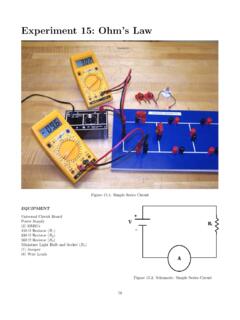
Experiment 15: Ohm’s Law - University of Mississippi
www.phy.olemiss.eduOhm’s Law states that the current, I, that flows in a circuit is directly proportional to the voltage, V, across the circuit and inversely proportional to the resistance,

Experiment 10: Archimedes’ Principle
www.phy.olemiss.edu54 Experiment 10: Archimedes’ Principle Advance Reading Text: Archimedes’ principle, buoyant force, density Objective The objective of this lab is to investigate the buoyant force acting on a variety of objects, the density of the objects, and the density of our tap water. Theory

Introduction to the Dobsonian Telescopes
www.phy.olemiss.eduIntroduction to the Dobsonian Telescopes One type of telescope that students in the astronomy class frequently use is a 10 - inch Dobsonian telescope. These telescopes are medium-size, as amateur telescopes go (the amateur rage would be 4 to 20 inches in …

Experiment 24 The Oscilloscope - University of Mississippi
www.phy.olemiss.eduExperiment 24 The Oscilloscope Advanced Reading: (Physics by Randall Knight) Chapter 15, section 15-1. You need to understand what is meant by wavelength, frequency, period and root mean square

Seebeck and Peltier Effects - Department of Physics and ...
www.phy.olemiss.edu1. Create two junctions between two different materials (as shown in Figure 1, above) by twisting wires firmly together. As shown in the diagram, you'll need one length of the first material, and two lengths of the second material. 2. Set your voltmeter to …
Experiment 15: Ohm’s Law
www.phy.olemiss.eduof about 100⌦. Once the voltage of a de-vice and your skin’s resistance are known, we can estimate the current that will flow through your body. Current E↵ect 0.001 A Can be felt 0.005 A Is painful 0.010 A Causes involuntary muscle contractions (spasms) 0.015 A Causes loss of muscle control 0.070 A If through the heart, causes serious
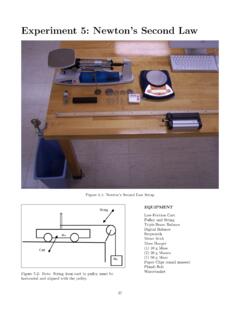
Experiment 5: Newton’s Second Law
www.phy.olemiss.edu1. State Newton’s First and Second Laws (qualitative explanations). (20 pts) 2. How is tension applied to the cart in this experiment? (15 pts) 3. How is friction compensated for in this experiment? (15 pts) 4. Should the acceleration determined in Step 5 (or any part of this experiment) be greater than, less than, or equal to the ...
Related documents
Infrared Spectroscopy and Mass Spectrometry
crab.rutgers.eduInfrared spectroscopy (IR spectroscopy observes the vibration of bonds, and gives information about which functionalities are present). Mass Spectrometry (MS provides information concerning the mass of the molecule, and sometimes about its structure). Nuclear Magnetic Resonance Spectroscopy (NMR spectroscopy provides
Chapter 6 Photoluminescence Spectroscopy
ocw.utm.myOne to three orders of magnitude better than absorption spectroscopy, even single molecules can be detected by fluorescence spectroscopy. Larger linear concentration range than absorption spectroscopy. Shortcomings Much less widely applicable than absorption methods. More environmental interference effects than absorption methods.
Ionization Interference in Inductively Coupled Plasma ...
global-sei.com108 · Ionization Interference in Inductively Coupled Plasma-Optical Emission Spectroscopy 3.5 3 2.5 2 1.5 1 0.5 0 Coexisting element Determined concentration (µ g/ml) Cs K Na Ba Li In Al Ga Cr Ni Cu B Zn P K/3 Na/3 Ba Li Al Y Mo Pb/3 Mn Ni Cu Ge B Cd Zn Fig. 2. Influence of coexisting elements in radial view 3.5 3 2.5 2 1.5 1 0.5 0 Coexisting ...

Spectroscopy: Principles, Theory, Techniques and Applications
mazams.weebly.comemission spectroscopy is used in chemistry and material sciences to determine elemental composition and chemical bonding. X-ray crystallography is a scattering process; crystalline materials scatter X-rays at well-defined angles. If the wavelength of …

Vibrational and Rotational Spectroscopy of Diatomic Molecules
personal.utdallas.eduSpectroscopy is the study of how matter interacts with electromagnetic radiation. Atoms and molecules inter-acting with light will sometimes emit photons at speci c frequencies; these frequencies depend on the energy level separation for whatever transitions caused the photon emission. We can use this to learn about the energy levels
An Introduction to Fluorescence Spectroscopy
www.chem.uci.eduSince the emission of fluorescence always takes place from the lowest vibrational level of the first excited state, the shape of the emission spectrum is always the same, despite changing the wavelength of exciting light. A plot of emission against wavelength for any given excitation wavelength is known as the emission spectrum.

Basic Principles of Atomic Absorption and Atomic Emission ...
www.philadelphia.edu.joFlame and Plasma Emission Spectroscopy are based upon those particles that are electronically excited in the medium. The Functions of Flame and Plasma 1. To convert the constituents of liquid sample into the vapor state. 2. To decompose the constituents into atoms or simple molecules: M+ + e-(from flame) -> M + hn 3.
Real Time Emission Measurements Using FTIR Spectroscopy ...
www3.epa.govInfrared Spectroscopy • IR spectroscopy is widely used for quantitative analysis • All molecular species except “homonuclear diatomics” (e.g., O 2, H 2, N 2, etc.) are detectable • IR light absorption due to changes in rotational and vibrational energy in molecule