
Key recommendations for clinical practice
appropriate adrenaline injector as an interim measure before the specialist allergy assessment (unless the reaction was drug-induced). o Patients prescribed adrenaline auto-injectors (and/or their parents/carers) must receive training in their use, …
Download Key recommendations for clinical practice

Information
Domain:
Source:
Link to this page:
Documents from same domain
Cardiopulmonary resuscitation, automated defibrillators ...
www.resus.org.ukbe as clear-cut if the rescuer isn’t medically qualified, the defence of necessity may be available, provided the rescuer acts reasonably in the circumstances. For instance, it would be reasonable to carry out CPR and use an AED if no healthcare professionals were available. Section 5 of the Mental Capacity Act (England
Emergency treatment of anaphylaxis Guidelines for ...
www.resus.org.ukBristol Royal Hospital for Children Bristol, UK E: nicholas.sargant@uhbw.nhs.uk No relevant conflict of interest Andrew F. Whyte Consultant in Allergy and Immunology Derriford Hospital University Hospitals Plymouth NHS Trust Plymouth UK E: andrew.whyte@nhs.net
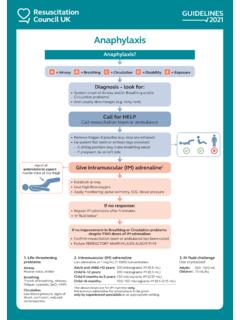
Anaphylaxis - resus.org.uk
www.resus.org.uk• Follow REFRACTORY ANAPHYLAXIS ALGORITHM • Remove trigger if possible (e.g. stop any infusion) • Lie patient flat (with or without legs elevated) – A sitting position may make breathing easier – If pregnant, lie on left side Give intramuscular (IM) adrenaline2 Call for HELP Call resuscitation team or ambulance Inject at

Refractory anaphylaxis A
www.resus.org.ukRefractory anaphylaxis No improvement in respiratory or cardiovascular symptoms despite 2 appropriate doses of intramuscular adrenaline Cardiac arrest – follow ALS ALGORITHM • Start chest compressions early • Use IV or IO adrenaline bolus (cardiac arrest protocol) • Aggressive fluid resuscitation
Resuscitation Council (UK)
www.resus.org.ukResuscitation Council (UK) EMERGENCY TREATMENT OF ANAPHYLACTIC REACTIONS6 1. Introduction 1.1 Purpose of this guideline The UK incidence of anaphylactic reactions is rising.2 Despite previous guidelines, there is confusion about …
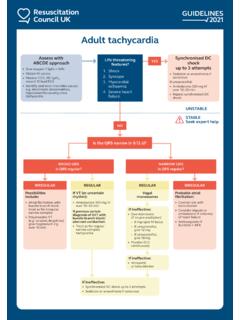
Adult tachycardia - Resus
www.resus.org.ukProbable atrial fibrillation: • Control rate with beta-blocker • Consider digoxin or amiodarone if evidence of heart failure •– Anticoagulate if duration > 48 h Vagal manoeuvres If ineffective: • Give Adenosine (if no pre-excitation) 6 mg rapid IV bolus – If unsuccessful, give 12 mg – If unsuccessful, give 18 mg • Monitor ECG
Decisions relating to cardiopulmonary resuscitation
www.resus.org.ukmay include family, other carers, close friends or others able to support or speak for the patient). This must not prevent discussion, to involve patients in shared decision-making whenever appropriate, or in some circumstances . Decisions relating to cardiopulmonary resuscitation 3 to inform patients of a decision and explain the reasons for ...
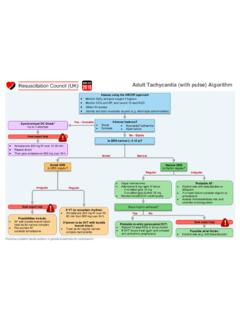
Adult Tachycardia (with pulse) Algorithm
www.resus.org.ukAF with bundle branch block treat as for narrow complex Pre-excited AF consider amiodarone If VT (or uncertain rhythm): Amiodarone 300 mg IV over 20-60 min then 900 mg over 24 h If known to be SVT with bundle branch block: Treat as for regular narrow-complex tachycardia Synchronised DC Shock* Up to 3 attempts
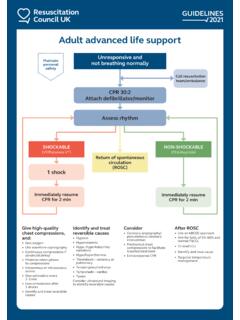
Adult advanced life support - Home | Resuscitation Council UK
www.resus.org.uk• Thrombosis – coronary or pulmonary • Tension pneumothorax • Tamponade – cardiac • Toxins Consider ultrasound imaging to identify reversible causes Consider • Coronary angiography/ percutaneous coronary intervention • Mechanical chest compressions to facilitate transfer/treatment • Extracorporeal CPR After ROSC
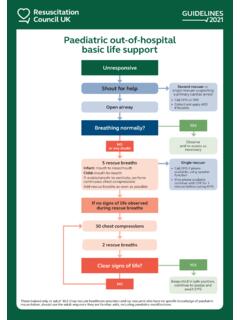
Paediatric out-of-hospital basic life support
www.resus.org.ukbasic life support Unresponsive Shout for help Open airway 5 rescue breaths Infant: mouth to nose/mouth Child: mouth to mouth If unable/unsafe to ventilate, perform continuous chest compressions Add rescue breaths as soon as possible 30 chest compressions 2 rescue breaths NO or any doubt NO YES YES Breathing normally? If no signs of life observed
Related documents

Guidance on the use of adrenaline auto-injectors in schools
assets.publishing.service.gov.uk2 Guidance on the use of adrenaline auto-injectors in schools Schools may administer their “spare” adrenaline auto-injector (AAI), obtained, without prescription, for use in emergencies, if available, but only to a pupil at risk of anaphylaxis, where both medical authorisation and written parental consent for use of the spare AAI has

Drug Safety Update
assets.publishing.service.gov.ukadrenaline auto-injectors. This advice follows the publication of a report from the Commission on Human Medicines on the effective and safe use of adrenaline auto-injectors for the emergency treatment of anaphylaxis. On page 9 we summarise recent advice relating to COVID-19 vaccines and medicines published since the October 2021 issue of Drug ...

From the Chief Medical Officer Dr Michael McBride HSS(MD ...
hscbusiness.hscni.netof adrenaline auto-injectors (AAIs) for patients who truly need them. Some healthcare professionals may be holding EpiPen® or similar AAI devices, in preference to adrenaline ampoules, to treat anaphylactic reactions; this should not be necessary. All healthcare professionals providing services where anaphylaxis treatment may be

Anaphylaxis: The Facts
www.anaphylaxis.org.ukPre-loaded auto-injectors containing adrenaline are prescribed for people believed to be at risk of anaphylaxis. Adrenaline is referred to in some countries as epinephrine, which is the internationally recognised term for adrenaline. Because severe allergic reactions can occur rapidly, the prescribed auto-injector must be readily available at

How to use an EpiPen (epinephrine injection, USP) Auto ...
www.med.unc.eduUse EpiPen ® (epinephrine injection, USP) 0.3 mg or EpiPen Jr (epinephrine injection, USP) 0.15 mg Auto-Injectors right away when you have an allergic emergency (anaphylaxis). Get emergency medical help right away. You may need further medical attention. Only a healthcare professional should give
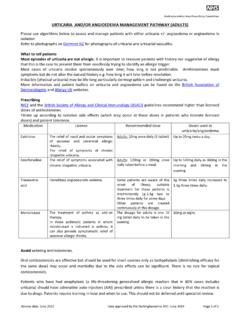
URTICARIA AND/OR ANGIOEDEMA MANAGEMENT …
www.nottsapc.nhs.ukeating, medication use, insect stings or exercise. If so, refer to allergy service particularly if features of anaphylaxis (difficulty in breathing, symptoms of hypotension). If future risk of anaphylaxis prescribe two adrenaline auto-injectors (AAI). Consider urticarial vasculitis. Refer to Dermatology. Review medication use.

How, and when, to give adrenaline using an auto-injector ...
www.sth.nhs.ukHow to use an adrenaline auto-injector: 1. Lie down. 2. Place the tip of the adrenaline auto-injector (the pointy bit) against the big muscle on the front or side of your thigh, holding the auto-injector at right angles to the leg. 3. Remove the safety cap. 4. Press hard and steadily into the thigh until the auto-injector mechanism functions.