Transcription of Key recommendations for clinical practice
1 Emergency treatment of anaphylaxis | May 2021 Key recommendations for clinical practice Anaphylaxis is a potentially life-threatening allergic reaction. Recognise anaphylaxis based on:osudden onset and rapid progression of symptomsoAirway and/or Breathing and/or Circulation problemsoskin and/or mucosal changes (flushing, urticaria, angioedema) but these may be absent in up to 20% of diagnosis is supported if a patient has been exposed to an allergen known to affect them. Treat life-threatening features, using the Airway, Breathing, Circulation,Disability, Exposure (ABCDE) approach. adrenaline is the first-line treatment for anaphylaxis. Give intramuscular (IM) adrenaline early (in the anterolateral thigh) for Airway/ single dose of IM adrenaline is well-tolerated and poses minimalrisk to an individual having an allergic reaction. If in doubt, give IM adrenaline after 5 minutes if Airway/Breathing/Circulationproblems persist.
2 Intravenous (IV) adrenaline must be used only in certain specialistsettings, and only by those skilled and experienced in its adrenaline infusions form the basis of treatment for refractoryanaphylaxis: seek expert help early in patients whose respiratory and/orcardiovascular problems persist despite 2 doses of IM adrenaline . Follow the National Institute for Health and Care Excellence (NICE) guidelinefor the assessment and referral of patients suspected to have hadanaphylaxis. Specifically:oAll patients should be referred to a specialist clinic for patients (or, if appropriate, their parent and/or carer) anappropriate adrenaline injector as an interim measure before thespecialist allergy assessment (unless the reaction was drug-induced).oPatients prescribed adrenaline auto -injectors (and/or theirparents/carers) must receive training in their use, and have anemergency management or action plan Further research is needed to better identify and treat patients at greatestrisk of severe treatment of anaphylaxis | May 2021 oAnaphylaxis reactions should be reported to the UK AnaphylaxisRegistry at (to register, guidance for reporting and debriefing of adverse treatment of anaphylaxis | May 2021 Summary of changes from previous guideline This guideline replaces the previous guideline from Resuscitation Council UK (RCUK): Emergency treatment of anaphylactic reactions Guidelines for healthcare providers (originally published January 2008, annotated July 2012 with links to NICE guidance).)
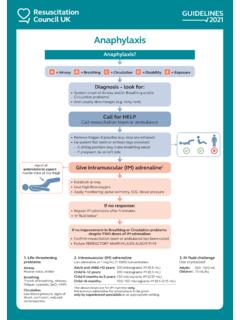
3 1 Greater emphasis on intramuscular adrenaline to treat anaphylaxis, and repeatedafter 5 minutes if Airway/Breathing/Circulation problems persist. A specific dose of adrenaline is now included for children below 6 months ofage. Increased emphasis on the importance of avoiding sudden changes in postureand maintaining a supine position (or semi-recumbent position if that makesbreathing easier for the patient) during treatment. There are 2 algorithms:oInitial treatment of anaphylaxis, with emphasis on repeating the doseof adrenaline after 5 minutes and giving an IV fluid bolus ifAirway/Breathing/Circulation problems of refractory anaphylaxis, defined as anaphylaxis wherethere is no improvement in respiratory or cardiovascular symptomsdespite two appropriate doses of IM adrenaline . IV fluids are recommended for refractory anaphylaxis, and must be givenearly if hypotension or shock is present.
4 Antihistamines are considered a third -line intervention and should not be used totreat Airway/Breathing/Circulation problems during initial emergency oral antihistamines, in preference to chlorphenamine,may be given following initial stabilisation especially in patients withpersisting skin symptoms (urticaria and/or angioedema). Corticosteroids ( hydrocortisone) are no longer advised for the routineemergency treatment of anaphylaxis. New guidance is offered relating to the duration of observation followinganaphylaxis, and timing of updated guideline has been developed according to the GRADE Evidence to Decision (EtD) frameworks for adoption, adaptation, and de novo development of trustworthy recommendations (GRADE-ADOLOPMENT).2 The evidence tables and conclusions have been peer-reviewed and Emergency treatment of anaphylaxis | May 2021 Download this algorithm: Emergency treatment of anaphylaxis | May 2021 Download this algorithm.