
Learning Convolutional Neural Networks for Graphs
neighborhood graphs as the CNN’s receptive fields. Figure2illustrates the PATCHY-SAN architecture which has several advantages over existing approaches: First, it is highly efficient, naively parallelizable, and applicable to large graphs. Second, for a number of applications, rang-ing from computational biology to social network analysis,
Download Learning Convolutional Neural Networks for Graphs

Information
Domain:
Source:
Link to this page:
Documents from same domain

TPOT: A Tree-based Pipeline Optimization Tool for ...
proceedings.mlr.pressJMLR: Workshop and Conference Proceedings 64:66{74, 2016 ICML 2016 AutoML Workshop TPOT: A Tree-based Pipeline Optimization Tool for Automating Machine …
Ensembles for Time Series Forecasting
proceedings.mlr.pressEnsembles for Time Series Forecasting set of real world time series. Our results clearly indicate that this is a promising research direction. In Section2we provide a brief description of the tasks being tackled in this paper.
Show, Attend and Tell: Neural Image CaptionGeneration …
proceedings.mlr.pressShow, Attend and Tell: Neural Image Caption Generation with Visual Attention Kelvin Xu? KELVIN.XU@UMONTREAL.CA Jimmy Lei Bay JIMMY@PSI.UTORONTO.CA Ryan Kirosy RKIROS@CS.TORONTO.EDU Kyunghyun Cho?
Wasserstein Generative Adversarial Networks
proceedings.mlr.pressWasserstein Generative Adversarial Networks Figure 1: These plots show ˆ(P ;P 0) as a function of when ˆis the EM distance (left plot) or the JS divergence (right plot).The EM plot is continuous and provides a usable gradient everywhere.
Self-Attention Generative Adversarial Networks
proceedings.mlr.pressSelf-Attention Generative Adversarial Networks Figure 1. The proposed SAGAN generates images by leveraging complementary features in distant portions of the image rather than local regions of fixed shape to generate consistent objects/scenarios. In each row, the first image shows five representative query locations with color coded dots.
Generative Adversarial Text to Image Synthesis
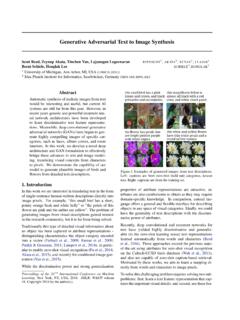
proceedings.mlr.pressdeep convolutional decoder networks to generate realistic images.Dosovitskiy et al.(2015) trained a deconvolutional network (several layers of convolution and upsampling) to generate 3D chair renderings conditioned on a set of graph-ics codes indicating shape, position and lighting.Yang et al. (2015) added an encoder network as well as actions ...

On the di culty of training recurrent neural networks
proceedings.mlr.pressOn the di culty of training recurrent neural networks @Et+1 @xt+1 Et Et+1 Et 1 xt 1 xt +1 ut +11 u tu @Et @xt @Et1 @xt1 @ xt +2 @xt +1 @x +1 x @xt1 @xt1 @xt2 Figure 2. Unrolling recurrent neural networks in time by creating a copy of the model for each time step.

Deep Gaussian Processes
proceedings.mlr.pressrepresentational power of a Gaussian process in the same role is significantly greater than that of an RBM. For the GP the corresponding likelihood is over a continuous vari-able, but it is a nonlinear function of the inputs, p(yjx) = N yjf(x);˙2; where N j ;˙2 is a Gaussian density with mean and variance ˙2. In this case the likelihood is ...
Noise-contrastive estimation: A new estimation principle ...
proceedings.mlr.pressated noise y. The estimation principle thus relies on noise with which the data is contrasted, so that we will refer to the new method as “noise-contrastive estima-tion”. In Section 2, we formally define noise-contrastive es-timation, establish fundamental statistical properties, and make the connection to supervised learning ex-plicit.
Gender Shades: Intersectional Accuracy Disparities in ...
proceedings.mlr.press117 million Americans are included in law en-forcement face recognition networks. A year-long research investigation across 100 police de-partments revealed that African-American indi-viduals are more likely to be stopped by law enforcement and be subjected to face recogni-tion searches than individuals of other ethnici-ties (Garvie et al.,2016).
Related documents

Algorithms Graph Search - Stanford University Computer …
cs.stanford.eduApplications: Game-playing Tic-tac-toe Go. Graphs have nodes and edges. How many nodes are there? How many edges? Graphs . Graphs We cast real-world problems as graphs. Graphs can be undirected or directed. Edges can have weights.
Inductive Representation Learning on Large Graphs - …
proceedings.neurips.ccreal-world applications require embeddings to be quickly generated for unseen nodes, or entirely new (sub)graphs. This inductive capability is essential for high-throughput, production machine learning systems, which operate on evolving graphs and constantly encounter unseen nodes (e.g., posts on Reddit, users and videos on Youtube).

154-2010: Using PROC SGPLOT for Quick High-Quality Graphs
support.sas.comgraphs tailored to each specific statistical analysis, and to integrate those graphs with the destinations and styles of the Output Delivery System. In SAS 9.2, over 60 statistical procedures have the ability to produce graphs using ODS ... and some applications, it will. But ODS Graphics is not designed to do everything that traditional SAS ...

The Basics of Creating Graphs with SAS/GRAPH Software Jeff ...
support.sas.comand applications that help manage graphical data and output. There are five main procedures that produce specific types of graphs: GCHART bar, pie, block, donut, star charts GPLOT scatter, bubble, line, area, box, regression plots G3D 3-D scatter and surface plots GCONTOUR contour plots GMAP maps with user-defined data CREATING BAR CHARTS

Chapter 2 Graphs - Cornell University
www.cs.cornell.edubasis have graphs embedded in them. 2.2 Paths and Connectivity We now turn to some of the fundamental concepts and definitions surrounding graphs. Per-haps because graphs are so simple to define and work with, an enormous range of graph-theoretic notions have been studied; the social scientist John Barnes once described graph

Deep Learning and Its Applications to Signal and ...
www.cse.fau.edutite graphs as shown in Figure 1, where all visible units are connected to all hid-den units, and there are no visible-visible or hidden-hidden connections. In an RBM, the joint distribution p (v, h; u) over the visible units v and hidden units h, given the model parameters u, is defined in terms of an energy function E (v, h; u) of p1v, h; u2 5

Graph Theory with Applications to Engineering and …
www.shahucollegelatur.org.in14-10 Graphs in Game Theory Summary References 15 SURVEY OF OTHER APPLICATIONS 15-1 Signal-Flow Graphs 15-2 Graphs in Markov Processes 15-3 Graphs in Computer Programming 15-4 Graphs in Chemistry 15-5 Miscellaneous Applications Appendix ABINET-CAUCHY THEOREM Appendix BNULLITY OF A MATRIX AND SYLVESTER’S LAW INDEX …

Name Date Ms - White Plains Public Schools
www.whiteplainspublicschools.org(2) Match simple graphs with situations Pgs. #1 - 7 Hw pgs. #7 - 8 Chapter 4-2: FUNCTIONS SWBAT: Determine if a relation is a function, by examining ordered pairs and inspecting graphs of relations Pgs. #9 - 13 Hw pg. 14 Chapter 4-3: WRITING and EVALUATING FUNCTIONS SWBAT: (1) Model functions using rules, tables, and graphs