
Learning Organic Chemistry
Learning Organic Chemistry Memorizing the structure, properties, and reactivities of each molecule will severely limit your abilities Organic chemistry is rational and systematic
Download Learning Organic Chemistry

Information
Domain:
Source:
Link to this page:
Documents from same domain
Experiment 1: Polymerization of acrylamide in water
www.chemistry2011.orgmonomer (ii) to its active radical end, thereby making the added monomer the new active end. R-(CH 2CHX) n-1 CH C H X • + H 2CC X H R-(CH 2CHX) n CH C H X • (i) (ii)
in (MMA) methacrylate methyl of Polymerization …
www.chemistry2011.orgExperiment 10: Polymerization of methyl methacrylate (MMA) in bulk to form PMMA. Aim: (a) To study the bulk polymerization of undiluted MMA to PMMA initiated by a single radical initiator at elevated temperature and to determine volumetric shrinkage after

Experiment 13: Bead (suspension) polymerization …
www.chemistry2011.orgFree radical polymerization of MMA to PMMA: See readings for experiment 10, especially pages 260-263 from Rempp and Merrill, “Polymer Synthesis”, Ch 12.
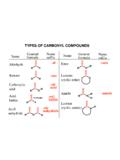
TYPES OF CARBONYL COMPOUNDS - …
www.chemistry2011.orgTYPES OF CARBONYL COMPOUNDS General Name Name formula suffix O -al Aldehyde C R H O Ketone C -one R R' O -oic C acid Carboxylic acid H R O Acid O X=halogen -oyl halide C halide R X

6,10 Nylon of polymerization Interfacial 6: Experiment
www.chemistry2011.org(2) (2) Brief Background: Step polymerization: (see handouts from Rempp & Merrill, Polymer Synthesis, pp35-40 and 50-57.) As we noted before, the two main types of polymerization are chain and step

Experiment 2: Characterization of polyacrylamide …
www.chemistry2011.orgExperiment 2: Characterization of polyacrylamide (PAM) by viscometry and gel permeation chromatography (optional) Aim: (a) To determine the intrinsic viscosity and molecular weight of polyacrylamide (synthesized in experiment 1) using a Ubbelohde capillary viscometer.

Reactions of Alkenes: Summary - Chemistry2011.org
www.chemistry2011.orgHalohydrin Alcohol Alcohol Alcohol Carbocation Radical ring Carbocation None (concerted) anti anti anti syn Markovnikov Markovnikov ring ring
Related documents

A SELF-STUDY GUIDE TO THE PRINCIPLES OF ORGANIC CHEMISTRY
www.bookpump.comvii This book, A Self-Study Guide to the Principles of Organic Chemistry: Key Concepts, Reaction Mechanisms, and Practice Questions for the Beginner is written in plain and simple language and it is formatted as a self-study guidebook for the students. For instructors, it is a handbook dealing with all the concepts necessary to
Worksheets for Organic Chemistry - cffet.net
www.cffet.netChemistry of Natural Substances – Organic Chemistry Worksheets 7 Worksheet 4 Alkenes/Alkynes Question 1. Predict the products of the reaction of 2-methyl-2-pentene with each of the following.Name each product. a) HBr b) dilute sulfuric acid c) Br
An Introduction to Organic Chemistry - cffet.net
www.cffet.netIntroduction to Organic Chemistry Chem. Nat. Substances p3 An Introduction to Organic Chemistry Organic chemistry is the study of carbon containing compounds and their properties.

ESTERS An Introduction to Organic Chemistry Reactions
www.chymist.comPhosphoric acid is corrosive causing severe burns. In the event of contact, rinse well with water for at least 10 minutes, then seek qualified medical assistance.

organic chemistry: SN2, E2, SN1, E1 - Freelance Teacher
www.freelance-teacher.comorganic chemistry: S N2, E2, S N1, E1 1 www.freelance-teacher.com S N2 S N1/E1 S N1 and E1 have identical rate determining steps, so they generally occur simultaneously and have the same properties. E2 S N2 and E2 S N1/E1 mechanism one step—this single step is the rate-determining step (RDS) two steps—RDS is formation of carbocation

A hand-book of industrial organic chemistry adapted for ...
www.jonnsaromatherapy.comTitle: A hand-book of industrial organic chemistry adapted for the use of manufacturers, chemists, and all interested in the utilization of organic materials in the industrial arts
Unit 5 Organic Chemistry - Nelson
www.nelson.comUnit 5 NEL Organic Chemistry 355 5. Photosynthesis is the formation of carbohydrates and oxygen from carbon dioxide, water, and sunlight, catalyzed by chlorophyll in the green parts of a
CHAPTER 1 INTRODUCTION TO ORGANIC CHEMISTRY 1.1 Historical ...
www.siue.eduCHAPTER 1 INTRODUCTION TO ORGANIC CHEMISTRY 1.1 Historical Background of Organic Chemistry Organic chemistry is the area of chemistry that involves the study of carbon
Related search queries
Study Guide to the Principles of Organic Chemistry, Worksheets for Organic Chemistry, Chemistry, Organic Chemistry, INTRODUCTION TO ORGANIC CHEMISTRY, Introduction to Organic Chemistry Organic chemistry, An Introduction to Organic Chemistry Reactions, Organic chemistry: SN2, E2, SN1, Organic, Organic Chemistry Organic chemistry