Learning Transferable Features with Deep Adaptation Networks
Deep Adaptation Networks In unsupervised domain adaptation, we are given a source domainDs = {(xs i,y s i)} ns i=1 withns labeledexamples,and a target domain Dt = {xt j} nt j=1 with nt unlabeled exam-ples. The source domain and target domain are charac-terized by probability distributions p and q, respectively.
Download Learning Transferable Features with Deep Adaptation Networks

Information
Domain:
Source:
Link to this page:
Documents from same domain

TPOT: A Tree-based Pipeline Optimization Tool for ...
proceedings.mlr.pressJMLR: Workshop and Conference Proceedings 64:66{74, 2016 ICML 2016 AutoML Workshop TPOT: A Tree-based Pipeline Optimization Tool for Automating Machine …
Ensembles for Time Series Forecasting
proceedings.mlr.pressEnsembles for Time Series Forecasting set of real world time series. Our results clearly indicate that this is a promising research direction. In Section2we provide a brief description of the tasks being tackled in this paper.
Show, Attend and Tell: Neural Image CaptionGeneration …
proceedings.mlr.pressShow, Attend and Tell: Neural Image Caption Generation with Visual Attention Kelvin Xu? KELVIN.XU@UMONTREAL.CA Jimmy Lei Bay JIMMY@PSI.UTORONTO.CA Ryan Kirosy RKIROS@CS.TORONTO.EDU Kyunghyun Cho?
Wasserstein Generative Adversarial Networks
proceedings.mlr.pressWasserstein Generative Adversarial Networks Figure 1: These plots show ˆ(P ;P 0) as a function of when ˆis the EM distance (left plot) or the JS divergence (right plot).The EM plot is continuous and provides a usable gradient everywhere.
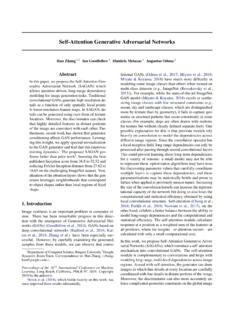
Self-Attention Generative Adversarial Networks
proceedings.mlr.pressSelf-Attention Generative Adversarial Networks Figure 1. The proposed SAGAN generates images by leveraging complementary features in distant portions of the image rather than local regions of fixed shape to generate consistent objects/scenarios. In each row, the first image shows five representative query locations with color coded dots.
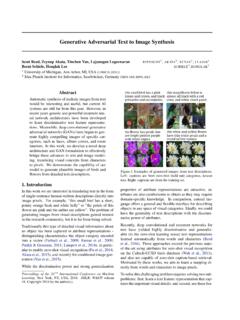
Generative Adversarial Text to Image Synthesis
proceedings.mlr.pressdeep convolutional decoder networks to generate realistic images.Dosovitskiy et al.(2015) trained a deconvolutional network (several layers of convolution and upsampling) to generate 3D chair renderings conditioned on a set of graph-ics codes indicating shape, position and lighting.Yang et al. (2015) added an encoder network as well as actions ...

On the di culty of training recurrent neural networks
proceedings.mlr.pressOn the di culty of training recurrent neural networks @Et+1 @xt+1 Et Et+1 Et 1 xt 1 xt +1 ut +11 u tu @Et @xt @Et1 @xt1 @ xt +2 @xt +1 @x +1 x @xt1 @xt1 @xt2 Figure 2. Unrolling recurrent neural networks in time by creating a copy of the model for each time step.

Deep Gaussian Processes
proceedings.mlr.pressrepresentational power of a Gaussian process in the same role is significantly greater than that of an RBM. For the GP the corresponding likelihood is over a continuous vari-able, but it is a nonlinear function of the inputs, p(yjx) = N yjf(x);˙2; where N j ;˙2 is a Gaussian density with mean and variance ˙2. In this case the likelihood is ...
Noise-contrastive estimation: A new estimation principle ...
proceedings.mlr.pressated noise y. The estimation principle thus relies on noise with which the data is contrasted, so that we will refer to the new method as “noise-contrastive estima-tion”. In Section 2, we formally define noise-contrastive es-timation, establish fundamental statistical properties, and make the connection to supervised learning ex-plicit.
Gender Shades: Intersectional Accuracy Disparities in ...
proceedings.mlr.press117 million Americans are included in law en-forcement face recognition networks. A year-long research investigation across 100 police de-partments revealed that African-American indi-viduals are more likely to be stopped by law enforcement and be subjected to face recogni-tion searches than individuals of other ethnici-ties (Garvie et al.,2016).
Related documents
AAAI-21 Accepted Paper List.1.29
aaai.org! 4!! 228:!Rain!Streak!Removal!via!Dual!Graph!Convolutional!Network! Xueyang!Fu,!Qi!Qi,!Yurui!Zhu,!Xinghao!Ding,!Zheng*Jun!Zha!! 233:!RevMan:!Revenue*Aware!Multi*Task ...
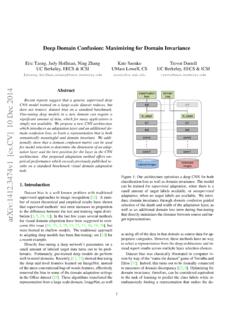
Deep Domain Confusion: Maximizing for Domain Invariance
arxiv.orgcan be trained for supervised adaptation, when there is a small amount of target labels available, or unsupervised adaptation, when no target labels are available. We intro-duce domain invariance through domain confusion guided selection of the depth and width of the adaptation layer, as well as an additional domain loss term during fine-tuning

Internal Audit: Key risk areas 2021
assets.kpmgcircumvented when employees are unsupervised, as they are often overlooked and ignored to save time. Advancements of technology also increase the sophistication and frequency of cyber security attacks and frauds. Internal Audit can offer its view on the extent to which any relaxing or adaptation of controls has
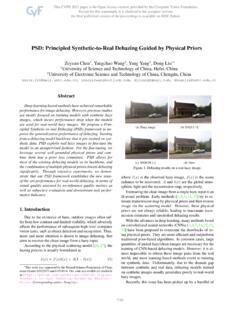
PSD: Principled Synthetic-to-Real Dehazing Guided by ...
openaccess.thecvf.com2.2. Unsupervised Domain Adaptation Unsupervised domain adaptation aims to tackle domain shift between source and target domains, while images in the target domain are unlabeled. One major idea is to in-duce alignment between the source and target domains in feature space by optimizing for some measurements of dis-tributional discrepancy [23 ...

Maximum Classifier Discrepancy for Unsupervised Domain ...
openaccess.thecvf.comMaximum Classifier Discrepancy for Unsupervised Domain Adaptation Kuniaki Saito1, Kohei Watanabe1, Yoshitaka Ushiku1, and Tatsuya Harada1,2 1The University of Tokyo, 2RIKEN {k-saito,watanabe,ushiku,harada}@mi.t.u-tokyo.ac.jp Abstract In this work, we present a method for unsupervised do-

Guidance on the Use of Antipsychotics
www.sussexpartnership.nhs.ukLester UK Adaptation – Positive Cardiometabolic Health Resource 51 Appendix 7 Drugs known to prolong QT interval 54 Appendix 8 References ... who are unsupervised For non-adherent patients who are supervised Change to an alternative depot medication or other long-acting

WIPO Technology Trends 2019: Artificial Intelligence
www.wipo.int“unsupervised learning” – learning without labelled data – remains a holy grail of AI. Even without this “holy grail,” AI is already creating massive economic value in the world today. In covering AI, the media tends to focus on images, speech and natural language processing because those types of data are very human.