
Lecture 13: Generative Models
nonlinearity (sigmoid) Later: Deep, fully-connected Later: ReLU CNN. Fei-Fei Li & Justin Johnson & Serena Yeung Lecture 13 - May 18, 2017 Some background first: Autoencoders 39 Encoder Input data Features Unsupervised approach …
Download Lecture 13: Generative Models

Information
Domain:
Source:
Link to this page:
Documents from same domain
NaveenAppiah SagarVare - Stanford University
cs231n.stanford.eduNaveenAppiah Mechanical Engineering nappiahb@stanford.edu SagarVare Stanford ICME svare@stanford.edu ... the popular mobile game - Flappy Bird. It involves navi-gating a bird through a bunch of obstacles. Though, this ... the game emulator and learns to make good decisions over time. It is this simple learning framework and their

Fei-Fei Li & Justin Johnson & Serena Yeung Lecture 2 ...
cs231n.stanford.eduFei-Fei Li & Justin Johnson & Serena Yeung Lecture 2 - April 6, 2017 Administrative: Piazza For questions about midterm, poster session, projects,

Lecture 9: CNN Architectures
cs231n.stanford.eduLecture 9 - 22 May 2, 2017 ImageNet Large Scale Visual Recognition Challenge (ILSVRC) winners First CNN-based winner. Fei-Fei Li & Justin Johnson & Serena Yeung Lecture 9 - 23 May 2, 2017 ImageNet Large Scale Visual Recognition Challenge (ILSVRC) winners ZFNet: Improved hyperparameters over AlexNet. Fei-Fei Li & Justin Johnson & Serena Yeung ...

Attention and Transformers Lecture 11
cs231n.stanford.edugraph with shared weights h 0 f W h 1 f W h 2 f W h 3 x 3 y T ... Extract spatial features from a pretrained CNN Image Captioning using spatial features 11 CNN Features: H x W x D h 0 [START] Xu et al, “Show, Attend and Tell: Neural Image Caption Generation with Visual Attention”, ICML 2015 z 0,0 z 0,1 z 0,2 z 1,0 z 1,1 z 1,2 z 2,0 z 2,1 z ...

CNNs for Face Detection and Recognition
cs231n.stanford.edudevelopment of object classification, localization and detec-tion techniques. 2.1. Sliding Window In the early development of face detection, researchers tended to treat it as a repetitive task of object classifica-tion, by imposing sliding windows and performing object classification with the neural networks on the window re-gion.
Vector, Matrix, and Tensor Derivatives
cs231n.stanford.eduErik Learned-Miller The purpose of this document is to help you learn to take derivatives of vectors, matrices, and higher order tensors (arrays with three dimensions or more), and to help you take ... At this point, we have reduced the original matrix equation (Equation 1) …

Lecture 14: Reinforcement Learning
cs231n.stanford.eduFei-Fei Li & Justin Johnson & Serena Yeung Lecture 14 - May 23, 2017 Markov Decision Process 19 - Mathematical formulation of the RL problem - Markov property: Current state completely characterises the state of the

Convolutional Neural Networks for Visual Recognition
cs231n.stanford.eduProgressive GAN, Karras 2018. Models from Single RGB Images”, ECCV 2018 Beyond recognition: Segmentation, 2D/3D Generation. Fei-Fei Li, Ranjay Krishna, Danfei Xu Lecture 1 - 15 March 30, 2021 Scene Graphs Krishna et al., Visual Genome: Connecting Vision and Language using Crowdsourced Image Annotations, IJCV 2017
Lecture 11: Detection and Segmentation
cs231n.stanford.eduFei-Fei Li & Justin Johnson & Serena Yeung Lecture 11 - 1 May 10, 2017 Lecture 11: Detection and Segmentation

Lecture 10: Recurrent Neural Networks
cs231n.stanford.eduimage -> sequence of words. Fei-Fei Li & Justin Johnson & Serena Yeung Lecture 10 - 13 May 4, 2017 Recurrent Neural Networks: Process Sequences e.g. Sentiment Classification sequence of words -> sentiment. Fei-Fei Li & Justin Johnson & Serena Yeung Lecture 10 - 14 May 4, 2017
Related documents
A Rapid and Sensitive Method for the Quantitation of ...
hoffman.cm.utexas.edunonlinearity is in the reagent itself since there is an overlap in the spectrum of the two different color forms of the dye. The background value for the reagent is continually decreasing as more dye is bound to protein. This presents no real problem since the degree of …
Recti er Nonlinearities Improve Neural Network Acoustic Models
ai.stanford.eduNonlinearity functions used in neural network hidden layers. The hyperbolic tangent (tanh) function is a typical choice while some recent work has shown im-proved performance with recti ed linear (ReL) functions. The leaky recti ed linear function (LReL) has a non-zero
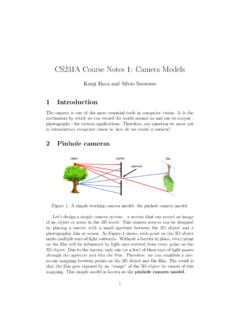
CS231A Course Notes 1: Camera Models - Stanford University
web.stanford.eduP 0= x y0 T = fx z fy z T (1) Notice that one large assumption we make in this pinhole model is that the aperture is a single point. In most real world scenarios, however, we

MCP6N16 - Microchip Technology
ww1.microchip.comMCP6N16 DS20005318A-page 2 2014 Microchip Technology Inc. Minimum Gain Options Table 1 shows key specifications that differentiate between the different minimum gain (GMIN) options. See Section 1.0 “Electrical Characteristics”, Section 6.0 “Packaging Information” and Product Identification System for further information on GMIN. Figures 1 to3 show input offset voltage …
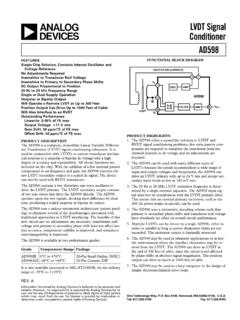
AD598 LVDT Signal Conditioner - Analog Devices
www.analog.comNonlinearity is defined as the maximum measured deviation of the AD598 output voltage from a straight line. The straight line is determined by connecting the maximum produced full-scale negative voltage with the maximum produced full-scale positive voltage. 4See Transfer Function.

Analog Multiplier Data Sheet AD633
www.analog.comNonlinearity for the Y input is typically less than 0.1% and noise referred to the output is typically less than 100 µV rms in a 10 Hz to 10 kHz bandwidth. A 1 MHz bandwidth, 20 V/µs slew rate, and the ability to drive capacitive loads make the AD633 useful in a wide variety of applications where

Typical Application - SparkFun Electronics
www.sparkfun.comNonlinearity E LIN Over full range of I P – 1.5 – % Symmetry E SYM Over full range of I P 98 100 102 % Zero Current Output Voltage V IOUT(Q) Bidirectional; I P = 0 A, T A = 25°C – V CC × 0.5 –V Power-On Time t PO Output reaches 90% of steady-state level, T J = 25°C, 20 A present on leadframe –35 –μs Magnetic Coupling2 – 12 ...