Logit Models for Binary Data
First, we move from the probability ˇ ito the odds odds i= ˇ i 1 ˇ i; de ned as the ratio of the probability to its complement, or the ratio of favorable to unfavorable cases. If the probability of an event is a half, the odds are one-to-one or even. If the probability is 1/3, the odds are one-to-two.
Download Logit Models for Binary Data

Information
Domain:
Source:
Link to this page:
Documents from same domain
Logit Models for Binary Data
data.princeton.eduChapter 3 Logit Models for Binary Data We now turn our attention to regression models for dichotomous data, in-cluding logistic regression and probit analysis.
Multinomial Response Models - Princeton University
data.princeton.eduChapter 6 Multinomial Response Models We now turn our attention to regression models for the analysis of categorical dependent variables with more than …
Non-Parametric Estimation in Survival Models
data.princeton.eduNon-Parametric Estimation in Survival Models Germ´an Rodr´ıguez grodri@princeton.edu Spring, 2001; revised Spring 2005 We now discuss the analysis of survival data without parametric assump-
Parametric Survival Models - Princeton University
data.princeton.eduParametric Survival Models Germ an Rodr guez grodri@princeton.edu Spring, 2001; revised Spring 2005, Summer 2010 We consider brie y the analysis of survival data when one is willing to
Survival Models - Princeton University
data.princeton.eduChapter 7 Survival Models Our nal chapter concerns models for the analysis of data which have three main characteristics: (1) the dependent variable or …
Multinomial Response Models - data.princeton.edu
data.princeton.eduChapter 6 Multinomial Response Models We now turn our attention to regression models for the analysis of categorical dependent variables with more than two response categories.

Poisson Models for Count Data
data.princeton.edudistribution if you consider the distribution of the number of successes in a very large number of Bernoulli trials with a small probability of success in each trial. Speci cally, if Y ˘B(n;ˇ) then the distribution of Y as n!1 and ˇ!0 with = nˇremaining xed approaches a …
Parametric Survival Models - Princeton University
data.princeton.eduThe Gompertz distribution is characterized by the fact that the log of the hazard is linear in t, so (t) = expf + tg and is thus closely related to the Weibull distribution where the log of the hazard is linear in logt. In fact, the Gompertz is a log-Weibull distribution. This distribution provides a remarkably close t to adult mortality in
Survival Models - Princeton University
data.princeton.edu2 CHAPTER 7. SURVIVAL MODELS It will often be convenient to work with the complement of the c.d.f, the survival function S(t) = PrfT tg= 1 F(t) = Z 1 t f(x)dx; (7.1) which gives the probability of being alive just before duration t, or more generally, the probability that the event of interest has not occurred by duration t. 7.1.2 The Hazard ...
Generalized Linear Model Theory - Princeton University
data.princeton.eduB.2 Maximum Likelihood Estimation An important practical feature of generalized linear models is that they can all be fit to data using the same algorithm, a form of iteratively re-weighted least squares. In this section we describe the algorithm. Given a trial estimate of the parameters βˆ, we calculate the estimated linear predictor ˆη i ...
Related documents
Chapter 5: JOINT PROBABILITY DISTRIBUTIONS Part 1 ...
homepage.stat.uiowa.eduThere are 6 possible pairs (X;Y). We show the probability for each pair in the following table: x=length 129 130 131 y=width 15 0.12 0.42 0.06 16 0.08 0.28 0.04

Chapter 1 Markov Chains
www.stat.yale.edu2 1MarkovChains 1.1 Introduction This section introduces Markov chains and describes a few examples. A discrete-time stochastic process {X n: n ≥ 0} on a countable set S is a collection of S-valued random variables defined on a probability space (Ω,F,P).The Pis a probability measure on a family of events F (a σ-field) in an event-space Ω.1 The set Sis the state space …
University of Toronto
www.utstat.toronto.eduChapter 1 introduces the probability model and provides motivation for the study of probability. The basic properties of a probability measure are developed. Chapter 2 deals with discrete, continuous, joint distributions, and the effects of a change of variable. It also introduces the topic of simulating from a probability distribution.
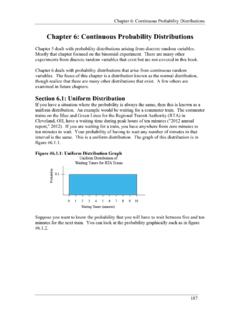
Chapter 6: Continuous Probability Distributions
coconino.eduChapter 6: Continuous Probability Distributions 191 The equation that creates this curve is f(x)= 1 σ2π e − 1 2 x−µ σ ⎛ ⎝⎜ ⎞ ⎠⎟ 2. Just as in a discrete probability distribution, the object is to find the probability of an event occurring. However, unlike in a discrete probability distribution where the event
A Short Introduction to Probability
people.smp.uq.edu.auA Short Introduction to Probability Prof. Dirk P. Kroese School of Mathematics and Physics The University of Queensland c 2018 D.P. Kroese. These notes can …

Chapter 4 RANDOM VARIABLES - University of Kent
www.kent.ac.ukThe pf of a discrete rv describes how the total probability, 1, is split, or distributed, between the various possible values of X. This ‘split’ or pattern is known as the distribution of the rv. Note: The pf is not the only way of describing the distribution of …