Mass Spectroscopy
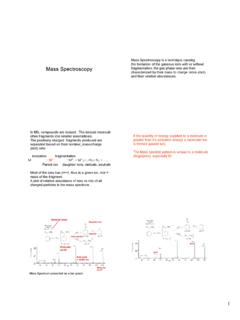
1 Mass Spectroscopy Mass Spectroscopy is a technique causing the formation of the gaseous ions with or without fragmentation; the gas phase ions are then
Download Mass Spectroscopy

Information
Domain:
Source:
Link to this page:
Documents from same domain
Chapter 4: Energy from Combustion The primary …
web.mnstate.eduChapter 4: Energy from Combustion The primary means of generating energy for human endeavors is the combustion of fuels. Fuels: Coal -burned in power plants Gasoline -burned in automobiles

African Environmental Issues - Minnesota State …
web.mnstate.eduAfrican Environmental Issues . Environment in Africa: continuity & change. •Important to consider geological age of Africa & its tropical location. •Both affect
Reactions of Amines - Minnesota State University …
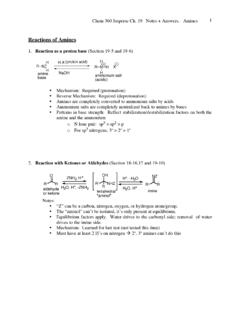
web.mnstate.eduChem 360 Jasperse Ch. 19 Notes + Answers. Amines 1 Reactions of Amines 1. Reaction as a proton base (Section 19-5 and 19-6) RN H H N H R H H X …

Test3 ch17b Buffer-Titration-Equilibrium Practice …
web.mnstate.edu4 Preparation and Recognition of Buffer Systems 14. Which of the following is not a buffer system? A solution containing roughly equal concentrations of _____ a.
Standardization of a Hydrochloric Acid Solution
web.mnstate.eduPage 1 Spring 2011 Standardization of a Hydrochloric Acid Solution The purpose of this experiment is to test your lab technique and examine potential sources of error in

Some Arrow-Pushing Guidelines (Section 1.14)
web.mnstate.eduOrganic Chemistry I Review: Highlights of Key Reactions, Mechanisms, and Principles 1 Some Arrow-Pushing Guidelines (Section 1.14) 1. Arrows follow electron movement.

Recrystallization I 9 Chem 355 Jasperse RECRYSTALLIZATION
web.mnstate.eduRecrystallization I 9 Chem 355 Jasperse RECRYSTALLIZATION Background: Impurities often contaminate organic compounds, whether they have been synthesized in

1. Given the relation R (1 1) (1 3) (1 4) (2 2) (3 1) (3 4 ...
web.mnstate.edu9. For each of the following collections of subsets of A= {1,2,3,4,5}, determine whether of not the collection is a partition. If it is, list the ordered pairs in the equivalence relation determined by the partition.
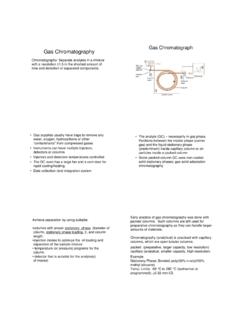
Gas Chromatograph Gas Chromatography
web.mnstate.eduColumn selection GC: Select a stationary phase that would retain (‘dissolve’) the analytes of interest. Stationary phase polarity ~ analyte polarity; (like dissolves like). Selectivity to individual analytes determines the quality of separation (ability to discern the

Acute Stress Response Spectrum Adaptationist Perspectives ...
web.mnstate.edurecent literature, freeze, flight, fight, fright, faint provides a more complete description of the human acute stress response sequence than current descriptions.
Related documents

Principles of NMR
process-nmr.com- 1 - Principles of NMR By John C. Edwards, Ph.D. Process NMR Associates LLC, 87A Sand Pit Rd, Danbury CT 06810 Nuclear magnetic resonance spectroscopy (NMR) was first developed in 1946 by
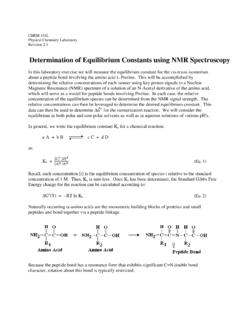
Determination of Equilibrium Constants using NMR …
infohost.nmt.eduCHEM 331L Physical Chemistry Laboratory Revision 2.1 Determination of Equilibrium Constants using NMR Spectroscopy In this laboratory exercise we will measure the equilibrium constant for the cis-trans isomerism about a peptide bond involving the amino acid L-Proline.This will be accomplished by

Chapter 13: Nuclear Magnetic Resonance (NMR) …
www.vanderbilt.edu1 Chapter 13: Nuclear Magnetic Resonance (NMR) Spectroscopy direct observation of the H’s and C’s of a molecules Nuclei are positively charged and spin on an axis; they create a
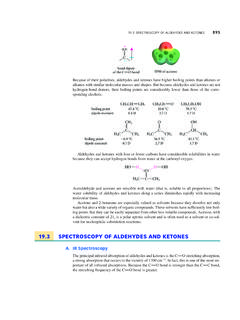
19.3 SPECTROSCOPY OF ALDEHYDES AND KETONES
www.saplinglearning.com898 CHAPTER 19 • THE CHEMISTRY OF ALDEHYDES AND KETONES. CARBONYL-ADDITION REACTIONS C. Carbon NMR Spectroscopy The most characteristic absorption of aldehydes and ketones in 13C NMR spectroscopy is that of the carbonyl carbon, which occurs typically in the d190–220 range (see Fig. 13.20, p. 624).
13C NMR - UCLA
www.chem.ucla.edu13C NMR The 13C NMR is generated in the same fundamental was as proton NMR spectrum. Only 1.1 % of naturally occurring carbon is 13C and actually an advantage because of less coupling. Requirement for NMR: Spin quantum # (I) ≠ 0 Meaning must be an odd number

3 Basic concepts for two-dimensional NMR
www-keeler.ch.cam.ac.uk3–1 3 Basic concepts for two-dimensional NMR ,QWURGXFWLRQ The basic ideas of two-dimensional NMR will be introduced by reference to the appearance of a COSY spectrum; later in this lecture the product
INFRARED SPECTROSCOPY (IR)
utdallas.edu1 INFRARED SPECTROSCOPY (IR) Theory and Interpretation of IR spectra ASSIGNED READINGS • Introduction to technique 25 (p. 833-834 in lab textbook)
Infrared Spectroscopy and Mass Spectrometry
crab.rutgers.eduInfrared Spectroscopy and Mass Spectrometry Introduction It is fundamental for an organic chemist to be able to identify, or characterize, the new compound that he/she has just made. Sometimes this can be achieved by a chemical means, such as determining the elemental composition and molecular weight.

NMR Spectroscopy of Aromatic Compounds (#1e)
www.unm.edu40 13C NMR Spectroscopy of Aromatic Compounds As with other 13C NMR spectra, aromatic compounds display single lines for each unique carbon environment in a benzene ring. Aromatic carbons appear between 120-170 ppm. The 13C NMR spectra of bromobenzene and p-bromoethylbenzene are shown below for comparison.There are four different carbon environments in bromobenzene, and four …
Related search queries
Principles of NMR, Nuclear magnetic resonance spectroscopy, Determination of Equilibrium Constants using NMR, Determination of Equilibrium Constants using NMR Spectroscopy, Chapter 13: Nuclear Magnetic Resonance (NMR), Chapter 13: Nuclear Magnetic Resonance (NMR) Spectroscopy, 19.3 SPECTROSCOPY OF ALDEHYDES AND KETONES, NMR spectroscopy, 13C NMR, Basic concepts for two-dimensional NMR, INFRARED SPECTROSCOPY IR, Infrared Spectroscopy and Mass Spectrometry, NMR Spectroscopy of Aromatic Compounds