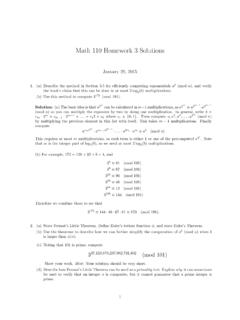
Math 110 Homework 3 Solutions
By the Chinese Remainder Theorem, we already knew that the map (Z=mnZ) ! (Z=mZ) (Z=nZ) c(mod nm) 7! c(mod m) ;c(mod n) is one-to-one and onto. Now we know that it maps every unit c(mod mn) to a pair of units c(mod m) ;c(mod n) , and conversely that every pair of units is in the image of a unit c(mod mn). We conclude that the map re-
Download Math 110 Homework 3 Solutions

Information
Domain:
Source:
Link to this page:
Documents from same domain

Thermal properties of organic light-emitting diodes
www.math.lsa.umich.eduThermal management is important for the efficient operation of organic light-emitting diodes (OLED, or PHOLED) at high brightness, with the device operating temperature influ- …

Regular Expressions: The Power of Perl
www.math.lsa.umich.eduRegular Expressions: The Power of Perl 1.What is a regular expression (regex) ? - it is a ‘description’ for a group of characters you want to search for in a string, a file, a website, etc... - think of the group of characters as a ‘pattern’ that you want to find within a string.

Math 110 Homework 4 Solutions - University of Michigan
www.math.lsa.umich.eduMath 110 Homework 4 Solutions February 5, 2015 1. (a) Let pbe a positive prime. De ne a primitive root modulo p. (b) Identify all primitive roots modulo 11. Is your solution consistent with the claim that there are ... For the second part, the rst condition is equivalent to gj k 1 (mod p) by multiplying by g . The

Orthogonal Transformations - U-M LSA
www.math.lsa.umich.eduso x= 53=5. G. TRUE OR FALSE. Justify. In all problems, Tdenotes a linear transformation from Rn to itself, and Ais its matrix in the standard basis. 1. If Tis orthogonal, then xy= TxTyfor all vectors xand yin Rn. 2. If T sends every pair of orthogonal vectors to another pair of orthogonal vectors, then T is

Math 217: Summary of Change of Basis and All That
www.math.lsa.umich.edu2 of polynomials of degree 2 consists of all expressions of the form a+bx+cx2. Here, the choice of the basis f1;x;x2ggives an isomorphism identifying P 2 with R3: P 2!R3 a+bx+cx2 7! 2 4 a b c 3 5: The formal mathematical statement is that the mapping V !Rn ~x7![~x] B is an isomorphism of vector spaces.2 This is deeper than just matching up the ...
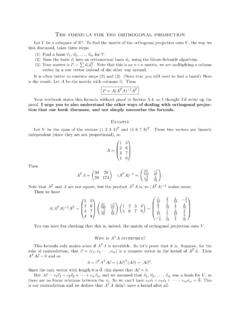
The formula for the orthogonal projection
www.math.lsa.umich.eduLet V be a subspace of Rn. To nd the matrix of the orthogonal projection onto V, the way we rst discussed, takes three steps: (1) Find a basis ~v 1, ~v 2, ..., ~v m for V. (2) Turn the basis ~v i into an orthonormal basis ~u i, using the Gram-Schmidt algorithm. (3) Your answer is P = P ~u i~uT i. Note that this is an n n matrix, we are ...
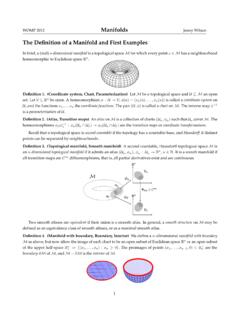
The Definition of a Manifold and First Examples
www.math.lsa.umich.eduWOMP 2012 Manifolds Jenny Wilson A manifold with boundary is smooth if the transition maps are smooth. Recall that, given an arbitrary subset X Rm, a function f: X!Rnis called smooth if every point in Xhas some neighbourhood where fcan be extended to a smooth function.

Fermi Questions - University of Michigan
www.math.lsa.umich.edu2. Wild Guess: Make a wild guess involving no calculations. 3. Educated Guess: Make an educated guess involving a chain of reasoning and calculations based on everyday experiences and estimates. 4. Variables and Formulas: De ne variables and create a formula to solve the Fermi question. 5.

Math 110 Homework 1 Solutions
www.math.lsa.umich.eduMath 110 Homework 1 Solutions January 15, 2015 1. (a) De ne the phrase m divides n. (b) Given integers m and n, state the de nition of the greatest common divisor of m and n. (c) Suppose that m and n are two integers such that m jn. Find gcd(m;n), and prove your solution. Solution: (a) The integer m divides n if there exists an integer r such ...

A QUICK PROOF OF THE CAUCHY-SCHWARTZ INEQUALITY
www.math.lsa.umich.eduyou know and love in R2, then the Cauchy-Schwartz inequality is a consequence of the law of cosines. Speci cally, uv = jujjvjcos , and cos 1. In case you are nervous about using geometric intuition in hundreds of dimensions, here is a direct proof. First, note that we have ww= w2 1 + w 2 2 + w 2 n 0 for any w.
Related documents

The Chinese Remainder Theorem - luc.edu
gauss.math.luc.eduBy solving this by the Chinese remainder theorem, we also solve the original system. (The solution is x 20 (mod 56).) Of course, the formula in the proof of the Chinese remainder theorem is not the only way to solve such problems; the technique presented at the beginning of this lecture is actually more general, and it requires no mem-orization.

The Chinese Remainder Theorem - homepages.math.uic.edu
homepages.math.uic.eduChinese Remainder Theorem tells us that there is a unique solution modulo m, where m = 11 ⋅ 16 ⋅ 21 ⋅ 25 = 92400. We apply the technique of the Chinese Remainder Theorem with k = 4, m 1 = 11, m 2 = 16, m 3 = 21, m 4 = 25, a 1 = 6, a 2 = 13, a 3 = 9, a 4 = 19, to obtain the solution. We compute z 1 = m / m 1 = m 2 m 3 m 4 = 16 ⋅ 21 ...

Section 4.3 - The Chinese Remainder Theorem
zimmer.csufresno.eduSolution: Since 8 and 9 are relatively prime, we can use the Chinese remainder theorem to solve the congruences x ≡ 1 (mod 8) x ≡ 3 (mod 9) One comes up with x ≡ 57 (mod 72). Thus since 12 divides 72, we must also have x ≡ 57 (mod 12). But 57 6≡2 (mod 12)

Math 127: Chinese Remainder Theorem - CMU
www.math.cmu.eduMath 127: Chinese Remainder Theorem Mary Radcli e 1 Chinese Remainder Theorem Using the techniques of the previous section, we have the necessary tools to solve congruences of the form ax b (modn). The Chinese Remainder Theorem gives us a tool to consider multiple such congruences simultaneously.

Problems on Discrete Mathematics1 LTEX at January 11, 2007
www.itk.ilstu.eduThen we exam each case to see if the theorem is valid. If the theorem holds in every case, then the theorem is correct in the entire domain. Note that we must use the idea of universal generalization2 in the proof of each case. 2See the logic chapter for more details. °c Chung-Chih Li, Kishan Mehrotra
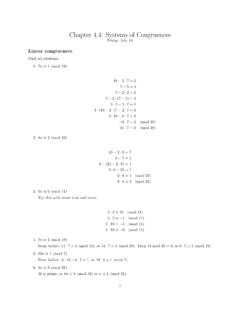
Chapter 4.4: Systems of Congruences
math.berkeley.eduChinese Remainder Theorem Decide whether the system has a solution. If it does, nd it. 1. x 3 (mod 8), x 1 (mod 7) Try x = 8a+7b. mod 8, we get 3 x 7b (mod 8), and solving gives b = 5. mod 7, we get 1 x 8a (mod 7), so a 1 (mod 7). Therefore one …

MODULAR ARITHMETIC
www.ucd.ieBy the de nition of a \remainder," we can write a = im + r 1, where r 1 is the remainder under division by m and satis es 0 r 1 m 1. Similarly, b = jm + r 2 with 0 r 2 m 1. Then if m divides a b, this means that m divides im + r 1 jm r 2 = m(i j) + r 1 r 2. Since m clearly divides m(i j), we get that m divides r 1 r 2. We know that r 1 and r