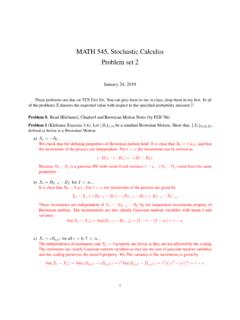
MATH 545, Stochastic Calculus Problem set 2
d) X t = ˆ tB 1=t; if t>0 0; if t= 0;1 By Theorem 3.3 in [Klebaner]: X t is a mean zero gaussian process with covariance structure Cov(X s;X t) = min(s;t).Because rescaling time and brownian motion paths does not affect the mean of the process not its Gaussian structure, the first two points above are trivial.
Download MATH 545, Stochastic Calculus Problem set 2

Information
Domain:
Source:
Link to this page:
Documents from same domain

Essentials of Stochastic Processes - Duke University
services.math.duke.eduEssentials of Stochastic Processes ... Between the first undergraduate course in probability and the ... Stochastic Processes to students with many different ...

rd Grade Astronomy Lessons - Duke University
services.math.duke.edu3rd Grade Astronomy Lessons The following is a set of suggested activities for a third grade curriculum unit on the Earth/Sun/Moon system. The goal is to provide students with an understanding of the

Programming ActionScript 3 - Duke University
services.math.duke.eduProgramming ActionScript™ 3.0 If this guide is distributed with software that includes an end-user agreement, this guide, as well as the software described i n it, is furnished under license and may be used or copied only in accordance with the terms of such license.

Math 361S Lecture Notes Numerical solution of ODEs
services.math.duke.eduUsing ODE solvers in MATLAB and python: For example, ode45 is an adaptive method in MATLAB that is a workhorse of solving ODE’s, that often \just works." ... For our purposes, we will attempt to construct numerical solutions where the actual solution exists, so the theory is just there to ensure that the problem to solve is well-de ned.

Math 230.01, Fall 2012: HW 2 Solutions
services.math.duke.eduMath 230.01, Fall 2012: HW 2 Solutions This homework is due at the beginning of class on Thursday January 26th, 2011. You are free to talk with each other and get help. However, you should write up your own solutions and understand everything that you write. Problem 1. The 1987 World Series was tied at two games a piece before the St. Louis ...

Introduction to Stochastic Calculus
services.math.duke.edumodel the number of genetic mutations an animal species. We may also think about Nptqas the number of sick individuals in a population. Reasonable and widely applied models for the spread of infectious diseases are obtained by modifying (1.1), and observing its behavior. In all these cases, one may be interested in knowing if it is likely for the

Probability: Theory and Examples Rick Durrett Version 5 ...
services.math.duke.eduthe second focusing on Donsker’s theorem, etc. The material on the central limit theorem for martingales and stationary sequences deleted from the fourth edition has been reinstated. • The four sections of the random walk chapter have been relocated.
Lecture Notes on PDEs, part I: The heat equation and the ...
services.math.duke.edunical conditions hold on the boundary conditions. One can think of the ‘boundary’ of the solution domain to have three sides: fx= ag;fx= bg and ft= 0g;with the last side left …

Math 230, Fall 2012: HW 9 Solutions - Duke University
services.math.duke.eduf(x;y) : 0 <jxj+ jyj<1g. Find: a) the joint density of (X;Y); b) the marginal densities f X(x) and f Y(y). c) Are Xand Y independent? d) Find EXand EY. SOLUTION. The region is a square rotated by 45 degrees with corners at ( 1;0) and (0; 1). The area of this square region is 2, so the density is f(x;y) = (1 2 0 <jx + y 1 0 else: To nd the ...
Related documents
Factor Analysis - Harvard University
cdn1.sph.harvard.eduoblimin: minimize covariance of squared loadings between factors. ! promax: simplify orthogonal rotation by making small loadings even closer to zero. ! Target matrix: choose “simple structure” a priori. ! Intuition: from previous picture, angle between axes is not necessarily a right angle. !
CHAPTER 6. SIMULTANEOUS EQUATIONS
eml.berkeley.edusame in each equation, so that Eνitνjs = σijρts, or Eνν = R Σ, then GLS using this covariance structure collapses to GLS applied separately to each equation. When there is no correlation across t, GLS collapses to OLS. Suppose you are interested in estimating the pa rameters of the beha vioral demand equation (1).
Vector Autoregressive Models for Multivariate Time Series
faculty.washington.edutain assumptions about the causal structure of the data under investiga-tion are imposed, and the resulting causal impacts of unexpected shocks or ... 0 is the residual covariance matrix without a de-grees of freedom correction from a VAR(p)model,cTis a sequence indexed bythesamplesizeT,andϕ(n,p) is a penalty function which penalizes
UNDERSTANDING ANALYSIS OF COVARIANCE (ANCOVA)
oak.ucc.nau.eduUNDERSTANDING ANALYSIS OF COVARIANCE (ANCOVA) In general, research is conducted for the purpose of explaining the effects of the independent variable on the dependent variable, and the purpose of research design is to provide a structure
188-29: Repeated Measures Modeling with PROC MIXED
support.sas.comcovariance structure of the errors. The GROUP= optional statement parameter permits different levels of the GROUP effect to have different structure parameters, though the structure TYPE remains the same. Only one REPEATED statement is permitted in a PROC MIXED model. RANDOM EFFECTS
198-30: Guidelines for Selecting the Covariance Structure ...
support.sas.comTYPE=covariance-structure specifies the covariance structure of G or R. TYPE=VC (variance components) is the default and it models a different variance component for each random effect or repeated effect. SUBJECT=effect identifies the subjects in your mixed model. Complete independence is
Chapter 15 Mixed Models - Carnegie Mellon University
www.stat.cmu.eduety of possible variance-covariance structures for the relationships among the lower level units. One common structure is called compound symmetry, which indicates the same correlation between all pairs of measurements, as in the sphericity char-