Modals - Pearson Education
3 WORKSHEET 8 I. Fill in the blanks in the following sentences by using appropriate modals. a) _____ you please tell me the direction …
Download Modals - Pearson Education

Information
Domain:
Source:
Link to this page:
Documents from same domain
Notice Writing - Pearson Education
wps.pearsoned.com1 NOTICE WRITING A notice is a formal means of communication. The purpose of a notice is to announce or display information to a specific group of people. Notices are generally meant to

Order of Adjective - Pearson Education
wps.pearsoned.com1 ORDER OF ADJECTIVES When there are many adjectives before a noun that is being modified, they have to be arranged according to a certain order. Given below is the sequence generally followed to arrange adjectives before a noun:
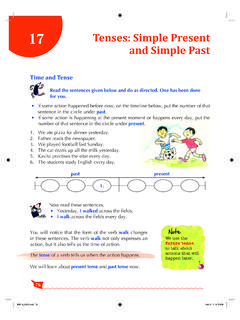
Tenses: Simple Present and Simple Past
wps.pearsoned.com77 Simple Present Tense Read these sentences. • He comes to school by bus. (regular action) • She likes ice cream. • Janaki dances gracefully. (regular action) • We use the simple present tense to show that an action happens regularly or often. We use words like always, usually, sometimes, generally or every day to speak about such actions.
Determiners - Pearson Education
wps.pearsoned.com1 DETERMINERS Determiners are words that are used before nouns to identify them. Determiners may be divided into: • Articles: a/an, the The words ‘a’ and ‘an’ are called indefinite articles.
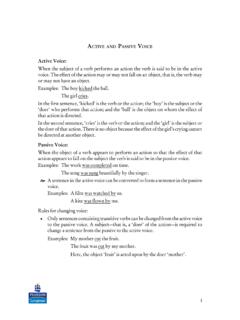
Active and Passive Voice
wps.pearsoned.com2 • For the simple present tense use am, is or are with a past participle to form the passive voice. Active voice Passive voice The caretaker locks the door. The doors are locked by the caretaker. The waiter carries the trays.
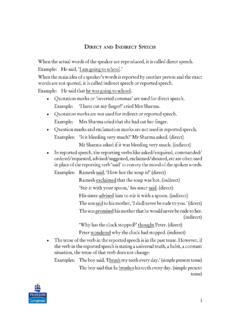
Direct and Indirect Speech - Pearson Education
wps.pearsoned.com1 DIRECT AND INDIRECT SPEECH When the actual words of the speaker are reproduced, it is called direct speech. Example: He said, ‘ I am going to school.’ When the main idea of a speaker’s words is reported by another person and the exact
© copyright Pearson Education www.pearsoned.co
wps.pearsoned.comHis Most Famous fairy tales The Little Mermaid The Ugly Ducking Thumbelina The emperor’s new clothes The Princess and The Pea The Snow Queen Charles Perrault was born ... ‘Panchatantra ‘means ‘five doctrines of conduct’. A few of the fables in the Panchatantra are common to …
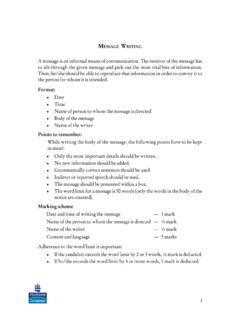
Message Writing - Pearson Education
wps.pearsoned.com1 MESSAGE WRITING A message is an informal means of communication. The receiver of the message has to sift through the given message and pick out the most vital bits of information.

Full Feasibility Analysis - Pearson Education
wps.pearsoned.com70 APPENDIX 3.1 Full Feasibility Analysis Note: All fields can be expanded to provide additional space to respond to the questions. A copy of this template, along ...
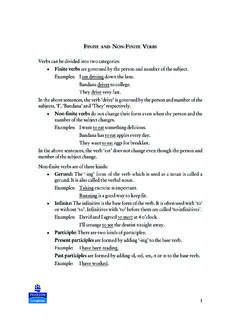
Finite and Non-finite Verbs - Pearson Education
wps.pearsoned.com1 FINITE AND NON-FINITE VERBS Verbs can be divided into two categories: • Finite verbs are governed by the person and number of the subject. Examples: I am driving down the lane. Bandana drives to college. They drive very fast. In the above sentences, the verb ‘drive’ is governed by the person and number of the
Related documents
Modals can and can't - British Council LearnEnglish …
learnenglishkids.britishcouncil.orgModals – can and can't 1. Where does it go? Find the activities and write them in the correct boxes. I know lots of sports. I can swim and I can play football. I can play basketball too because we are learning at school!
Grammar test can and can’t - LearnEnglish Kids
learnenglishkids.britishcouncil.orgGrammar test – Modals – can and can’t Do the test then write down your score. 1. Choose the correct sentence! Read the sentences and underline the correct one. 1. a. I can to swim. b. I can swim. c. I can swimming.

Could, Should and Would Exercise - autoenglish.org
www.autoenglish.orgwww.autoenglish.org Written by Bob Wilson ©Robert Clifford McNair Wilson 2007 Could, Should and Would Exercise Š could options

Past Modal Verbs of Deduction Exercise - …
www.autoenglish.orgPast Modal Verbs of Deduction Exercise She must have gone out - There is strong evidence. I might have made a mistake - There is a possibility that I made a mistake. He can't have been there. - It's impossible. You should have apologised - A criticism You shouldn't have said that. - A criticism A Fill the gaps with must have, might have or …
The effects of essay topics on modal verb uses in …
www.elihinkel.orgThe effects of essay topics on modal verb uses in L1 and L2 academic writing Eli Hinkel Seattle University, United States Received 9 May 2006; received in revised form 25 November 2007; accepted 22 September 2008

Upper-Intermediate INSTRUCTIONS
www.headsupenglish.comSkill Builders: Grammar - Let's Speculate! (Modals of Speculation II) Upper-Intermediate Heads Up English www.headsupenglish.com INSTRUCTIONS

modals of ability - Perfect English Grammar
www.perfect-english-grammar.com© 2011 www.perfect-english-grammar.com May be freely copied for personal or classroom use. www.perfect-english-grammar.com Modals of Ability Exercise 1

modals of probability 2 - Perfect English Grammar
www.perfect-english-grammar.com© 2012 www.perfect-english-grammar.com May be freely copied for personal or classroom use. Modals of Probability 2 Put in ‘can’t’ or ‘must’: