
Module 3 Constitutive Equations
Understand basic stress-strain response of engineering materials. Quantify the linear elastic stress-strain response in terms of tensorial quantities and in particular the fourth-order elasticity or sti ness tensor describing Hooke’s Law. Understand the relation between internal material symmetries and macroscopic anisotropy,
Download Module 3 Constitutive Equations

Information
Domain:
Source:
Link to this page:
Documents from same domain

Wireless Communications and Networks
web.mit.edu4 MIT Physical layer •The physical layer plays a very important role in wireless network because it has severe limitation on transmissions Uplink with respect to downlink
The Aleph - MIT
web.mit.eduThe Aleph by Jorge Luis Borges O God! ... He read me many other stanzas, each of which also won his own approval and elicited his lengthy explications.
Finite Element Method
web.mit.eduRobert Cook, Finite Element Modeling For Stress Analysis, John Wiley & Sons, 1995 Introduction to Finite Element Method, http://210.17.155.47 (in Korean)
Finite Element Analysis
web.mit.eduFinite Element Analysis David Roylance Department of Materials Science and Engineering Massachusetts Institute of Technology Cambridge, MA 02139 February 28, …

TECHNICAL & SERVICE MANUAL - MIT
web.mit.eduwhen wiring electrical shock can cause severe personal injury or death. only a qualified, experienced electrician should attempt to wire this system.
Chapter 21 Rigid Body Dynamics: Rotation and …
web.mit.eduChapter 21 Rigid Body Dynamics: Rotation and ... patience to the establishment of the laws of rotation of the solid ... general treatment of mechanics, ...
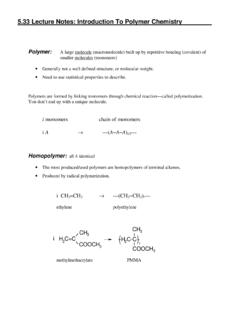
5.33 Lecture Notes: Introduction To Polymer …
web.mit.edu5.33 Lecture Notes: Introduction To Polymer Chemistry Polymer: A large molecule (macromolecule) built up by repetitive bonding (covalent) of smaller molecules (monomers) • Generally not a well defined structure, or molecular weight.
UNDERSTANDING, FINDING, & ELIMINATING …
web.mit.edua Senior Member of the Institute of Electrical and Electronic Engineers. CEDIA EST016 UNDERSTANDING, ... GROUNDING, AC POWER, AND SAFETY ...
PRESENTED AT THE 2004 AMERICAN CONTROL …
web.mit.eduPRESENTED AT THE 2004 AMERICAN CONTROL CONFERENCE 1 Internal and External Op-Amp Compensation: A Control-Centric Tutorial ... circuit operational …
Frank and Lillian Gilbreth and the Manufacture and ...
web.mit.eduFrank and Lillian Gilbreth and the Manufacture ... time study, despite its ... publicizing micro-motion study as an advance over time study and as an
Related documents

Uniaxial Tension and Compression Testing of Materials
web.mit.eduSep 25, 2013 · With the sample geometry, a stress-strain curve can then be generated from the recorded load and displacement. A typical stress-strain profile for a ductile metal resembles the following: Fig. 1.2 Typical stress-strain curve of a ductile metal2 The material initially behaves in a linear elastic manner: stress and strain are linearly related, and

stress and strain
www.freestudy.co.ukIf F and x refer to direct stress and strain then F = A x = L hence Ax FL and 0/ 1$ x F The stiffness is now in terms of stress and strain only and this constant is called the MODULUS of ELASTICITY and it has a symbol E. Ax FL E A graph of stress against strain will be a straight line with a gradient of E. The units
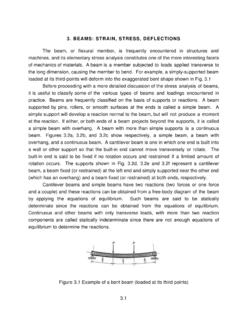
3. BEAMS: STRAIN, STRESS, DEFLECTIONS The beam, or ...
courses.washington.eduNormal Stress: Having derived the proportionality relation for strain, ε x, in the x-direction, the variation of stress, σ x, in the x-direction can be found by substituting σ for ε in Eqs. 3.3 or 3.7. In the elastic range and for most materials uniaxial tensile and compressive stress-strain curves are identical. If there are differences in ...

CHAP 4 FINITE ELEMENT ANALYSIS OF BEAMS AND FRAMES
mae.ufl.edu– Curvature is second derivative and related to strain and stress – B is linear function of s and, thus, the strain and stress – Alternative expression: – If the given problem is linearly varying curvature, the approximation is accurate; if higher-order variation of curvature, then it is approximate 1 22 1 222 2 2 2 11 [6 12, (4 6),6 12 ...

7.2 Analysis of Three Dimensional Stress and Strain
pkel015.connect.amazon.auckland.ac.nz7.2 Analysis of Three Dimensional Stress and Strain . The concept of traction and stress was introduced and discussed in Book I, §3. For the most part, the discussion was confined to two-dimensional states of stress. Here, the fully three dimensional stress state is examined. There will be some repetition of the earlier analyses.

Stress-Strain Measurement and Strain Gauge
www.davuniversity.orgo Strain gauges given indication of strain at only one point. o Strain gauges are mostly used to measure strains on the free surface of a body. The state of strain at any point on the free surface of a body can be characterized in terms of three Cartesian strain components xx, yy and xy as

3. Shear Stress and Shear Strain - Purdue University
www.purdue.eduThe relationship between shear stress and shear strain, as with those between normal stress and axial strains, is determined from experimental tests. Experiments show that for linear behavior of materials, the stress/strain relationship is given by: τ=Gγ where G …