
Nutrient Management Guide (RB209)
3. Assess soil structure and take action to remove soil compaction if necessary. Poor soil structure can restrict crop growth and results in poor nutrient use efficiency. 4. Carry out soil analysis for pH, P, K and Mg every 3–5 years (page 19). Target values to maintain in arable rotations are: • Soil pH 6.5 (5.8 on peat soils) • Soil P ...
Download Nutrient Management Guide (RB209)

Information
Domain:
Source:
Link to this page:
Documents from same domain
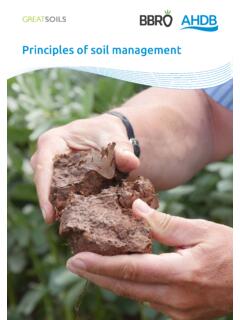
Principles of soil management - .NET Framework
projectblue.blob.core.windows.netOrganic matter Structure Water 12 Principles to improve soil health 15 Soil-related problems 18 Soil assessments Physical condition Chemical condition Biological condition 19 Further information This publication was created as part of the …

Barley growth guide - .NET Framework
projectblue.blob.core.windows.netstages (GS21, GS31, GS39, GS59, GS71 and GS87). Detailed information on the growth stages is published near the back of this guide. Development can only be altered by variety choice and sowing date. Subsequent management decisions aim to influence growth during development (eg by controlling disease or applying fertiliser).

Understand how to influence farmers' decision-making …
projectblue.blob.core.windows.netexchange with farmers and other practitioner groups. 6. Recruit ‘peer champions’ to shape AHDB advice and literature – where face-to-face knowledge exchange is not possible, consider the value of including testimonies of peer groups (e.g. fellow farmers or advisors) in advice booklets. Results suggest that farmers listen more

Nutrient Management Guide (RB209)
projectblue.blob.core.windows.netUsing the Nutrient Management Guide (RB209) The Nutrient Management Guide (RB209) helps you make the most of organic materials and balance the benefits of fertiliser use against the costs – both economic and environmental. The guide outlines the value of nutrients and soil, and explains why good nutrient management is about more than just

Principles, installations and maintenance
projectblue.blob.core.windows.netDrainage may be needed to reduce vulnerability to compression, slaking and compaction Light-textured soils: These soils are highly permeable but drainage may be required to provide water table control in low-lying areas Springs: Drains are used to intercept springs before they reach the surface; this helps prevent erosion,

2019 pig cost of production in selected countries
projectblue.blob.core.windows.netFigure 1. Cost of production in selected countries, 2019 The average cost of production in the EU in 2019 for the countries above was £1.42 per kg deadweight – a 1% decrease on the previous year. Costs of production in Great Britain for pork from indoor sows were the same as the EU average at £1.42,
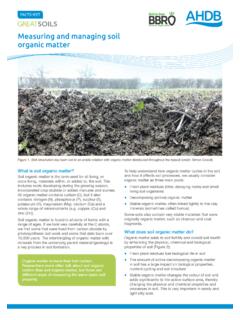
Measuring and managing soil organic matter
projectblue.blob.core.windows.netWell structured clay loam soil in an arable rotation with organic matter distributed throughout the topsoil (credit: Simon Cowell) ... Measuring and managing soil organic matter ... soil organic matter in the field is often a slow process. The presence of roots or added organic materials (residues, manures, composts) in the sample can give ...

Nutrient Management Guide (RB209)
projectblue.blob.core.windows.net2. Understand if the field is within a nitrate vulnerable zone (NVZ) and check the rules for application rates and timing for organic materials and fertilisers. 3. Assess soil structure. 4. Ensure drainage systems are maintained and functioning correctly. 5. Calibrate the fertiliser spreader. 6.
Beef yield guide - .NET Framework
projectblue.blob.core.windows.netBeef carcase to primal cuts – yield information The information in this brochure is based on a 303kg carcase (side weight 151.5kg) , Classification R4H (after 2 weeks maturation). Therefore, the weights/percentages of cuts are intended to act as a guide only, as butchery techniques, carcase weights and types may vary from one business to another.
Related documents
Small-scale freshwater fish farming - Journey to Forever
journeytoforever.orgSoil should contain a minimum of 25% clay. Rocks, grass, branches and other undesirable objects should be eliminated from the dikes. Pond depth Depth should be 0.5-1.0 m at shallow end, sloping to 1.5-2.0 m at the drain end. Configuration Best shape for ponds is rectangular or square. Side slopes Construct ponds with 2:1 or 3:1 slopes on all sides.
Inherent Factors Affecting Soil pH - USDA
www.nrcs.usda.govMethods for Assessing Soil Quality, page 173 (SSSA, 1996) Problems Related to pH and Relationship of pH to Soil Function Soil pH is an excellent indicator of a soil’s suitability for plant growth For most . crops, a range of 6 to 7.5 is best as shown in Table 1. Soil pH levels that are too high or too low
8 Managing Soil pH and Crop Nutrients
extension.cropsciences.illinois.edutiveness of soil tests as a basis for planning a soil fertility and liming program for Illinois field crops. Traditionally, soil testing has been used to decide how much lime and fertilizer to apply to a field. With increased emphasis on precision agriculture, economics, and the envi-ronment, soil tests are also a logical tool to determine areas
Soil Sampling Guidelines - Purdue University
www.extension.purdue.eduInformative soil sampling can improve on-farm nutrient efficiency, leading ... event will greatly improve the quality and reliability of your results. This means taking samples in the same ... and provides a map of a field’s nutrient and liming requirements. Spatially explicit management is an

TABLE OF CONTENTS FOOD AND AGRICULTURAL CODE
www.cdfa.ca.govminerals, packaged soil amendments, and auxiliary soil and plant substances that the product purchased is properly identified, and to provide assurance of the validity of the quality and quantity represented by the manufacturer of these products. (c) To provide funds for the administration and enforcement of this chapter. 14502.
UNDERSTANDING AND INTERPRETING YOUR SOIL ANALYSIS …
servitechlabs.comthe liming material quality. Soluble salts are a measurement used to estimate the total ion content (or “dissolved minerals”) found in the soil water. Levels above the moderate range suggest a potential for soil salinity to affect growth of certain plant species.

Liming to Improve Soil quality - USDA
www.nrcs.usda.govSoil pH is an excellent chemical indicator of soil quality. Farmers can improve the soil quality of acid soils by liming to adjust pH to the levels needed by the crop to be grown. Benefits of liming include increased nutrient availability, improved soil structure, and increased rates of infiltration. This technical note addresses the following ...

Nutrient Management Guide (RB209)
media.ahdb.org.ukThe soil type can be identified using Figure 4.1 which categorises soils on their ability to supply and retain mineral nitrogen. The initial selection can then be checked using Table 4.1. Carefully assess the soil organic matter content when deciding if the soil is organic (10% to 20% organic matter for the purposes