PARTICIPATORY LEARNING AND ACTION (PLA)
zones. Transects can be constructed by walking in a line through an area with a key informant, using direct observation to note specific features and factors, and talking to people met on the way. Social maps . These are maps of a village or area which show where groups of people live
Download PARTICIPATORY LEARNING AND ACTION (PLA)

Information
Domain:
Source:
Link to this page:
Documents from same domain

Theory of Change - INTRAC
www.intrac.org1 1. The reality of change Theory of Change is nothing new. It is not just a donor fad or yet another hoop to jump through. It is an on-going process of reflection to explore change and how
Theory of Change - INTRAC
www.intrac.orgA Theory of Change approach to planning and evaluation is increasingly being considered an essential practice for many organisations, programmes and projects. Theories of Change can be
BASIC TOOLS FOR DATA COLLECTION - INTRAC
www.intrac.orgObservation: At its most simple, observation involves ‘seeing’ things – such as objects, processes, relationships, events – and formally recording the information. There are different types of observation. Structured or direct observation is a process in which observations are recorded against an agreed checklist.
Monitoring and Evaluation: New Developments and …
www.intrac.orgConference overview As development organisations, we are all finding ourselves placing a greater emphasis on measuring for results, on looking for evidence of impact, on justifying our effectiveness and on responding to a growing demand for accountability. Development organisations are continually experimenting with innovative

PROCESS TRACING
www.intrac.orgPROCESS TRACING . Process tracing is a qualitative analysis methodology. The main purpose of process tracing is to establish whether, and how, a potential cause or causes influenced a specified change or set of changes. This is done by applying formal tests to examine the strength of evidence linking potential causes to the changes.
QUANTITATIVE AND QUALITATIVE METHODS - INTRAC
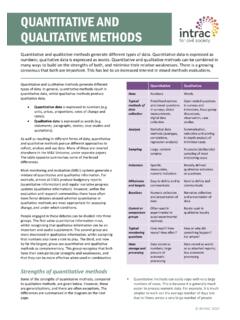
www.intrac.orgquantitative methods are seen as weaker, qualitative methods are seen as (relatively) stronger. Some of the main strengths of qualitative methods are listed below, and are summarised in the diagram above. As with the section on quantitative methods, these are general rules only, and there are often exceptions. Quantitative methods ...
SECONDARY DATA SOURCES - INTRAC
www.intrac.orgFurther papers in the M&E Universe explain other simple data collection tools and methods. To access these papers directly, click on the relevant links below. Author(s): INTRAC . Contributor(s): ... Interviews Focus group discussions Observation Photography and video Surveys and questionnaires Case studies and stories of change
QUALITATIVE COMPARATIVE ANALYSIS (QCA) - INTRAC
www.intrac.orgQualitative Comparative Analysis (QCA), developed by Charles Ragin in the 1970s, was originally developed as a research methodology. Lately, it has increasingly been applied within monitoring and evaluation (M&E). QCA is a methodology that enables the analysis of multiple cases in complex situations, and can help explain why change
THEORY OF CHANGE
www.intrac.orgTheories of Change can be developed in many ways. Common elements include ... stakeholder analysis or gender analysis might also be used. And if others have conducted similar assessments in the past then their findings can be used to arrive at a consensus.
CASE STUDIES AND STORIES OF CHANGE - INTRAC
www.intrac.orgCase studies are usually written, but can also be presented as photographs, drawings or videos. In some circumstances case studies have been presented as songs or dramas. There is no fixed size for a written case study. A case study can vary in length between a few lines of text and an entire book. Stories of change are similar to case studies ...
Related documents

A Line Transect - University of Georgia
gen.uga.edubiodiversity study of organisms in one local habitat: plot studies and line transects. A transect is a long, narrow sampling area, while a plot study is a square area that can be divided into subplots. Transects extend over a longer portion of a study area than a plot does, resulting in a larger sample of different plant species.
Econometrica, Vol. 78, No. 6 (November, 2010), 1863–1903
scholar.harvard.edusmoothly at the mita boundary, I focus exclusively on the portion that transects the Andean range in southern Peru. Much of the boundary tightly follows the steep Andean precipice, and hence has elevation and the ethnic distribution of the population changing discretely at the boundary. In contrast, elevation, the

CITY OF JOHANNESBURG IDP 2020/21 REVIEW
www.joburg.org.zaFigure 19: Graphical Examples of Urban Transects 95 Figure 20: Nodes and Development Zones 96 Figure 21: Residential Densities for Nodes and Development Zones 98 Figure 22 - Society-Environment Inter-linkages in respect of natural resources 106 Figure 23: 2020/21 budget (Capex and Opex) 123 Figure 24: Capital Budget 124

Kelp Forests - USF
www.marine.usf.edumeasure. Band transects are larger sample areas created using a PVC pole and a shorter tape measure. These band transects are laid perpendicular to the main transect. As with the quadrats, selected species are counted along these band transects. Roving fish counts are used to monitor all the fish sited within ten meters of the transect line.

Corps of Engineers Wetlands Delineation Manual
www.nrcs.usda.govGeneral orientation of baseline and transects (dotted lines) in a hypothetical project area. Alpha characters represent different plant communities. All transects start at the midpoint of a baseline segment except the
Field Book for Describing and Sampling Soils
www.nrcs.usda.govFOREWORD. Purpose: The following instructions, definitions, concepts, and codes are a field guide for making or reading soil descriptions and sampling soils as presently practiced in the USA.