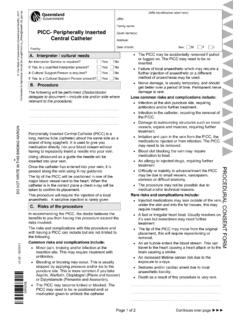
PICC- Peripherally Inserted Central Catheter
Peripherally Inserted Central Catheter (PICC) is a long, narrow tube (catheter) about the same size as a strand of long spaghetti. It is used to give you medication directly into your blood stream without having to repeatedly insert a needle into your vein. Using ultrasound as a guide the needle will be inserted into your vein.
Download PICC- Peripherally Inserted Central Catheter

Information
Domain:
Source:
Link to this page:
Documents from same domain

Carbohydrate counting - Home | Queensland Health
www.health.qld.gov.au• Australian Carb Counter; The Traffic Light Guide to Food Check with your Dietitian about other ... NEMO carbohydrate counting nutrition education material
Guidelines for Subcutaneous Infusion Device …
www.health.qld.gov.au1 Guidelines for Subcutaneous Infusion Device Management in Palliative Care - Second Edition Revised by: John Haberecht Research Officer, Centre for Palliative Care Research and Education
The Administration of Electroconvulsive Therapy
www.health.qld.gov.auThe Administration of Electroconvulsive Therapy - ii - Guideline for the Administration of Electroconvulsive Therapy Published by the State of Queensland …
Maternity and Neonatal Clinical Guideline - Queensland Health
www.health.qld.gov.auQueensland Clinical Guideline: Early pregnancy loss. Flowchart version: F17.29-4-V1-R22 Refer to online version, destroy printed copies after use Page 4 of 39

Queensland Stay On Your Feet Community Good Practice ...
www.health.qld.gov.auQueensland Stay On Your Feet® community good practice guidelines i ... NARI National Ageing Research Institute NICE National Institute for Clinical Excellence NPHP National Public Health Partnership PHC Primary Health Care PMSEIC Prime Minister’s Science Engineering and
Management of Subcutaneous Infusions in Palliative Care
www.health.qld.gov.auManagement of Subcutaneous Infusions in Palliative Care Centre for Palliative Care Research and Education Palliative Care Australia PO Box 24 Deakin West
CSCF maternity services - Queensland Health
www.health.qld.gov.auThe aim of maternity services is to achieve the safe provision of care for mother and baby, as close as ... safe maternity care is the primary catalyst for a healthy society. Maternal health directly affects ... culturally appropriate and evidence-based written information (or verbal, if written information is
Asbestos health risks
www.health.qld.gov.auAsbestos health risks Guidance Note Introduction Asbestos is the term used to describe a group of naturally occurring minerals whose characteristic feature is that ...
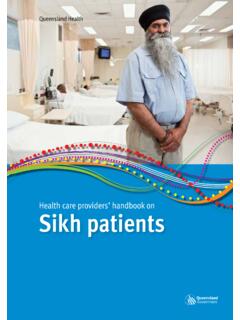
Health Care Providers' Handbook on Sikh Patients
www.health.qld.gov.au4 Healt ar ovider S atients Preface In 2010, Queensland Health and the Islamic Council of Queensland published the Health Care Providers’ Handbook on Muslim Patients (second edition) as a quick-reference tool for health workers when caring for Muslim patients. This handbook, the Health Care Providers’ Handbook on Sikh Patients, covers a similar range of topics and aims to inform
Health Care Providers' Handbook on Muslim Patients second ...
www.health.qld.gov.auMuslim Patients as a quick-reference tool for health workers when caring for Muslim patients. The handbook aimed to The handbook aimed to help health care providers understand the religious beliefs and practices of Muslims that could affect health care, and
Related documents
2021 BILLING AND CODING GUIDELINES HEMODIALYSIS …
asiapac.medtronic.comCentral Venous Access Catheters, intended to be inserted via a central vein – typically, the jugular, subclavian, brachiocephalic, or femoral veins. Once inserted, the internal tip of the catheter is advanced into the superior or inferior vena cava or into the ... also provides codes for peripherally inserted catheters (PICC). These codes are ...
PICC or Midline Catheter Sterile Dressing Change
healthsystem.osumc.eduA PICC (Peripherally Inserted Central Catheter) and a Midline catheter are special types of IV lines that can be used to give IV medicines or fluids. A dressing is needed to cover and protect your catheter site to help lower the risk of infection. Sterile technique will be used when doing the dressing change.

CMS 802 Matrix for Providers
www.cms.govperipherally inserted central catheter, or other intravenous catheter. 20. Infections: Resident(s) who has a communicable disease or infection (e.g., MDRO-M, pneumonia-P, tuberculosis-TB, viral hepatitis-VH, C. difficile-C, wound infection-WI, UTI, sepsis-SEP, scabies-SCA, gastroenteritis-GI such as norovirus, SARS-CoV-2
Intravenous Therapy
www.mmlearn.orgPeripherally inserted central catheter PICC. 3. Central line. 4. Subcutaneous injection port. Peripheral catheter • This is the most common intravenous access method in both hospitals and pre-hospital services. A peripheral IV line consists of a short catheter (a few centimeters long)
Peripherally Inserted Central Catheter (PICC)
www.qhc.on.cainserted peripherally but the tip sits in the central venous circulation in the lower 1/3 of the superior vena cava. It is suitable for long term use and there are no restrictions for age, or gender. Location PICCs are commonly placed at or above the antecubital space in the following veins: