PID Control - cds.caltech.edu
The input-output relation of a controller with proportional and derivative action is u = kpe+kd de dt = k e+Td de dt, where Td = kd/kp is the derivative time constant. The action of a controller with proportional and derivative action can be interpreted as if the control is made proportional to the predicted process output, where the prediction
Download PID Control - cds.caltech.edu

Information
Domain:
Source:
Link to this page:
Documents from same domain
Feedback Systems: An Introduction for Scientists …
www.cds.caltech.eduFeedback Systems: An Introduction for Scientists and Engineers Karl Johan ˚Astr¨om Department of Automatic Control Lund Institute of Technology
am07 - cds.caltech.edu
www.cds.caltech.educontrol systems majors. ... and sensors, whether for engineered or natural systems. The second half of the book presents material that is often considered to be
Simple Control Systems - Graduate Degree in Control
www.cds.caltech.eduthat can be handled using only knowledge of differential equations. Sec-tion 4.2 deals with design of a cruise controller for a car. In Section 4.3 ... ties of second order systems. Section 4.5 deals with design of PI and PID ... Simple Control Systems.
Feedback Systems - Graduate Degree in Control
www.cds.caltech.eduSystem Modeling 27 2.1 Modeling Concepts 27 2.2 State Space Models 34 ... This book provides an introduction to the basic principles and tools for the design and analysis of feedback systems. It is intended to serve a diverse audience of ... PID control is by far the most common design technique in control systems and a useful tool for any ...
PID Control - Caltech Computing
www.cds.caltech.eduPID Control 6.1 Introduction The PID controller is the most common form of feedback. It was an es- ... distributed control system. The controllers are also embedded in many ... ods for an ideal PID controller and use an iterative design procedure. The controller is first designed for the process. P. D. s. E. The design gives the con-
System Modeling - Caltech Computing
www.cds.caltech.edu2.1. MODELING CONCEPTS 33 science for many centuries. One of the triumphs of Newton’s mechanics was the observation that the motion of the planets could be predicted based on the current positions and
1 Linear Quadratic Regulator
www.cds.caltech.eduThis equation is satisfied if we can find P(t) such that −P˙ = PA+ATP −PBR−1BTP +Q P(T) = P 1 ... This equation is called the algebraic Riccati equation. 4. In MATLAB, K = lqr(A, B, Q, R). ... the system is nonlinear in the state, but linear in the input; this is often the case in applications). Let e = x−xd, v = u−ud and compute ...

Adaptive Control: Introduction, Overview, and Applications
www.cds.caltech.edu(Model Reference Adaptive Control) • Uncertain Roll dynamics: – p is roll rate, – is aileron position –are unknown damping, aileron effectiveness • Flying Qualities Model: –are desired damping, control effectiveness – is a reference input, (pilot stick, guidance command) – roll rate tracking error: • Adaptive Roll Control: p ...
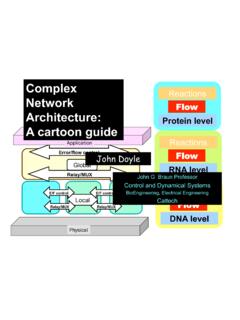
Flow Architecture: A cartoon guide
www.cds.caltech.eduNetwork Math and Engineering (NetME) Challenges • Predictive modeling, simulation, and analysis of complex systems in technology and nature
System Modeling - cds.caltech.edu
www.cds.caltech.eduA model is a precise representation of a system’s dynamics used to an-swer questions via analysis and simulation. The model we choose depends ... In the remainder of this section we provide an overview of some of the key concepts in modeling. ... (Chapter 4 provides a much more detailed analysis of linear systems.) Many electrical engineering ...
Related documents

Introducing Formal Methods
web.mit.eduIntroducing Formal Methods Formal Methods for Software Specification and Analysis: An Overview L 5 2 Software Engineering and Formal Methods nEvery Software engineering methodology is based on a recommended development process ... » Input-Output Assertions » Sets of operations
Operational Amplifiers: Basics and Design Aspects
www.mcvts.netoutput impedance value could be between 0-100 Ω, while an input impedance could be around 1 MΩ. [1,2] The figure below illustrates the benefits of a high input impedance and a low output impedance by introducing an op-amp circuit called a voltage follower which will be revisited again later in the tutorial. Figure 7.

ANALYSIS OF HOSPITAL COSTS: A MANUAL FOR MANAGERS
www.people.brandeis.eduanalysis of district health service costs and financing (Hanson and Gilson, 1996) 1. The steps are: 1. Define the final product. 2. Define cost centers. 3. Identify the full cost for each input. 4. Assign inputs to cost centers. 5. Allocate all costs to final cost centers. 6. Compute total and unit cost for each final cost center. 7. Report ...

Exact Signal Measurements using FFT Analysis - uni-kl.de
kluedo.ub.uni-kl.deoutput: N/2 point power spectrum If the time signal represents a voltage over a resistor R, the output of Alg. 1 can be converted to dBm on a logarithmic scale with P[dBm] = 10 log 10 power_ t R 1mW An overview of all calculation steps is shown in Fig. 2.1. FFT abs(x) x† 10log(x/ref) time domain signal complex FFTbins RMSspectrum power spectrum

Long Short-Term Memory - University of Wisconsin–Madison
pages.cs.wisc.edulayers vertically, with the output sequence of one layer forming the input sequence of the next (in addition to recurrent connections within the same layer) Increases the number of parameters - but given sufficient data, performs significantly better than single-layer LSTMs (Graves et al. 2013)
JournalofStatisticalSoftware - Hadley
vita.had.co.nzmunging the output from one tool so you can input it into another. Tidy datasets and tidy tools work hand in hand to make data analysis easier, allowing you to focus on the interesting domain problem, not on the uninteresting logistics of data. The principles of tidy data are closely tied to those of relational databases and Codd’s rela-

Introducing Stata—sample session
www.stata.com1 Introducing Stata—sample session Introducing Stata This chapter will run through a sample work session, introducing you to a few of the basic tasks that can be done in Stata, such as opening a dataset, investigating the contents of the dataset, using some descriptive statistics, making some graphs, and doing a simple regression analysis. As you