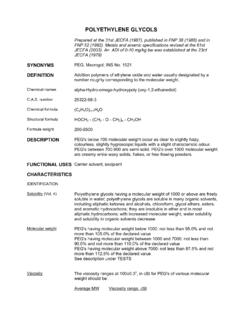
POLYETHYLENE GLYCOLS
Lead (Vol. 4) Not more than 1 mg/kg Determine using an atomic absorption technique appropriate to the specified level. The selection of sample size and method of sample preparation may be based on the principles of the method described in Volume 4, “Instrumental Methods.”
Download POLYETHYLENE GLYCOLS

Information
Domain:
Source:
Link to this page:
Documents from same domain

Forest and landscape restoration
www.fao.orgForest and landscape restoration An international journal of forestry and forest industries Vol. 66 2015/3 245 ISSN 0041-6436

i1379e - Good Practices for the Feed Industry ...
www.fao.orgFOOD AND AGRICULTURE ORGANIZATION OF THE UNITED NATIONS Rome, 2010 FAO ANIMAL PRODUCTION AND HEALTH 9 manual GOOD PRACTICES FOR THE FEED INDUSTRY Implementing the Codex Alimentarius

Adoption of Climate-Smart Agricultural Practices: …
www.fao.org1 Adoption of Climate-Smart Agricultural Practices: Barriers, Incentives, Benefits and Lessons Learnt from the MICCA Pilot Site in Kenya FINAL REPORT
Ethiopia Climate-Smart Agriculture Scoping Study
www.fao.orgFOOD AND AGRICULTURE ORGANIZATION OF THE UNITED NATIONS Addis Ababa 2016 ETHIOPIA CLIMATE-SMART AGRICULTURE SCOPING STUDY Melaku Jirata, Sebastian Grey and Edward Kilawe

Climate-Smart Agriculture Sourcebook
www.fao.orgClimate-Smart Agriculture Sourcebook Summary Second Edition Food and Agriculture Organization of the United Nations Rome, 2017

FAO Statistical Pocketbook 2015 World Food and …
www.fao.orgFAO Statistical Pocketbook 2015 Food and Agriculture Organization of the United Nations, Rome, 2015
SOLOMON ISLANDS FORESTRY OUTLOOK STUDY
www.fao.orgasia-pacific forestry sector outlook study ii working paper series working paper no. apfsos ii/wp/2009/31 solomon islands forestry outlook study1 by

Landgrabordevelopment opportunity?
www.fao.orgLandgrabordevelopment opportunity? Agricultural investment and international land deals in Africa Enabling poor rural people to overcome poverty Lorenzo Cotula, Sonja …

The State of Food Insecurity in the World
www.fao.org2015 The State of Food Insecurity in the World Meeting the 2015 international hunger targets: taking stock of uneven progress

STATE OF THE WORLD’S FORESTS
www.fao.orgforests and agriculture: land-use challenges and opportunities state of the world’s forests 2016 state of the world’s forests 2016 fao
Related documents
Determination of Calcium, Magnesium, and Sodium by …
web.pdx.eduof the sample, both of which lead to a number of complications. These problems can be addressed if their presence is anticipated and the physical mechanism is understood. In addition to giving you a little experience with AAS (Atomic Absorption Spectrophotometry) and AES (Atomic Emission Spectrophotometry) for quantitative
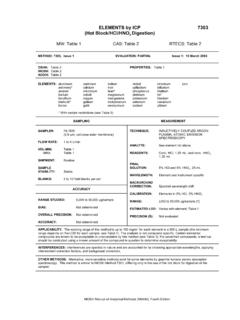
ELEMENTS by ICP 7303 (Hot Block/HCl/HNO3 Digestion)
www.cdc.govOTHER METHODS: Alternative, more sensitive methods exist for some elements by graphite furnace atomic absorption spectroscopy. This method is similar to NIOSH Method 7301, differing only in the use of the hot block for digestion of the sampler.
METHOD 3052 MICROWAVE ASSISTED ACID DIGESTION OF …
www.epa.govatomic absorption (GFAA) and inductively coupled plasma mass spectrometry (ICP-MS). Hydrofluo ric acid, which is capable of dissolving silicates, may require the removal of excess hydrofluor ic acid or the use of specialized non-glass components during instrumental analysis .
Zinc in Drinking-water - WHO
www.who.intAtomic absorption spectrophotometry is the most widely used method for the determination of zinc. The detection limit of the direct air–acetylene flame method is 50 µg/litre (4). Low concentrations can be measured by chelating zinc with ammonium pyrrolidine dithiocarbamate and extracting it with methyl