Probability Theory Review for Machine Learning
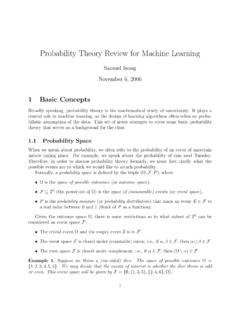
Probability Theory Review for Machine Learning Samuel Ieong November 6, 2006 1 Basic Concepts Broadly speaking, probability theory is the mathematical study of uncertainty. It plays a central role in machine learning, as the design of learning algorithms often relies on proba-
Download Probability Theory Review for Machine Learning

Information
Domain:
Source:
Link to this page:
Documents from same domain

Lecture 3 Linear Equations and Matrices
see.stanford.eduso multiplication by matrix inverse solves a set of linear equations some comments: • x = A−1b makes solving set of 100 linear equations in 100 variables look simple, but the notation is hiding alot of work!
Much of this handout was written by Justin Manus and ...
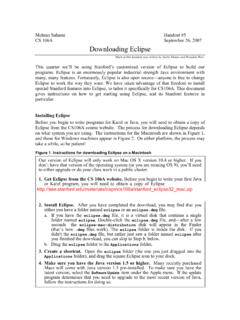
see.stanford.eduDownloading Eclipse Much of this handout was written by Justin Manus and Brandon Burr. This quarter we’ll be using Stanford’s customized version of Eclipse to build our programs. Eclipse is an enormously popular industrial strength Java environment with many, many features. Fortunately, Eclipse is also open source—anyone is free to change

cvx Users’ Guide - Stanford Engineering Everywhere
see.stanford.edu1.2 What is disciplined convex programming? Disciplined convex programming is a methodology for constructing convex optimiza-tion problems proposed by Michael Grant, Stephen Boyd, and …
EE364a Homework 3 solutions
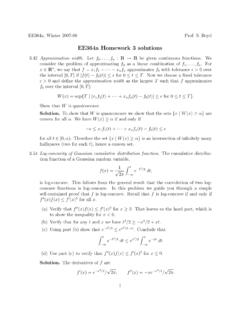
see.stanford.eduEE364a Homework 3 solutions 3.42 Approximation width. Let f0,...,fn: R → R be given continuous functions. We ... Use part (c) to verify that f ... 4.8 Some simple LPs. Give an explicit solution of each of the following LPs. (a) Minimizing a linear function over an affine set. minimize cTx subject to Ax = b.

CS229 Lecture notes - Stanford Engineering Everywhere
see.stanford.eduwe decide to approximate y as a linear function of x: hθ(x) = θ0 +θ1x1 +θ2x2 Here, the θi’s are the parameters (also called weights) parameterizing the space of linear functions mapping from X to Y. When there is no risk of confusion, we will drop the θ …

CS 229, Public Course Problem Set #1 Solutions: Supervised ...
see.stanford.edu2. Locally-weighted logistic regression In this problem you will implement a locally-weighted version of logistic regression, where we weight different training examples differently according to the query point. The locally-weighted logistic regression problem is to maximize ℓ(θ) = − λ 2 θTθ + Xm i=1 w(i) h y(i) logh θ(x (i))+(1−y ...
Lecture 5 Least-squares - Stanford Engineering Everywhere
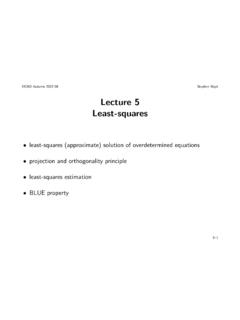
see.stanford.eduLeast-squares (approximate) solution • assume A is full rank, skinny • to find xls, we’ll minimize norm of residual squared, krk2 = xTATAx−2yTAx+yTy • set gradient w.r.t. x to zero: ∇xkrk2 = 2ATAx−2ATy = 0 • yields the normal equations: ATAx = ATy • assumptions imply ATA invertible, so we have xls = (ATA)−1ATy. . . a very famous formula
Convex Optimization — Boyd & Vandenberghe 3. Convex …
see.stanford.edu2. for twice differentiable functions, show ∇2f(x) 0 3. show that f is obtained from simple convex functions by operations that preserve convexity • nonnegative weighted sum • composition with affine function • pointwise maximum and supremum • composition • minimization • perspective Convex functions 3–13

Lecture 15 Symmetric matrices, quadratic forms, matrix ...
see.stanford.edu• rotate by QT • diagonal real scale (‘dilation’) by Λ • rotate back by Q decomposition A = Xn i=1 λiqiq T i expresses A as linear combination of 1-dimensional projections Symmetric matrices, quadratic forms, matrix norm, and SVD 15–5

Lecture 13 Linear dynamical systems with inputs & outputs
see.stanford.edu• output is state: y = x • unit resistors, unit capacitors • step response matrix shows delay to each node Linear dynamical systems with inputs & outputs 13–14. system is
Related documents

Mark Paskin - Stanford AI Lab
ai.stanford.eduProbability Theory is key to the study of action and communication: { Decision Theory combines Probability Theory with Utility Theory. { Information Theory is \the logarithm of Probability Theory".

Probability Theory - University of Connecticut
bass.math.uconn.eduA probability or probability measure is a measure whose total mass is one. Because the origins of probability are in statistics rather than analysis, some of the terminology is di erent.

Probability Theory: Background and Bayes Theorem
cda.psych.uiuc.eduThe formalism of thought o ered by probability theory is one of the more useful portions of any beginning course in statistics in helping to promote ethical reasoning. As typically presented, we speak of an event represented by a capital letter, say A, and the probability of the event as some

Review of Basic Probability Theory
circuit.ucsd.edu4 Review of Basic Probability Theory set of events is typically taken to contain all open subintervals of Ω, i.e., all intervals of theform (a,b), a,b∈ Ω. More formally, let Fbe thesmallest σ-algebra thatcontains all opensubintervalsin Ω. is σ-albegra is commonly referred to as the Borelσ-algebraB

Review of Probability Theory - Machine learning
cs229.stanford.eduReview of Probability Theory Zahra Koochak and Jeremy Irvin. Elements of Probability Sample Space fHH;HT;TH;TTg Event A fHH;HTg, Event Space F Probability Measure P : F!R P(A) 0 8A 2F P() = 1 If A 1;A ... you choose is gold, then what is the probability that you a) p p p. I
Review of Probability Theory
cs229.stanford.eduProbability theory is the study of uncertainty. Through this class, we will be relying on concepts from probability theory for deriving machine learning algorithms.
Probability Theory - Bard College
faculty.bard.eduProbability Theory Probability Spaces and Events Consider a random experiment with several possible outcomes. For example, we might roll a pair of dice, ip a coin three times, or choose a random real number between 0 and 1. The sample space for such an experiment is the set of all possible

Probability Theory II - Bard College
faculty.bard.eduProbability Theory II These notes begin with a brief discussion of independence, and then discuss the three main foundational theorems of probability theory: the weak law of large numbers,
Solutions of Problems on Probability theory - Intranet DEIB
home.deib.polimi.itSolutions of Problems on Probability theory Chapter 1 ... a red face, what is the probability that also on the third rolling is red? d) If the first n rollings show a red face, what is the probability that you are using dice A? Solution. a) 1 2 b) 1 2 c) 3 5 d) 2n 1+2n. F. Borgonovo - 2

Probability Theory - University of Arizona
math.arizona.eduProbability Theory December 12, 2006 Contents 1 Probability Measures, Random Variables, and Expectation 3 ... called the theory of probability. A probability model has two essential pieces of its description. 1. Ω, the sample space, the set of possible outcomes.