REINFORCEMENT HANDBOOK
Aug 02, 2012 · YOUR GUIDE TO STEEL REINFORCEMENT. ARC - Reinforcement Handbook ... design and construction industry – in a design office, on a construction site or a student preparing to enter the industry. ... “After-Fabrication Hot Dip Galvanizing”, Galavanizers Association of Australia, Melbourne, Australia, 1999
Download REINFORCEMENT HANDBOOK

Information
Domain:
Source:
Link to this page:
Documents from same domain
:DIFFERENT TYPES OF BRIDGES AND ITS SUITABILITY: A …
www.sefindia.org• Semi through bridges The semi-through bridge has its deck midway and the deck load is transmitted to the girder through the web of the girder.
CONSTRUCTION JOINTS - Structural Engineers
www.sefindia.orgDesigning concrete members for lateral forces may require special design treatment of construction joints. Shear keys, diagonal dowels, or the shear transfer method (ACI Code,
Offshore Structural Design - Structural Engineers
www.sefindia.orgplanning, designing and constructing fixed offshore platforms The structural offshore code, Regulations of a major certifying authority. – DnV: Rules for the classification of fixed offshor e installations. – AISC: Specification for the design, fabrication an …
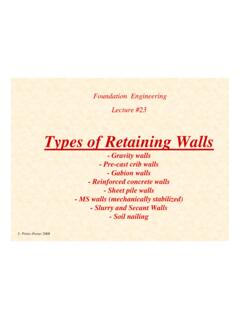
Types of Retaining Walls - Structural Engineers
www.sefindia.orgRetaining walls are structure used to retain soil, rock or other materials in a vertical condition. Hence they provide a lateral support to vertical slopes of soil that would otherwise collapse into a more natural shape. Most common materials used for retaining walls are:

SEISMIC DESIGN AND STEEL CONNECTION DETAILING
www.sefindia.orgDETAILING MICHAEL L.COCHRAN S.E. Introduction: Building Codes The three typical model building codes used in the United States have now merged as a single model building code: the International Building Code, commonly referred to as the IBC. The first published code edition was the 2000 IBC which has been

DESIGN OF HYDRO POWER PLANT
www.sefindia.orgThe backbone of most power generation system is the generator. An electric generator is “any machine that converts mechanical energy into electricity for transmission and distribution.” The generator works by spinning a rotor that is turned by a turbine. The rotor is a …
Design of confinement reinforcement for RC columns
www.sefindia.orgReinforced concrete columns are the main load bearing elements of any structure. They support the beams and ... the transverse reinforcement of columns and detail them ... required area of rectangular hoops, as given in equation 2.4 of ACI code is based on the equation for spirals

DUCTILITY REQUIREMENTS FOR BUILDINGS
www.sefindia.orgthe brittle failure as result of inelastic deformation can be avoided only if the concrete is made to behave in a ductile manner so that the member can absorb and dissipate large amount of energy. Hence in the case of reinforced concrete members subjected to inelastic deformation, not only strength but also ductility plays vital role in the design.
FLOOR DIAPHRAGMS.
www.sefindia.orgquite satisfactory, because usually diaphragm flexibility affects neither overall structural stiffness (and hence natural period) nor the distribution of forces within a structure. Moreover, during a major earthquake, in ductile structures where the diaphragms are designed to remain essentially elastic, the superstructure
Structural Design of Raft Foundation
www.sefindia.orgThis foundation will be done for a storage 5 story building. The raft will be used for economical consideration. The justification of using raft foundation will be discussed in columns loads section 3.2.0. The raft foundation is a kind of combined footing that may cover the entire area under the
Related documents

Specification for Structural Joints Using High-Strength Bolts
boltcouncil.orgA faying surface that has been hot-dip galvanized. Grip. The total thickness of the plies of a joint through which the bolt passes, exclusive of washers or direct-tension indicators. Guide. The Guide to Design Criteria for Bolted and Riveted Joints, 2nd Edition (Kulak et al., 1987). High-Strength Bolt. An ASTM A325 or A490 bolt, an ASTM F1852 ...
Specification for Structural Joints Using ASTM A325 or ...
www.boltcouncil.orgA faying surface that has been hot-dip galvanized. Grip. The total thickness of the plies of a joint through which the bolt passes, exclusive of washers or direct-tension indicators. Guide. The Guide to Design Criteria for Bolted and Riveted Joints,2nd Edition (Kulak et al., 1987). High-Strength Bolt. An ASTM A325 or A490 bolt, an ASTM F1852 ...

Design Guide for Hot Dip best practice - GB Galvanizing
gbgal.com.auDesign Guide for Hot Dip Galvanizing – best practice for venting and draining Purpose Formation of the hot dip galvanized coating occurs from the reaction of ferrous metal and molten zinc. The ferrous metal needs to have a clean, unoxidised surface for the molten zinc to react with it. The purpose of venting and draining is to ensure

HOT-DIP GALVANIZING FOR CORROSION PROTECTION
galvanizeit.orgin the publication, The Inspection of Products Hot-Dip Galvanized after Fabrication, published by the American Galvanizers Association (AGA). This publication, as well as all others referenced in this guide, can be found on the AGA website (www.galvanizeit.org). hot-dip galvanizing Traditionally, hot-dip galvanized steel is specified for its ...
SPECIFICATIONS FOR REINFORCED CAST-IN-PLACE CONCRETE
www.gov.mb.caCAN/CSA G164, Hot Dip Galvanizing of Irregularly Shaped Articles AASHTO T 176, Standard Method of Test for Plastic Fines in Graded Aggregates and Soils by Use of the Sand Equivalent Test Nineteenth Edition ASTM C 29, Standard Test Method for Bulk Density (“Unit Weight”) and Voids in Aggregate
Guide to protection of steel against corrosion
www.infosteel.beoutside, hot-dip galvanizing is a suitable protection solution for an interior atmosphere of class C1 to C4. This applies for the majority of cases where the steel structure directly (Figure 2a) or indirectly (Figure 2b) comes into contact with the non-a. b. c.

Best Practices for Selection and Installation of Expanded ...
www.clarkdietrich.comZinc-Iron Alloy-Coated (Galvannealed) by the Hot-Dip Process. In addition, ASTM A653 requires hot-dipped galvanized lath to have a coating of at least G-60, signifying a zinc content of 0.6 ounces/square feet (183 grams/square meter). While the minimum galvanized coating required by ASTM C847 is G-60, it is possible

An introduction to AS/NZS 2312.2, Guide to C1 C2 C3 C4 the ...
membership.corrosion.com.auAn introduction to AS/NZS 2312.2, Guide to the protection of structural steel against atmospheric corrosion by the use of protective coatings – Part 2: Hot dip galvanizing New design advice AS/NZS 2312.2 includes design advice on how the chemistry of some steels can be used to develop thicker coatings or when more durability is required