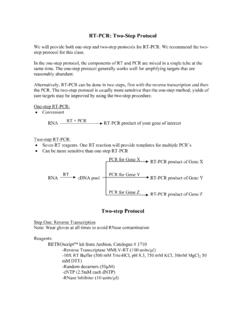
RT-PCR: Two-Step Protocol - MIT OpenCourseWare
1) Assemble your reaction as follows on ice. Add the enzyme last. Component Stock Final amount Experiment (+RT) Control (-RT) Total RNA ~1-2 µg ~1-2 µg Random Decamers 50µM 5M µ 2 µl 2 µl 10X RT Buffer 10X 1X 2 µl 2 µl dNTP mix 2.5mM 0.5mM 4 µl 4l µ …
Download RT-PCR: Two-Step Protocol - MIT OpenCourseWare

Information
Domain:
Source:
Link to this page:
Documents from same domain
Wireless Communications - MIT OpenCourseWare
ocw.mit.eduWireless Communications Wireless telephony Wireless LANs Location-based services 1 The Technology: ... Cellular Phone Networks Frequency reuse
SYSTEMS ENGINEERING FUNDAMENTALS - MIT …
ocw.mit.eduSystems Engineering Fundamentals Introduction iv PREFACE This book provides a basic, conceptual-level description of engineering management disciplines that
Fundamentals of Chemical Reactions - MIT …
ocw.mit.edu10.37 Chemical and Biological Reaction Engineering, Spring 2007 Prof. William H. Green Lecture 4: Reaction Mechanisms and Rate Laws Fundamentals of Chemical Reactions
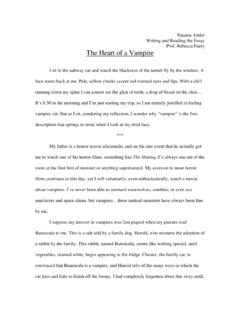
The Heart of a Vampire - MIT OpenCourseWare
ocw.mit.eduThe Heart of a Vampire ... Interview with the Vampire might not have convinced me that vampires could be sexy until I read a fantasy book on the subject, ...
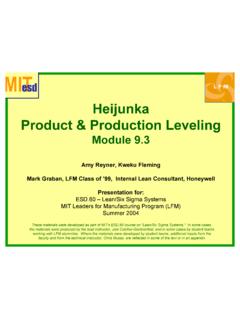
Heijunka Product & Production Leveling
ocw.mit.eduHeijunka Product & Production Leveling Module 9.3 Mark Graban, LFM Class of ’99, Internal Lean Consultant, Honeywell Presentation for: Summer 2004
15.501/516 Final Examination December 18, 2002
ocw.mit.edu15.501/516 Final Examination December 18, 2002 ... accounting, used for many years ... Metro Area Inc. was in severe financial difficulty and threatened to
Sloan School of Management Massachusetts …
ocw.mit.eduSloan School of Management Massachusetts Institute of Technology ... Managerial Accounting ... Financial accounting information facilitates the

USS Vincennes Incident - MIT OpenCourseWare
ocw.mit.eduOverview • Introduction and Historical Context • Incident Description • Aegis System Description • Human Factors Analysis • Recommendations
Stochastic Processes and Brownian Motion
ocw.mit.eduChapter 1. Stochastic Processes and Brownian Motion 2 1.1 Markov Processes 1.1.1 Probability Distributions and Transitions Suppose …
Stochastic Processes I - MIT OpenCourseWare
ocw.mit.eduLecture 5 : Stochastic Processes I 1 Stochastic process A stochastic process is a collection of random variables indexed by time. An alternate view is that it is a probability distribution over a space
Related documents
Ni-NTA Purification System - Thermo Fisher Scientific
tools.thermofisher.com1. Equilibrate the Guanidinium Lysis Buffer, pH 7.8 (supplied with the system or see page 26 for recipe) to 37°C. 2. Harvest cells from a 50 mL culture by centrifugation (e.g., 5000 rpm for 5 minutes in a Sorvall SS-34 rotor). 3. Resuspend the cell pellet in 8 mL of Guanidinium Lysis Buffer from Step 1. 4.
TRIzol Reagent User Guide - Pub. no. MAN0001271 - Rev. A
tools.thermofisher.coma. Resuspend the pellet in 20–50 µL of RNase-free water, 0.1 mM EDTA, or 0.5% SDS solution by pipetting up and down. IMPORTANT! Do not dissolve the RNA in 0.5% SDS if the RNA is to be used in subsequent enzymatic reactions. b. Incubate in a water bath or …

制限酵素を用いたプラスミド DNA の切断→Ligation …
web.cc.iwate-u.ac.jp1本振ったらブロックに戻し、もう1本を振るというように手早くやる。 ⑧1ml程度のGB-gel Solutionが2本ずつ出来るので、1回目700ul、2回目300ulという ように2回に分けてカラムを通し、全量を4℃、15,000rpmで遠心する(時間は1分弱、

INSTRUCTIONS DNase I, RNase-free - Thermo Fisher Scientific
assets.thermofisher.com1,8 • DNase I is inhibited by metal chelators, monovalent metal ions such as Na and K (i.e., ≥ 100mM NaCl), SDS even at concentrations below 0.1%, reducing agents and ionic strength above 50-100mM. • DNase I is inactivated by heating to 65°C for 10 minutes in the presence of EGTA or EDTA (use at least 1 mole of EGTA or EDTA per 1 mole of Mn

PureLink RNA Mini Kit - Thermo Fisher Scientific
assets.thermofisher.comRNase-free microcentrifuge pestles allow disruption and lysis of tissue samples in a microcentrifuge tube. They are usually made of Teflon, polyethylene, or stainless steel, and are designed to fit standard microcentrifuge tube sizes (e.g. conical 1.5 mL tubes or 2 mL round–bottom tubes). To use the microcentrifuge pestle: 1.
Total RNA extraction using Trizol reagent
health.uconn.edu1. Isolation of RNA from small quantities of tissue (1 to 10 mg) or Cell (102 to 104) Samples: Add 800 µl of TRIZOL to the tissue or cells. Following sample lysis, add chloroform and proceed with the phase separation as described in step 2. Prior to precipitating the RNA with isopropyl alcohol, add 5-10 •Ïg RNase-free glycogen (Cat.
TRIzol Reagent User Guide - Pub. no. MAN0001271 - Rev. A
tools.thermofisher.coma. Resuspend the pellet in 20–50 µL of RNase-free water, 0.1 mM EDTA, or 0.5% SDS solution by pipetting up and down. IMPORTANT! Do not dissolve the RNA in 0.5% SDS if the RNA is to be used in subsequent enzymatic reactions. b. Incubate in a water bath or heat block set at 55–60°C for 10–15 minutes.