
Section 18. Continuous Functions
Jun 11, 2016 · 18. Continuous Functions 3 Example 3. Let R have the standard topology and R` have the lower limit topol-ogy. Let f : R → R` be the identity function f(x) = x (which is of course continuous when mapping R → R). Then f is not continuous here since for a < b, [a,b) is open in R` for f−1([a,b)) = [a,b) is not open in R. Note.
Download Section 18. Continuous Functions

Information
Domain:
Source:
Link to this page:
Documents from same domain
A Four-Stage Model of Mathematical Learning
faculty.etsu.eduA Four-Stage Model of Mathematical Learning Jeff Knisley Department of Mathematics East Tennessee State University Box 70663 Johnson City, TN 37614-0663

4.1. The Riemann Integral Chapter 4. Lebesgue Integration
faculty.etsu.eduNov 04, 2018 · These are the same definitions as used by J.R. Kirkwood in An Introduc- tion to Analysis, 2nd Edition, Waveland Press (2002), with the exception that m i and M i are defined using [x i−1 ,x i ] and the term “Riemann sum” replaces the term

2.2 The Michelson-Morley Experiment
faculty.etsu.eduJun 24, 2019 · Example (Exercise 2.2.2). Suppose L1 is the length of arm #1 and L2 is the length of arm#2. The speed of a photon (relative to the source) on the trip “over” to the mirror is c − v and so takes a time of L1/(c − v). On the return trip, the photon has speed of c +v and so takes a time of L1/(c +v). Therefore the round trip time is t1 ...

Row Space, Column Space, and Nullspace
faculty.etsu.eduFind a basis for the subspace of <5 spanned by S that is a subset of the vectors in S. To do this, we To do this, we set the columns of a matrix A as the vectors v 1 , v 2 , v 3 and v 4 :

Span, Linear Independence and Basis - East Tennessee State ...
faculty.etsu.eduSpan, Linear Independence and Basis Linear Algebra MATH 2010 † Span: { Linear Combination: A vector v in a vector space V is called a linear combination of vectors u1, u2, ..., uk in V if there exists scalars c1, c2, ..., ck such that v can be written in the form v = c1u1 +c2u2 +:::+ckuk { Example: Is v = [2;1;5] is a linear combination of u1 = [1;2;1], u2 = [1;0;2], u3 = …

Section 13. Basis for a Topology - East Tennessee State ...
faculty.etsu.eduMay 28, 2016 · Section 13. Basis for a Topology Note. In this section, we consider a basis for a topology on a set which is, in a sense, analogous to the basis for a vector space. Whereas a basis for a vector space is a set of vectors which (efficiently; i.e., linearly independently) generates
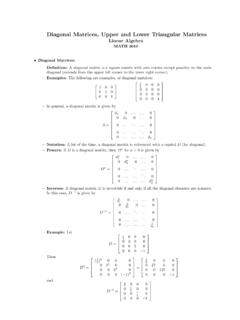
Diagonal Matrices, Upper and Lower Triangular Matrices
faculty.etsu.eduDiagonal Matrices, Upper and Lower Triangular Matrices Linear Algebra MATH 2010 Diagonal Matrices: { De nition: A diagonal matrix is a square matrix with zero entries except possibly on the main diagonal (extends from the upper left corner to the lower right corner).
Section 3.3. Matrix Rank and the Inverse of a Full Rank Matrix
faculty.etsu.edu3.3. Matrix Rank and the Inverse of a Full Rank Matrix 5 Note. If n × m matrix A is of rank r then for any q ≤ r (with E π 1 and E π 2 as described in the previous note) we have E
1.4. Borel Sets Chapter 1. Open Sets, Closed Sets, and ...
faculty.etsu.eduAug 22, 2020 · 1.4. Borel Sets 1 Chapter 1. Open Sets, Closed Sets, and Borel Sets Section 1.4. Borel Sets Note. Recall that a set of real numbers is open if and only if it is a countable
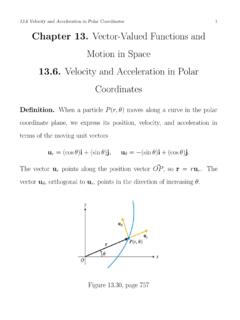
13.6 Velocity and Acceleration in Polar Coordinates Vector ...
faculty.etsu.edu13.6 Velocity and Acceleration in Polar Coordinates 2 Note. We find from the above equations that dur dθ = −(sinθ)i +(cosθ)j = uθ duθ dθ = −(cosθ)i−(sinθ)j = −ur. Differentiatingur anduθ with respectto time t(and indicatingderivatives with respect to time with dots, as physicists do), the Chain Rule gives
Related documents
list of some useful R functions - Columbia University
www.columbia.eduuence.measures: suite of functions to compute regression (leave-one-out dele-tion) diagnostics for linear and generalized linear models ("stats") { lm.in uence: provides the basic quantities used in diagnostics for checking the quality of regression ts ("stats") { outlier.test: Bonferroni outlier test …
Introduction to the R Language - Functions
www.stat.berkeley.eduFunctions Functions are created using the function() directive and are stored as R objects just like anything else. In particular, they are R objects of class \function". f <- function(<arguments>) {## Do something interesting} Functions in R are \ rst class objects", which means that they can be treated much like any other R object. Importantly,

Chapter 1 Character Functions - SAS
support.sas.comFunctions That Count the Number of Letters or Substrings in a String 109 COUNT 109 COUNTC 111 Miscellaneous String Functions 113 MISSING 113 RANK 115 REPEAT 117 REVERSE 119 . Chapter 1: Character Functions 3 Introduction A major strength of SAS is its ability to work with character data. The SAS character

Inverse Trig Functions - Cornell University
twiki.math.cornell.eduDefinitions of the Inverse Functions When the trig functions are restricted to the domains above they become one-to-one func-tions, so we can define the inverse functions. For the sine function we use the notation sin−1(x) or arcsin(x). Both are read “arc sine” . Look carefully at where we have placed the -1.

2 Complex Functions and the Cauchy-Riemann Equations
www.math.columbia.eduWe can de ne a broader class of complex functions by dividing polynomi-als. By de nition, a rational function R(z) is a quotient of two polynomials: R(z) = P(z)=Q(z); where P(z) and Q(z) are polynomials and Q(z) is not identically zero. Using the factorization (1) above, it is not hard to see that, if R(z) is not actually

Sequences and Series Functions - Rowan University
users.rowan.eduChapter 9 Sequences and Series of Functions 9.1 Pointwise Convergence of Sequence of Functions Definition 9.1 A Let {fn} be a sequence of functions defined on a set of real numbers E. We say that {fn} converges pointwise to a function f on E for each x ∈ E, the sequence of real numbers {fn(x)} converges to the number f(x).

2.1 Functions: definition, notation
case.fiu.eduChapter 2: 2.1 Functions: definition, notation A function is a rule (correspondence) that assigns to each element x of one set , say X, one and only one element y of another set, Y. The set X is called the domain of the function and the set of all elements of the set Y that are associated with some element of the set X is called the range of the function.

Exponential Functions with Base e
www.alamo.eduExponential Functions with Base e. Any positive number can be used as the base for an exponential function, but some bases are more useful than others. For instance, in computer science applications, the base 2 is convenient. The most important base though is the number denoted by the letter e.

Using R, Chapter 6: Normal Distributions pnorm and …
cosmosweb.champlain.edu1 Using R, Chapter 6: Normal Distributions The pnorm and qnorm functions. Getting probabilities from a normal distribution with mean and standard deviation ˙
Related search queries
Of some useful R functions, Columbia University, Functions, Introduction to the R Language, Functions Functions, Character Functions, Character, SAS character, Func-tions, Complex Functions and the Cauchy-Riemann Equations, Function, R, Chapter 6: Normal Distributions pnorm and, R, Chapter 6: Normal Distributions