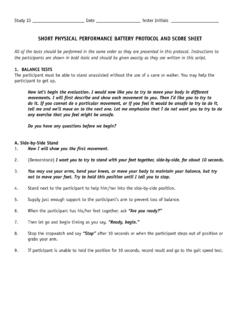
SHORT PHYSICAL PERFORMANCE BATTERY PROTOCOL …
First, fold your arms across your chest and sit so that your feet are on the floor; then stand up keeping your arms folded across your chest. 4. Please stand up keeping your arms folded across your chest.(Record result). 5. If participant cannot rise without using arms, say “Okay, try to stand up using your arms.”This is the end of their test.
Download SHORT PHYSICAL PERFORMANCE BATTERY PROTOCOL …

Information
Domain:
Source:
Link to this page:
Documents from same domain
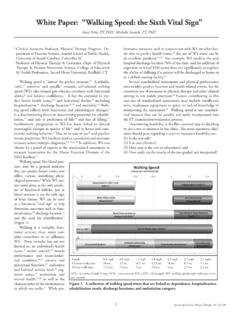
White Paper: “Walking Speed: the Sixth Vital Sign”
geriatrictoolkit.missouri.edu2 Journal of Geriatric Physical Therapy Vol. 32;2:09 1 Clinical Assistant Professor, Physical Therapy Program, De - partment of Exercise Science, Arnold School of …
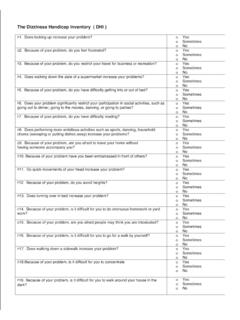
The Dizziness Handicap Inventory ( DHI )
geriatrictoolkit.missouri.eduThe Dizziness Handicap Inventory ( DHI ) P1.Does looking up increase your problem? o Yes o Sometimes o No E2.Because of your problem, do you feel frustrated?
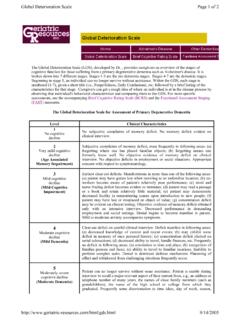
Global Deterioration Scale Page 1 of 2
geriatrictoolkit.missouri.eduThe Global Deterioration Scale for Assessment of Primary Degenerative Dementia Level Clinical Characteristics 1 No cognitive decline No subjective complaints of memory deficit. No memory deficit evident on clinical interview. 2 Very mild cognitive decline (Age Associated
The Dizziness Handicap Inventory ( DHI )
geriatrictoolkit.missouri.eduThe Dizziness Handicap Inventory ( DHI ) P1.Does looking up increase your problem? o Yes o Sometimes o No E2.Because of your problem, do you feel frustrated?
White Paper: “Walking Speed: the Sixth Vital Sign”
geriatrictoolkit.missouri.eduStacy Fritz, PT, PhD;1 Michelle Lusardi, PT, PhD2 0 mph 0.4 mph 0.9 mph 1.3 mph 1.8 mph 2.2 mph 2.7 mph 3.1 mph 10 meter walk time 50 sec 25 sec 16.7 sec 12.5 sec 10 sec 8.3 sec 7.1 sec 10 foot walk time 15.2 sec 7.6 sec 5 sec 3.8 sec 3 sec 2.5 sec 2.2 sec
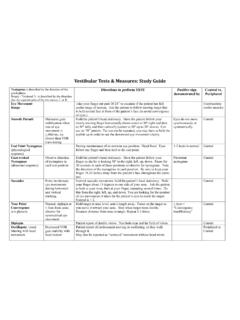
Vestibular Tests & Measures: Study Guide
geriatrictoolkit.missouri.eduVestibular hypofunction 2. Head Impulse Test. aka Head Thrust Test (eyes open: EO) The patient will need to understand what will be done so their neck is relaxed during the test. If you noted that the patient had pain or significant restriction in cervical spine mobility, this test should be performed with extreme caution or should be deferred.

Timed 10-Meter Walk Test - University of Missouri
geriatrictoolkit.missouri.eduDownloaded from www.rehabmeasures.org Page 1 Timed 10-Meter Walk Test General Information: individual walks without assistance 10 meters (32.8 feet) and the time is
Global Deterioration Scale Page 1 of 2
geriatrictoolkit.missouri.eduassessments, use the accompanying Brief Cognitive Rating Scale (BCRS) and the Functional Assessment Staging (FAST) measures. The Global Deterioration Scale for Assessment of Primary Degenerative Dementia Level Clinical Characteristics 1 No cognitive decline No subjective complaints of memory deficit. No memory deficit evident on clinical interview.
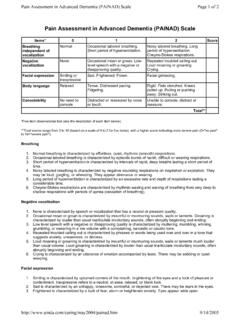
Pain Assessment in Advanced Dementia (PAINAD) Scale
geriatrictoolkit.missouri.eduPain Assessment in Advanced Dementia (PAINAD) Scale *Five-item observational tool (see the description of each item below). **Total scores range from 0 to 10 (based on a scale of 0 to 2 for five items), with a higher score indicating more severe pain (0="no pain"

The Confusion Assessment Method (CAM)
geriatrictoolkit.missouri.eduThe confusion assessment method (CAM): A systematic review of current usage. JAGS, 56(5), 823-830. Permission is hereby granted to reproduce, post, download, and/or distribute, this material in its entirety only for not-for-profit educational purposes only, provided that
Related documents

The Compendium of Physical Activities Tracking Guide
prevention.sph.sc.edu05190 2.5 home activities sit, play ing with animals, light, only active periods 05191 2.8 home activities stand, playing with animals, light, only active periods 05192 2.8 home activities walk/run, playing with animals, light, only active periods 05193 4.0 home activities walk/run, playing with animals, moderate, only active periods
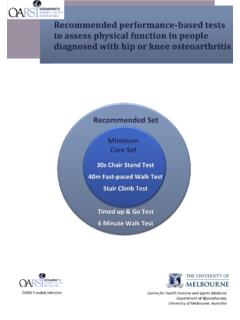
Recommended performance based tests to assess physical ...
oarsi.orgSit-to-stand 30 second chair stand test Walking short distances 4x10m fast-paced walk test Stair negotiation [No test recommendation] Ambulatory transitions Timed up and go test Aerobic capacity / walking long distances Six-minute walk test

THE FOLLOWING SIGNS MAY BE USED IN ALL CLASS LEVELS
cdn.akc.orgMoving Stand Walk Around X, M-#203. Moving Down Walk Around X, M-#204. Back Up 3 Steps X, M-#205. Down While Heeling Call to Finish Sit X, M-#206. Stand While Heeling Call to Finish Sit X, M-#207. X, M-#208 Stand Leave –Sit Call Front Finish Sit. X, M-#209 Stand Leave –Down Call Front Finish Sit. Send To Jump X-#210 3 ft. Double Left About ...

Six Minute Walk Test Instructions and Tracking Sheet
cdn.ymaws.comSix Minute Walk Test Instructions and Tracking Sheet . 4. Instruct the patient as follows: "The object of this test is to walk as far as possible for 6 minutes. You will walk back and forth in this hallway. Six minutes is a long time to walk, so you will be exerting yourself. You will probably get out of breath or become exhausted.

A Walk Through the Mass: A Step-by-Step Explanation
presentationparish.orgA Walk Through the Mass: A Step-by-Step Explanation Creed. Now we stand and together recite the creed. The creed is more than a list of things which we believe. It is a statement of our faith in the word we have heard proclaimed in the Scripture and the homily, and a profession of the
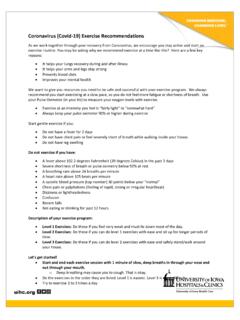
Coronavirus (Covid-19) Exercise Recommendations
www.healthcare.uiowa.eduSit to Stand • Start by sitting in chair. Stand up, then sit back down. Use your arms to help you, as needed. • Do this 2 to 10 times. Walking • Walking is a great way to improve lung health, strength, balance, and prevent blood clots. • Try to walk short to moderate distances near your home 3 times each day. Slowly walk longer distances.
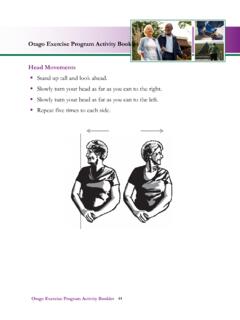
Otago Exercise Program Activity Booklet Head Movements
www.med.unc.eduStand up tall beside a table. Hold on and look ahead. Come back onto your heels, raising the front of your foot off the floor. Walk 10 steps on your heels. Lower your feet to the ground and turn around. Walk 10 steps on your heels. Repeat.
6-Minute Walk Test Protocol - University of Toronto
www.physicaltherapy.utoronto.ca“The aim of this test is to walk as far as possible for 6 minutes. You will walk along this hallway between the pylons as many times as you can in 6 minutes. I will let you know as each minute goes past, and then at 6 minutes I will ask you to stop where you are. 6 minutes is a long time to walk, so you will be exerting yourself.