Simulating Data with SAS
A random variate is a particular outcome of a random variable (Devroye 1986). For example, let Xbe a Bernoulli random variable that takes on the value 1 with probability pand the value 0 with probability 1 p. If you draw five observations from the
Download Simulating Data with SAS

Information
Domain:
Source:
Link to this page:
Documents from same domain
027-2009: Tips and Tricks for Creating the Reports …
support.sas.comPaper 027-2009 TIPS AND TRICKS FOR CREATING THE REPORTS YOUR CLIENTS NEED TO SEE Michael J Molter, INC Research, Raleigh, NC ABSTRACT Advanced reporting tools such as PROC REPORT have progressed by leaps and …
Step-by-Step Programming with Base SAS Software
support.sas.comThe correct bibliographic citation for this manual is as follows: SAS Institute Inc. 2001. Step-by-Step Programming with Base SAS® Software.Cary, NC: SAS Institute Inc.
227-2012: Executing a PROC from a DATA Step - …
support.sas.com2 Using RUN_MACRO to execute a PROC from a DATA step requires writing three blocks of code, described in the Introduction: a macro to execute a PROC, a user-written function to execute the macro, and a DATA step to call the
149-2012: Queries, Joins, and WHERE Clauses, Oh …
support.sas.comPaper 149-2012 Queries, Joins, and WHERE Clauses, Oh My!! Demystifying PROC SQL Christianna S. Williams, Chapel Hill, NC ABSTRACT Subqueries, inner joins, outer joins, HAVING expressions, set operators…just the terminology of PROC SQL might
158-2010: How to Use Arrays and DO Loops: Do I …
support.sas.com1 Paper 158-2010 How to Use ARRAYs and DO Loops: Do I DO OVER or Do I DO i? Jennifer L Waller, Medical College of Georgia, Augusta, GA ABSTRACT
248-2009: Learning When to Be Discrete: …
support.sas.com1 Paper 248–2009 Learning When to Be Discrete: Continuous vs. Categorical Predictors David J. Pasta, ICON Clinical Research, San Francisco, CA ABSTRACT
338-2011: An Introduction to Survival Analysis …
support.sas.com2 (Censored) Study Ends (From Applied Survey Data Analysis, p. 306) Figure 1. Prospective View of Event History Survey Data Time can be regarded as continuous or discrete and this basic distinction affects the analytic approach selected.
Dongsheng Yang and Jarrod E. Dalton - SAS
support.sas.com1 Paper 335-2012 A unified approach to measuring the effect size between two groups using SAS® Dongsheng Yang and Jarrod E. Dalton Departments of Quantitative Health Sciences and Outcomes Research
SAS/STAT 9.2 User's Guide: Introduction to Power …
support.sas.comSAS/STAT ® 9.2 User’s Guide Introduction to Power and Sample Size Analysis (Book Excerpt) SAS® Documentation
249-2012: A Tutorial on the SAS® Macro Language
support.sas.com1 Paper 249-2012 A Tutorial on the SAS® Macro Language John J. Cohen, Advanced Data Concepts LLC, Newark, DE ABSTRACT The SAS macro language is another language layering on top of regular SAS code.
Related documents
Simulation Programming with Python - Northwestern …
users.iems.northwestern.eduThe basic use of random variate generators in the random module is as follows: 1. Load the random module: import random 2. Instantiate a generator: g = random.Random() 3. Set the seed: g.seed(1234) 4. Draw a random variate: A random value from 0 to 1: g.random() A random value (oat) from a to b: g.uniform(a,b)
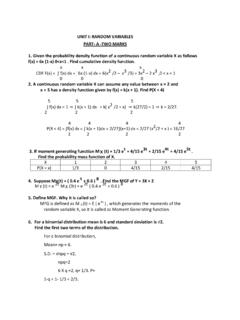
UNIT I: RANDOM VARIABLES PART- A -TWO MARKS 2. A ...
pradeepchandrasekar.weebly.comrandom variable X, so it is called as Moment Generating function. 6. For a binomial distribution mean is 6 and standard deviation is ... 11.If X is the number of …

4. Introduction to Statistics Descriptive Statistics
cosmologist.infoA variate or random variable is a quantity or attribute whose value may vary from one unit of investigation to another. For example, the units might be headache sufferers and the variate might be the time between taking an aspirin and the headache ceasing. An observation or response is the value taken by a variate for some given unit.

Lecture 1. Random vectors and multivariate normal …
www.stat.pitt.eduDe nition 1. Let 2Rp and (p p) >0. A random vector X2R p has p-variate normal distribution with mean and covariance matrix if it has probability density function f(x) = j2ˇ 0j12 exp 1
Chapter 3 Random Vectors and Multivariate Normal …
sites.pitt.eduRandom Vectors and Multivariate Normal Distributions 3.1 Random vectors Definition 3.1.1. Random vector. Random vectors are vectors of random 83. BIOS 2083 Linear Models Abdus S. Wahed variables. For instance, ... The distributionofX1|X2 is p-variate nor-
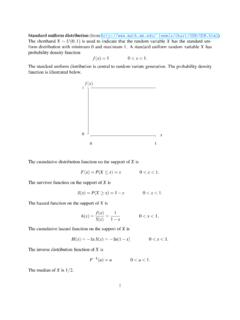
Standard uniform distribution (from http://www.math.wm.edu ...
www.math.wm.eduThe standard uniform distribution is central to random variate generation. The probability density function is illustrated below. 0 1 0 1 x f(x) The cumulative distribution function on the support of X is F(x)=P(X ≤x)=x 0 <x <1. The survivor function on the support of X is S(x)=P(X ≥x)=1−x 0 <x <1.
SAMPLE STATISTICS
www.le.ac.ukA random sample of size n from a distribution f(x) is a set of n random variables x 1,x 2,...,x n which are independently and identically distributed with x i ∼ f(x) for all i. Thus, the joint p.d.f of the random sample is ... variate of n degrees of freedom, and if the two variates are distributed independently, then the ratio t = x

consistent. Observe that Themean ¯ x V ,x x i x
www.le.ac.ukA random sample x 1,x 2 ... variate are E (u)= n and V (u)=2 n respectively. Theorem. The sum of two independent chi-square variates is a chi-square variate with degrees of freedom equal to the sum of the degrees of freedom of its additive components. If x

Chapter 3: Methods for Generating Random Variables
www.ynufe.edu.cnThe basic method to generate a Poisson( ) variate is to generate and store the cdf via the recursive formula f(x+ 1) = f(x) x+ 1;F(x+ 1) = F(x) + f(x+ 1): For each Poisson variate, a random uniform uis generated, and the cdf vector is searched for the solution to F(x 1) <u F(x): Note: R function rpois generates random Poisson samples.