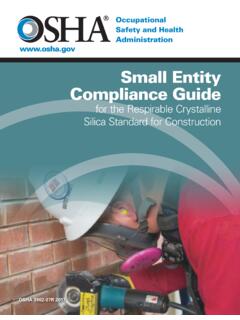
Small Entity Compliance Guide
exposure controls option must fully and properly implement protections for the tasks or equipment listed in Table 1 of the standard. Employers who fully and properly implement the controls in Table 1 do not have to assess employees’ silica exposure levels or keep employee exposures at or below the permissible exposure limit (PEL).
Download Small Entity Compliance Guide

Information
Domain:
Source:
Link to this page:
Documents from same domain
Motor Vehicles Safe Driving Practices for Employees
www.osha.govMotor Vehicles Safe Driving Practices for Employees You are your employer’s most valuable asset! The way that you drive says everything about you and your
U. S. Department of Labor Occupational Safety and …
www.osha.govU. S. Department of Labor Occupational Safety and Health Administration Notice of Alleged Safety or Health Hazards . For the General Public: This form is provided for the assistance of any complainant and is not intended to constitute the exclusive means by
Controlling Hazardous Fume and - osha.gov
www.osha.govFactSheet Controlling Hazardous Fume and Gases during Welding Welding joins materials together by melting a metal work piece along with a …
OSHA 3220-10N 2004
www.osha.govWORKER SAFETY SERIES WAREHOUSING 11 Hazards & Solutions Warehouse operations can present a wide variety of potential hazards for the worker. For warehousing establishments, the
Job Safety and Health - osha.gov
www.osha.govJob Safety and Health. IT’S THE LAW! All workers have the right to: A safe workplace. Raise a safety or health concern with your employer or OSHA, or report a work-
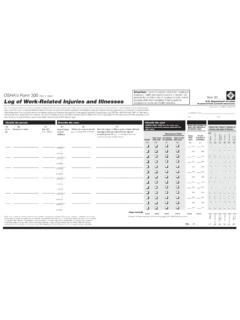
Year 20 Log of Work-Related Injuries and Illnesses
www.osha.govU.S. Department of Labor Occupational Safety and Health Administration OSHA’s Form 300 (Rev. 01/2004) Year 20__ __ Log of Work-Related Injuries and Illnesses You must record information about every work-related death and about every work-related injury or illness that involves loss of consciousness, restricted work activity or job transfer,
DEPARTMENT OF LABOR 29 CFR Part 1904
www.osha.gov2 The final rule also revises the requirements for reporting work-related fatality, injury, and illness information to OSHA. The current regulation requires employers to report …
CRANES AND DERRICKS IN CONSTRUCTION FINAL …
www.osha.govOSHA is making this document, the regulatory text, available for informational purposes only. This action does not affect the effective date of the final rule on Cranes and Derricks in Construction, which will be 90
Preventing Mold-Related Problems in the Indoor …
www.osha.govIntroduction This guide provides basic information about mold, mold sources, and building-related illnesses. Brief discussions are included on building design considerations for healthy indoor air,
HazardCommunicationGuidancefor CombustibleDusts
www.osha.govU.S.DepartmentofLabor OccupationalSafetyandHealthAdministration OSHA3371-08 2009 HazardCommunicationGuidancefor CombustibleDusts Occupational Safety and Health Act of 1970
Related documents

Silica Exposure Control Plan - Yale University
ehs.yale.eduSilica Exposure Control Plan ... effects from respirable crystalline silica exposures. This plan follows the requirements of both ... the report will include actions that will be taken to reduce exposures. All affected employees will be included in this notification. Alternatively, the results may be posted in an appropriate
Coal Mine Dust Exposures and Associated Health Outcomes
www.cdc.govExposure to Respirable Coal Mine Dust. This document had the following major recommendations: 1. Exposures to respirable coal mine dust should be limited to 1 mg/m3 as a time-weighted average concentration for up to a 10 hour day during a 40 hour work week; 2. Exposures to respirable crystalline silica should be limited to 0.05 mg/m3 as

Dust Sampling Instrumentation and Methods
www.cdc.govSep 28, 2010 · of respirable dust • Combines dust sampler and cap lamp into one unit • Sample inlet is mounted on cap lamp • Uses mass-based ... • Develop controls and/or improved work practices to reduce mobile workers’ dust exposure . Sampling to Isolate an Unconfined Dust Source . A – Ambient sampling location . A D D D D.

Right to Know Hazardous Substance Fact Sheet
www.nj.govRepeated exposure can lead to lung damage. Workplace Exposure Limits OSHA: The legal airborne permissible exposure limit (PEL) is 3 (as respirable dust) and 15 mg/m total dust) averaged over an 8-hour workshift. ACGIH: The threshold limit value (TLV) is 1 mg/m3 (as the respirable fraction for Aluminum) averaged over an 8-hour workshift.

OSHA’s Respirable Crystalline Silica Standard for General ...
www.osha.govexposure, workplace tasks that can expose them to silica, and ways to limit exposure; and • Keep records of workers’ silica exposure and medical exams. A worker uses a stone grinder that applies water at the work surface to reduce silica dust levels in the air. FactSheet

QGL02 Guideline for management of respirable dust in ...
www.rshq.qld.gov.auQGL02 - Guideline for management of respirable dust in Queensland mineral mines and quarries - Version 4 2 of 28 Introduction An SSE must ensure a workers exposure to respirable dust and other air contaminants, such as respirable crystalline silica (RCS) does not exceed the exposure limit and is as low as reasonably achievable1.

U.S. SILICA COMPANY SAFETY DATA SHEET
www.ussilica.comdetermine if dust is in the air. Respirable crystalline silica dust may be in the air without a visible dust cloud. Use adequate exhaust ventilation and dust collection. Maintain and test ventilation and dust collection to reduce respirable crystalline silica dust levels to below the occupational exposure limit. Use all available

U.S. SILICA COMPANY SAFETY DATA SHEET
www.ussilica.comRespirable crystalline silica dust may be in the air without a visible dust cloud. Use adequate exhaust ventilation and dust collection to reduce respirable crystalline silica dust levels to below the permissible exposure limit (“PEL”). Maintain and test ventilation and dust collection equipment. Use all available work practices to control 3.
Silica - Identifying and managing crystalline silica dust ...
www.worksafe.qld.gov.auThe exposure standard for respirable crystalline silica The National Workplace Exposure Standard for crystalline silica of 0.05 mg/m 3 pertaining to dusts containing quartz, cristobalite or trydimite, measured as respirable dust. The sampling protocol to be used is that contained in Australian Standard 2985 – 2009 Workplace Atmospheres - Method