
Solving the Simple Harmonic Oscillator
Solving the Simple Harmonic Oscillator 1. The harmonic oscillator solution: displacement as a function of time We wish to solve the equation of motion for the simple harmonic oscillator: d2x dt2 = − k m x, (1) where k is the spring constant and m is the mass of the oscillating body that is attached to the spring.
Download Solving the Simple Harmonic Oscillator

Information
Domain:
Source:
Link to this page:
Documents from same domain

MIL-STD-883E, Test Method Standard for …
scipp.ucsc.eduMIL-STD-883E vi TEST METHODS METHOD NO. TEST PROCEDURES 5001 Parameter mean value control 5002.1Parameter distribution control 5003 Failure analysis procedures for …

Principles of Quantum Mechanics, 2nd ed. - Welcome to SCIPP
scipp.ucsc.edu1 Mathematical Introduction The aim of this book is to provide you with an introduction to quantum mechanics, starting from its axioms. It is the aim of this chapter to equip you with the necessary
The complex logarithm, exponential and power functions
scipp.ucsc.eduwhere the integer Nn is given by: Nn = 1 2 − n 2π Arg z , (16) and [ ] is the greatest integer bracket function introduced in eq. (4). 2. Properties of the real-valued logarithm, exponential and power func-
The SphericalHarmonics - Welcome to SCIPP
scipp.ucsc.edu2. The spherical harmonics In obtaining the solutions to Laplace’s equation in spherical coordinates, it is traditional to introduce the spherical harmonics, Ym ℓ (θ,φ), Ym ℓ (θ,φ) = (−1)m s

Three-Dimensional Rotation Matrices
scipp.ucsc.eduPhysics 216 Spring 2012 Three-Dimensional Rotation Matrices 1. Rotationmatrices A real orthogonalmatrix R is a matrix whose elements arereal numbers and satisfies

Eigenvalues and eigenvectors of rotation matrices
scipp.ucsc.eduλ2 − 1 = 0, (12) which yields the eigenvalues, λ = ±1. The interpretation of this result is immediate. The matrix R(θ) when operating on a vector ~v represents a reflection of that vector through a line of reflection that passes through the origin. In the case of λ = 1 we have R(θ)~v = ~v, which means that ~v is a

Regular points and singular points of second-order linear ...
scipp.ucsc.edusecond-order linear differential equation in the case where the origin is an ordinary point of eq. (1). 2. A Frobenius series solution about a regular singular point Consider the homogeneous second-order linear differential equation, x2y′′ +xA(x)y′ +B(x) = 0. (3) We can convert this into the form of eq. (1) by dividing by x2 and identifying

Taylor Series Expansions
scipp.ucsc.eduOf course, if p is a non-negative integer, then the sum in eq. (5) is finite (containing precisely p+1 nonzero terms) and therefore converges trivially for all real values of x, as expected. ∗ Otherwise, the radius of convergence of the binomial series is
Related documents
Chapter 14. Oscillations - Physics & Astronomy
physics.gsu.eduSimple Harmonic Motion A system can oscillate in many ways, but we will be especially interested in the smooth sinusoidal oscillation ... natural frequency of the oscillator. • Suppose that this system is subjected to a periodic external force of frequency fext. This frequency
5. The Schrodinger equation
websites.umich.eduThe harmonic oscillator ... This allows us to write the energy balance equation as: E = K+V(x) = 1 2 m[v(t)]2+ 1 2 k[x(t)]2 = 1 2 mv2 0cos 2ωt+ 1 2 kx2 0sin 2ωt, (5.13) = 1 2 mv2 0 = 1 2 kx2 0. (5.14) Since hsin2()i = hcos2()i = 1 2 we can also write: hKi = hVi = E 2. (5.15) This means that the spring is a machine that equipartitions the ...
Chapter 5 Harmonic Oscillator and Coherent States
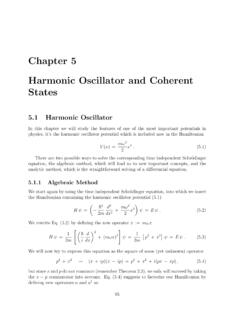
homepage.univie.ac.atHarmonic Oscillator and Coherent States 5.1 Harmonic Oscillator In this chapter we will study the features of one of the most important potentials in physics, it’s the harmonic oscillator potential which is included now in the Hamiltonian V(x) = m!2 2 x2: (5.1) There are two possible ways to solve the corresponding time independent Schr odinger
9. Harmonic Oscillator - MIT OpenCourseWare
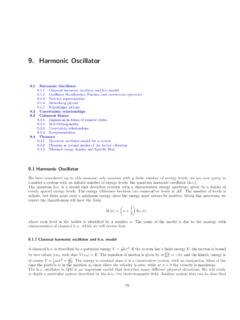
ocw.mit.edu9.1.1 Classical harmonic oscillator and h.o. model A classical h.o. is described by a potential energy V = 1kx2. If the system has a finite energy E, the motion is bound 2 by two values ±x0, such that V(x0) = E. The equation of motion is given by mdx2 dx2 = −kxand the kinetic energy is of course T= 1mx˙2 = p 2 2 2m. The energy is constant ...

Simple Harmonic Motion - University of Oklahoma
www.nhn.ou.eduThe simple harmonic oscillator is an example of conservation of mechanical energy. When the spring is stretched it has only potential energy U = (1/2)kx2 = (1/2)kA2 where A is the maximum amplitude. When the spring is unstretched, it has only kinetic energy K = (1/2)mv2 = (1/2)mv 0

Experiment 12: Simple Harmonic Motion
www.phy.olemiss.eduOne example of a harmonic oscillator is a spring that obeys Hooke’s Law (F = −kx). The period of an ideal, massless spring is related to the spring constant, k (or spring stiffness), and the mass of the object, m, that it moves: T = 2π m k The other harmonic oscillator modeled in this experi-ment is the ideal simple pendulum, whose period is

Harmonic Oscillator Physics - Reed College
www.reed.eduHarmonic Oscillator Physics Lecture 9 Physics 342 Quantum Mechanics I Friday, February 12th, 2010 For the harmonic oscillator potential in the time-independent Schr odinger equation: 1 2m ~2 d2 (x) dx2 + m2!2 x2 (x) = E (x); (9.1) we found a ground state 0(x) = Ae m!x2 2~ (9.2) with energy E 0 = 1 2 ~!. Using the raising and lowering operators ...

AN2867 Application note
www.st.comThe harmonic oscillator family can be divided into two main sub-families: negative-resistance oscillators positive-feedback oscillators. These two sub-families of oscillators are similar for what concerns the output waveform. They deliver an oscillating waveform at the desired frequency. This waveform is typically