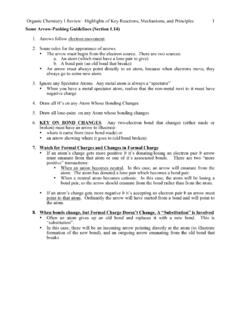
Some Arrow-Pushing Guidelines (Section 1.14)
5. E1 Reactions. 3º > 2º > 1º (Controlled by cation stability) Recognition: A. Neutral, weak nucleophile. No anionic nucleophile/base, and B. 3º or 2º alkyl halide. (Controlled by cation stability). (For 2º alkyl halides, E1 is often accompanied by variable amounts of SN1.) Orientation: The most substituted alkene forms
Download Some Arrow-Pushing Guidelines (Section 1.14)

Information
Domain:
Source:
Link to this page:
Documents from same domain
Chapter 4: Energy from Combustion The primary …
web.mnstate.eduChapter 4: Energy from Combustion The primary means of generating energy for human endeavors is the combustion of fuels. Fuels: Coal -burned in power plants Gasoline -burned in automobiles
Mass Spectroscopy
web.mnstate.edu1 Mass Spectroscopy Mass Spectroscopy is a technique causing the formation of the gaseous ions with or without fragmentation; the gas phase ions are then

African Environmental Issues - Minnesota State …
web.mnstate.eduAfrican Environmental Issues . Environment in Africa: continuity & change. •Important to consider geological age of Africa & its tropical location. •Both affect
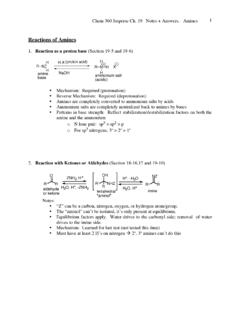
Reactions of Amines - Minnesota State University …
web.mnstate.eduChem 360 Jasperse Ch. 19 Notes + Answers. Amines 1 Reactions of Amines 1. Reaction as a proton base (Section 19-5 and 19-6) RN H H N H R H H X …

Test3 ch17b Buffer-Titration-Equilibrium Practice …
web.mnstate.edu4 Preparation and Recognition of Buffer Systems 14. Which of the following is not a buffer system? A solution containing roughly equal concentrations of _____ a.
Standardization of a Hydrochloric Acid Solution
web.mnstate.eduPage 1 Spring 2011 Standardization of a Hydrochloric Acid Solution The purpose of this experiment is to test your lab technique and examine potential sources of error in

Some Arrow-Pushing Guidelines (Section 1.14)
web.mnstate.eduOrganic Chemistry I Review: Highlights of Key Reactions, Mechanisms, and Principles 1 Some Arrow-Pushing Guidelines (Section 1.14) 1. Arrows follow electron movement.

Recrystallization I 9 Chem 355 Jasperse RECRYSTALLIZATION
web.mnstate.eduRecrystallization I 9 Chem 355 Jasperse RECRYSTALLIZATION Background: Impurities often contaminate organic compounds, whether they have been synthesized in

1. Given the relation R (1 1) (1 3) (1 4) (2 2) (3 1) (3 4 ...
web.mnstate.edu9. For each of the following collections of subsets of A= {1,2,3,4,5}, determine whether of not the collection is a partition. If it is, list the ordered pairs in the equivalence relation determined by the partition.
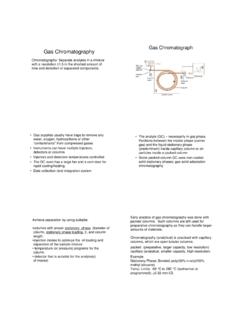
Gas Chromatograph Gas Chromatography
web.mnstate.eduColumn selection GC: Select a stationary phase that would retain (‘dissolve’) the analytes of interest. Stationary phase polarity ~ analyte polarity; (like dissolves like). Selectivity to individual analytes determines the quality of separation (ability to discern the
Related documents

Elimination Reactions
home.iitk.ac.in1 and E1 Reactions S N 1 and E1 reactions have exactly thesamefi tfirst step—ftiformation of a carbtibocation. They differ in what happens to the carbocation. Since in both the reactions, the rate determining steps are the same, they cannot be individually controlled. Because E1 reactions often occur with a competing S N 1 reaction, E1 ...

SN2 , SN1 , E2 , & E1: Substitution and Elimination Reactions
www.chem.ualberta.caElimination Reactions - E2 Reaction: • Reaction is: o Stereospecific (Anti-periplanar geometry preferred, Syn-periplanar geometry possible) o Concerted - all bonds form and break at same time o Bimolecular - rate depends on concentration of both base and substrate o Favoured by strong bases Elimination Reactions – E1 Reaction: • Reaction is:
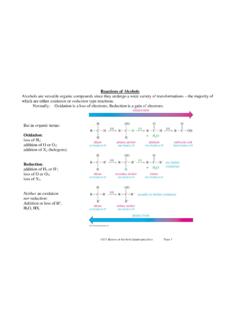
Reactions of Alcohols - Rutgers University
crab.rutgers.eduAlcohol dehydration usually occurs via the E1 mechanism. The first step is the exothermic protonation of the hydroxyl, followed by the slow, endothermic, rate determining ionization to generate the cation. The fast deprotonation is exothermic and produces the alkene.
Organic Chemistry I: Reactions and Overview
sites.tufts.edu8.4 The E1 Reaction E1 reactions almost always accompany S N1 reactions to some extent 9 Alkenes and Alkynes I - Mechanisms 9.1 Acid-Catalyzed Dehydration of Secondary or ertiaryT Alcohols: An E1 Reaction 11

SN1 and SN2 Reactions - Illinois Institute of Technology
web.iit.eduSN1 reactions are nucleophilic substitutions, involving a nucleophile replacing a leaving group (just like SN2). However: SN1 reactions are unimolecular: the rate of this reaction depends only on the concentration of one reactant. SN1 reactions happen in two steps: 1. The leaving group leaves, and the substrate forms a carbocation intermediate. 2.
1) Stability of Carbocations - Rutgers University
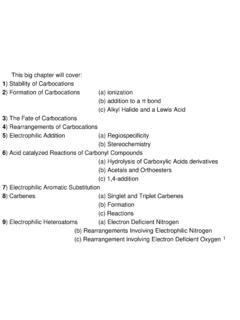
crab.rutgers.eduIf the carbocation leads to an elimination product = E1 reaction. In both cases the ionization is the rate determining step. E.g. Acid catalysed dehydration (loss of water) The protonation (and deprotonation) occur faster than the loss of water from the protonated alcohol.

Substitution and Elimination Reactions Comparative Chart
users.wfu.eduSN1/E1 are common in reactions with weak Nu: in polar protic solvents like water, high temps favor E1 E2 if Main reaction is with strong bases like OH- and RO-SN1/E1 if main reaction is with a poor Nu: High temperatures favor E1 out of the two.

Practice Problems on SN1, SN2, E1 & E2 - Answers
www2.chem.wisc.eduN2, E1 & E2 - Answers 1. Describe the following chemical reactions as S N1, S N2, E1 & E 2. Draw a curved arrow mechanism for each reaction. NaI 3 3 Cl KCN DMSO CN Br NaOH H2O, heat BrH 2O OH I CH3CH2O-Na+ ethanol HI NaSH DMSO HSH Br HO KOH DMSO OTs NaNH2 NH3 TsO NH3 H2N O O CH CH3 TsO

ORGANIC CHEMISTRY I – PRACTICE EXERCISE Elimination ...
personal.utdallas.eduElimination Reactions and Alkene Synthesis 1) One of the products that results when 1-bromo-2,2-dimethylcyclopentane is heated in ethanol is shown below. Give a mechanism by which it is formed and give the name of this mechanism. CH3 CH3 2) Provide the structure of the major organic product in the following reaction. CH3 H Br D NaOCH3 CH3OH