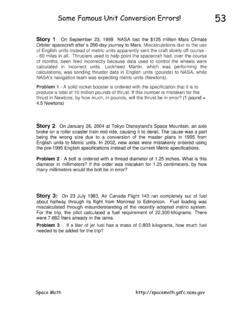
Some Famous Unit Conversion Errors! 53 - NASA
Some Famous Unit Conversion Errors! 53 Story 1: On September 23, 1999 NASA lost the $125 million Mars Climate Orbiter spacecraft after a 286-day journey to Mars. Miscalculations due to the use of English units instead of metric units apparently sent the craft slowly off course -
Download Some Famous Unit Conversion Errors! 53 - NASA

Information
Domain:
Source:
Link to this page:
Documents from same domain

Step 1 Step 2 - Space Math at NASA
spacemath.gsfc.nasa.govStep 2 - Draw a second circle centered on Earth with a radius of 1 centimeter. Label this 'Earth Orbit'. Step 3 - Using the string and thumbtack, draw a second circle with a radius of 30 centimeters. Label this 'Orbit of Moon'. Step 4 - Draw a

Using the Properties of Exponents 6.1 - Space Math at NASA
spacemath.gsfc.nasa.govUsing Properties of Exponents 6.1.2 Astronomers rely on scientific notation in order to work with 'big' things in the universe. The rules for using this notation are pretty straight-

Exploring Parabolas: The shape of a satellite dish
spacemath.gsfc.nasa.govsatellite dish with a radio receiver located at the focus of the parabola. The radio rays are reflected from the parabolic surface and concentrated at the focus. This focusing and amplification property of parabolic reflectors is also used for solar heating and generating
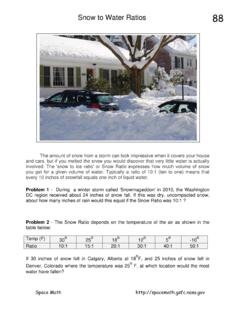
Snow to Water Ratios 88 - NASA
spacemath.gsfc.nasa.govSnow to Water Ratios 88 The amount of snow from a storm can look impressive when it covers your house and cars, but if you melted the snow you would discover that very little water is actually involved. The 'snow to ice ratio' or Snow Ratio expresses how much volume of snow you get for a given volume of water.
Related documents

Middle School Science - Educational Testing Service
www.ets.org3. Conservation of matter in chemical systems 4. Forms of kinetic and potential energy (thermal, chemical, radiant, mechanical) 5. Energy transformations 6. Chemical and physical properties/changes 7. Temperature scales (e.g., Celsius, Fahrenheit, and Kelvin; comparisons and conversions 8. Effect of thermal energy on matter and the
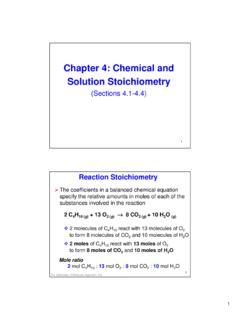
Chapter 4: Chemical and Solution Stoichiometry
webhost.bridgew.eduChapter 4: Chemical and Solution Stoichiometry (Sections 4.1-4.4) 1 Reaction Stoichiometry The coefficients in a balanced chemical equation specify the relative amounts in moles of each of the substances involved in the reaction 2 C 4H10 ( g) + 13 O 2 ( g) →→→→ 8 CO 2 ( g) + 10 H 2O (g) Tro: Chemistry: A Molecular Approach, 2/e Mole ratio
FE Exam Review: Environmental - University of Colorado …
www.colorado.edu• If a chemical has a BCF of 20, what is the likely concentration of the chemical in fish that live in water containing 10 ppm of the chemical? – BCF * Cw = Cfish; ppm = mg/kg • Chemicals A, B, and C have Koc values of 10, 100, and 1000. Which will travel fastest in GW? – If the soil has an organic carbon content of 3%, what
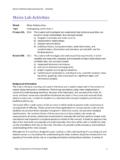
Moles Lab Activities - Virginia Department of Education
www.doe.virginia.govwith conversions involving elements followed by compounds and then by simple reactions. Doing one or more moles lab activities in each unit you teach will give students plenty of practice and time to become proficient with all of the basic conversions and calculations.
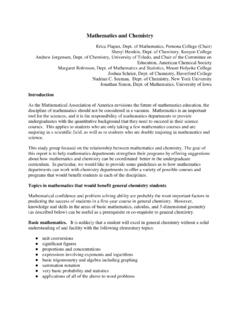
Mathematics and Chemistry - Mathematical Association of ...
www.maa.orgcourse emphasizes word problems while covering unit conversions, significant figures, proportions and concentrations, review of basic trigonometry and algebra including graphing, exponents, logarithms, summation notation, and very basic probability and ... (used in chemical reaction kinetics, mass transport and thermodynamics) numerical ...
Distributions of Residence Times for Chemical Reactors
websites.umich.edu1. To diagnose problems of reactors in operation 2. To predict conversion or effluent concentrations in existing/available reactors when a new reaction is used in the reactor System 1 In a gas–liquid continuous-stirred tank reactor (Figure 13-1), the gaseous reactant was bubbled into the reactor while the liquid reactant was fed
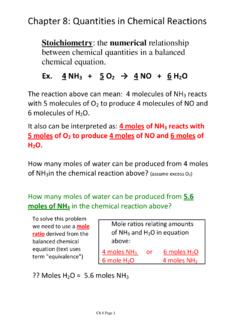
Chapter 8: Quantities in Chemical Reactions
webs.anokaramsey.eduStoichiometry : the numerical relationship between chemical quantities in a balanced chemical equation. Ex. 4NH3 + 5O2 → 4NO + 6H2O The reaction above can mean: 4 molecules of NH 3 reacts with 5 molecules of O 2 to produce 4 molecules of NO and 6 molecules of H 2O. It also can be interpreted as: 4 molesof NH3reacts with 5 molesof O 2to produce 4 molesof NO and 6 …
Chem 101: General Chemistry Lecture 1 - Matter ...
www.chem.uwec.eduThe physical and chemical properties of a pures substance can be ... When working problems it is also important to include the units a. Analyzing the units can help you determine if you have worked the ... D. Commonly used metric units and conversions Table 1.3 - Commonly used metirc units Exercises 1.29. Chem101 Lecture 1 - Matter ...
Chemical (Mole) Conversions - Henry County Schools
schoolwires.henry.k12.ga.usChemical (Mole) Conversions. ... Setting up the problems (you will have 2 “T’s” in the set up): 1. Underline the number and unit they give you. This will help you pick the 1st conversion factor. Then write this at the beginning of the T and then copy that unit at …