
Specimen Collection Guidelines
a. Optimal timing. Whole blood should be collected as soon as possible after illness onset and ideally before initiation of antimicrobial chemoprophylaxis or therapy. For fatal cases, postmortem whole blood should always be obtained at autopsy. b. Collection. Collect whole blood in bottles according to clinical laboratory guidelines. c ...
Download Specimen Collection Guidelines

Information
Domain:
Source:
Link to this page:
Documents from same domain
School Chemistry Laboratory Safety Guide
www.cdc.govSchool Chemistry Laboratory Safety Guide. October 2006. U.S. Consumer Safety Product Commission DEPARTMENT OF HEALTH AND HUMAN SERVICES. Centers for Disease Control and Prevention
Biosafety in Microbiological and Biomedical …
www.cdc.goviii. Foreword. Biosafety in Microbiological and Biomedical Laboratories (BMBL) quickly became the cornerstone of biosafety practice and policy in the United States upon first
Sobering Facts: Drunk Driving in Georgia
www.cdc.govSobering Facts: Drunk Driving in GEORGIA Keep Georgia safe. Keep drunk drivers off the road. This fact sheet provides a snapshot of alcohol-involved deaths and drunk driving
ALCOHOLS III 1402
www.cdc.govALCOHOLS III: METHOD 1402, Issue 2, dated 15 August 1994 - Page 3 of 4 a. Remove and discard back sorbent section of a media blank sampler. b. Inject a known amount of analyte or DE stock solution directly onto front sorbent section
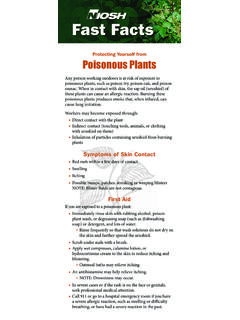
Fast Facts
www.cdc.govAny person working outdoors is at risk of exposure to poisonous plants, such as poison ivy, poison oak, and poison sumac. When in contact with skin, the sap oil (urushiol) of

Trans Fat: The Facts
www.cdc.gov• Read the Nutrition Facts label and ingredient list to compare foods. » Choose products with 0 grams trans fat. » Check the Ingredient List to see if there is any partially hydrogenated oil in the product.
ANTIBIOTIC RESISTANCE THREATS
www.cdc.govApr 23, 2013 · 6. ANTIBIOTIC RESISTANCE THREATS IN THE UNITED STATES, 2013. Executive Summary. Antibiotic Resistance Threats in the United States, 2013. is a snapshot of the complex problem
Chlorine Residual Testing
www.cdc.govChlorine Residual Testing Fact Sheet, CDC SWS Project 4 Methods to Test Free Chlorine in the Field in Developing Countries There are three main methods to test free chlorine residual in drinking water in the field
2018 Combined Recommended Immunization …
www.cdc.govRecommended Immunization Schedule for Children and Adolescents Aged 18 Years or Younger, UNITED STATES, 2018 Approved by the Advisory Committee on …
Traveling? Make Sure You Protect Yourself from …
www.cdc.govCS26201 Malaria transmission occurs throughout Malaria transmission occurs in some parts Malaria transmission is not known to occur Center for Global Health
Related documents
Blood Transfusion Guidelines in Clinical Practice
hematology-sa.org4. Previous repeated febrile reactions to red blood cells Guidelines for routine blood leucodepletion 1.Intrauterine transfusion (IUT) and neonates received IUT. 2.One week prior to stem cell collection, and for 12 months post autografting or allografting. 3.Hodgkin’s disease 4.Treatment with purine analogues (fludarabine, 2-CdA, deoxycofomycin)
Blood Culture Collection Procedure
a1.mayomedicallaboratories.comBlood Culture Collection Procedure Principle Detection of organisms in a patient’s blood has diagnostic and progn ostic importance. When bacteria multiply at a rate that exc eeds the capacity of the reticuloendothelial system to remove them; b acteremia results. Bacteria enter the blood stream from extrava scular sites via the lymphatic vessels.

9.0 Blood Bank - Health Facility Guidelines
healthfacilityguidelines.comBlood Collection, Preparation and Laboratory areas should be air-conditioned with the ability to maintain air temperature between 200 Centigrade to 250 Centigrade. Sterile manufacturing areas will require HEPA filtered, positive pressure air supply in accordance with licensing regulations. Refer to Guidelines for Blood Banks, CDSCO, India.

Blood Culture Collection Guidelines for Phlebotomists …
www.albertahealthservices.caBlood Culture Collection Guidelines for Phlebotomists Page 4 of 5 June 2020 Order of Draw/Collection Collect blood cultures first starting with the aerobic vial followed by the anaerobic lytic vial from the first site. Draw all other blood work (i.e. Chemistry, Hematology, etc.) from this site after blood culture has been collected.
Patient Blood Management Guidelines: Module 5
www.blood.gov.auPatient Blood Management Guidelines National Blood Authority Locked Bag 8430 Canberra ACT 2601 Telephone: +61 2 6151 5000 Email: guidelines@blood.gov.au Website: www.blood.gov.au Disclaimer This document is a general guide to appropriate practice, to be followed subject to the circumstances, clinician’s
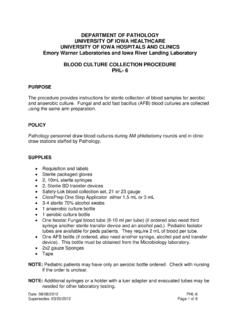
Blood Culture Collection Procedure (PHL-6)
www.healthcare.uiowa.edu3. If all blood is collected into sterile syringes, the last syringe collected is the best one to use for the other laboratory tests because there is less chance of clotting in the third syringe. If you can only fill two 10 mL syringes, it is also acceptable to put 7 or 8 mL in each blood culture bottle and empty the syringes into the other
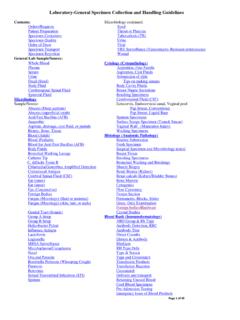
Laboratory-General Specimen Collection and Handling …
www.testmenu.comLaboratory-General Specimen Collection and Handling Guidelines Page 5 of 49 General Lab Sample/Source: Whole blood: o Whole blood is drawn into tubes that contain anticoagulant. o After the tube is filled, it must then be gently inverted 5-6 times to ensure adequate mixing and prevent coagulation.
Guidelines and Principles for Safe Blood Transfusion Practice
www.who.intrecruitment and retention, and for the collection, testing and issue of blood for transfusion. They comprise the following modules: Introductory Module: Guidelines and Principles for Safe Blood Transfusion Practice Module 1: Safe Blood Donation Module 2: Screening for HIV and Other Infectious Agents Module 3: Blood Group Serology.
Related search queries
Blood Transfusion Guidelines in Clinical Practice, Blood, Guidelines, Collection, Blood Culture Collection, Blood Collection, Laboratory, Blood Culture Collection Guidelines for Phlebotomists, Laboratory-General Specimen Collection and Handling, Laboratory-General Specimen Collection and Handling Guidelines, Of blood