Spectroscopy Experiment
spectroscopy are infrared IR, ultra-violet UV, and visible spectroscopy. In this experiment the absorption of light will be measured in the visible portion of the electromagnetic spectrum. Substances that have visible color absorb some portion of the visible region of the electromagnetic spectrum.
Download Spectroscopy Experiment

Information
Domain:
Source:
Link to this page:
Documents from same domain
Experiment: Identification of Unknowns* Introduction
classes.kvcc.eduCHM230 Identification of Unknowns Lab *Adapted from Introduction to Organic Laboratory Techniques by Pavia, Lampman, and Kriz 3rd edition and Organic Chemistry Laboratory Standard and Microscale Experiments by Rodig, Bell, and Clark.
Experiment: Solubility Product Constant (Ksp) for a Salt ...
classes.kvcc.eduCHM130 Solubility Product Experiment Experiment: Solubility Product Constant (Ksp) for a Salt of Limited Solubility Introduction: The equilibrium process in this experiment is a saturated aqueous solution of calcium iodate, Ca(IO 3) 2. The relevant solubility equation and solubility …
pH Measurements and Buffer Laboratory Introduction
classes.kvcc.eduCHM130 pH and Buffer lab pH Measurements and Buffer Laboratory Introduction: pH is a measure of the acidity of an aqueous solution.It is related to the concentration of hydrogen ion, H+.The pH scale can tell if a liquid is more acid or more base,
Determining the Formula of a Hydrate
classes.kvcc.eduA hydrate is an ionic compound that has a definite amount of water molecules attached to its crystalline structure. The ratio of water mol ecules to the anhydrous salt is constant. Many compounds exist as hydrates. Some examples are copper (II) sulfate, sodium sulfate, nickel (II) sulfate, iron (II) sulfate, cobalt (II) chloride, magnesium sulfate,
Experiment: Reactions of alkanes, alkenes, and ...
classes.kvcc.edu*Adapted from Experiments for General, Organic and Biochemistry, Experiment 24 by Bettelheim and Landesberg Experiment: Reactions of alkanes, alkenes, and cycloalkenes* Purpose : To investigate the physical properties, solubility, and density of some hydrocarbon.
Paper Chromatography of Amino Acids
classes.kvcc.edu1. Obtain a 24 x 15.5 cm rectangle of Whatman No. 1 filter paper. Handle this paper by the top edge only. If the paper is handled carelessly, fingerprints may appear as colored spots on the chromatogram. 2. Place the rectangle on a clean paper towel or piece of paper. 3. About 1.5 cm from the bottom of the paper, pencil a line (DO NOT USE PEN ...
General Chapters: <921> WATER DETERMINATION
classes.kvcc.eduReagent—Prepare the Karl Fischer Reagent as follows. Add 125 g of iodine to a solution containing 670 mL of methanol and 170 mL of pyridine, and cool. Place 100 mL of pyridine in a 250-mL graduated cylinder, and, keeping the pyridine cold in an ice bath, pass in dry sulfur
Recrystallization- Purifying an Unknown CHM 220
classes.kvcc.edustarting materials. When these reactions are completed is it often necessary to purify the resulting product, separating the side-products, left over reagents and or consumed reagents from the desired product. Similarly in the natural work it is rare to find a compound in a pure form. The techniques used
Determination of Caffeine in Beverages
classes.kvcc.eduRed Bull 8.3 oz. 80 Red Bull Sugarfree 8.3 oz. 80 Rockstar Energy Drink 8 oz. 80 SoBe Adrenaline Rush 8.3 oz. 79 Amp 8.4 oz. 74 Glaceau Vitamin Water Energy Citrus 20 oz. 50 SoBe Essential Energy, Berry or Orange 8 oz. 48 . Title: Determination of Caffeine in Beverages Author: TTC Library Created Date: 1/31/2012 11:39:46 AM ...
Related documents
How to prepare IR samples? - Northwestern University
www.nuance.northwestern.eduLiquid samples (2.2.1) Making a sandwich To prepare a liquid sample to IR analysis, firstly place a drop of the liquid on the face of a highly polished salt plate (such as NaCl, AgCl or KBr), then place a second plate on top of the first plate

Page 1 of 34 13:04 - 14-Jan-2021 of Your Home Business Use
www.irs.govage of inventory or product samples (discussed next). • You use the part of your home in question as a day-care facility (discussed later under Daycare Facility). Note. With the exception of these two uses, any por-tion of the home used for business purposes must meet the exclusive use test. Storage of inventory or product samples. If you use

Stripping for Reprobing - Abcam
www.abcam.comblotting multiple gels have the advantage of saving samples, materials, and time. It is not advisable to make quantitative comparisons of targets probed before and after stripping since the procedure removes some sample protein from the membrane. For the same reason, a stripped membrane should not be probed to demonstrate the absence of a protein.

Reading Comprehension Intermediate Level
ghaemiacademy.irIn this Practice Booklet we present samples of the questions used to demonstrate understanding of what is read. In pages #2 and #3 we present the instructions as they come in the student’s tests. Also, you may practice the three type of literary forms used in our tests: a Story, a Poem and an Essay appropriate for Elementary School students.

2021 Asphalt Mixture Ignition Oven Proficiency Samples 43 ...
www.aashtoresource.orgusing the direct IR irradiation-type furnace. Prepare three batches using the aggregate and asphalt provided. Prepare the three batches by first oven drying the aggregate provided. Then, combine the materials provided in the proportions described in the table below and mix at a temperature of 501 to 155°C (302 to 312°F). Make all necessary ...
Synthesis and Analysis of Acetyl Salicylic Acid
joshstaiger.orgsalicylate. The MIDAC spectrometer was used. It was first necessary to prepare the sample that was placed in the apparatus. For each powder, approximately 10 mg was massed before it was ground to a fine powder using the mortar and pestle. One drop of Nujol was added and the resulting suspension was thoroughly mixed using the pestle
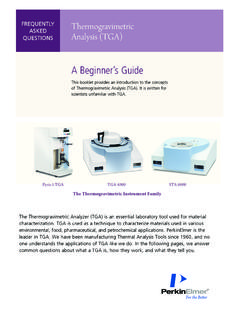
A Beginner’s Guide
www.perkinelmer.com5 Q What can we learn from this TGA Thermal Curve? A We must first list all pertinent information we know about the sample before we can analyze the data. In this case of calcium carbonate we know: • CaCO 3 is an irritant!; so be careful handling the sample, wear eye protection • It is hygroscopic (it absorbs or attracts moisture from the air). ...