STANDARDS FOR TESTING ADJUSTING AND BALANCING …
FOREWORD The purpose of the NEBB Procedural Standards for Testing Adjusting and Balancing of Environmental Systems is to establish a uniform and systematic set of criteria for the performance of the testing, adjusting and balancing of environmental or Heating, Ventilating and Air-conditioning (HVAC) systems. Today’s buildings provide highly controlled indoor environments.
Download STANDARDS FOR TESTING ADJUSTING AND BALANCING …

Information
Domain:
Source:
Link to this page:
Documents from same domain
Duct Leakage Testing - NEBB
www.nebb.orgDuct Leakage Measurements • % of Flow requirements – Problem: Disregards size of ductwork & static pressure – i.e. 1% of flow on 3900 cfm system = 39 cfm.
SECTION 15950 - TESTING, ADJUSTING, AND …
www.nebb.orgI SECTION 15950 - TESTING, ADJUSTING, AND BALANCING PART 1 - GENERAL 1.1 RELATED DOCUMENTS Drawings and general provisions of the Contract, including General and Supplementary Conditions

APPENDIX A-1 SAMPLE CLEANROOM …
www.nebb.orgiii . appendix a-1 sample cleanroom specifications. microelectronics & semiconductors. section xxxxx – cleanroom performance testing . part 1 -- general
PROCEDURAL STANDARDS FOR CERTIFIED …
www.nebb.orgPROCEDURAL STANDARDS FOR CERTIFIED TESTING OF CLEANROOMS 2009 – THIRD EDITION National Environmental Balancing Bureau 8575 Grovemont Circle ...
National Environmental Balancing Bureau 8575 …
www.nebb.orgPROCEDURAL STANDARDS FOR WHOLE BUILDING SYSTEMS COMMISSIONING OF NEW CONSTRUCTION 2009 – THIRD EDITION National Environmental Balancing Bureau 8575 Grovemont Circle
Airborne Particle Counters – APC/OPC - NEBB
www.nebb.orgAerodynamic Diameter . Optical : Diameter . Actual physical diameter . Based on ability of a particle with 1 charge to move in an electrical field
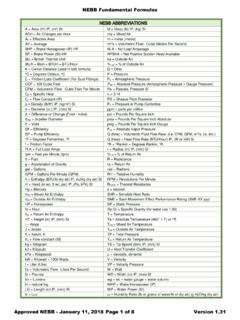
Approved NEBB - Page 1 of 8 Version 1.
www.nebb.orgSheave Equations RPM d _ l L l PD k m r m p PD d _ l pRPM k m r m p RPM d _ l RPM k m r m p L PD k m r m p PD d _ l Fan Belt Length L :2 ; E @1.57 H kPD j _ p e cPD q k _ j j o A E m PD j _ p e c PD q k _ j j o 6 4 ) q Electrical Equations Power : [ _ r r q ; E HI 1 kW L1000 Watts IE
PROCEDURAL STANDARDS FOR CERTIFIED …
www.nebb.orgIII FOREWORD The purpose of the NEBB Procedural Standards for Certified Testing of Cleanrooms is to establish a uniform and systematic set of criteria for the performance of cleanroom testing and certification.
DIVISION 15 SECTION 15999 MECHANICAL …
www.nebb.orgDIVISION 15 SECTION 15999 MECHANICAL COMMISSIONING PART I - GENERAL 1.01 DESCRIPTION A. ... DIVISION 15 SECTION 15999 MECHANICAL COMMISSIONING ... (SCA)), with support for start-up, testing, and commissioning responsibility of Division 16.
Top Ten Reasons Building HVAC Health Care Facilities …
www.nebb.orgTop Ten Reasons Building HVAC Systems Do Not Perform as Intended ... of a duct system, some areas at the end of the run may be short of airflow because the air has leaked from ... if a system has 10% leakage and the fan design was originally 20 Horsepower (HP), the new motor required ...
Related documents
Standard Test Methods for Deep Foundations Under …
www.centurionfondation.comStandard Test Methods for Deep Foundations Under Lateral Load1 This standard is issued under the fixed designation D3966; the number immediately following the designation indicates the year of original adoption or, in the case of revision, the year of last revision. A number in parentheses indicates the year of last reapproval. A
Duct Leakage Testing - NEBB
www.nebb.orgEU Standards SMACNA Standard Report Requirements Specified in Standards •Measurements •Duct surface area Tt Defers to project specifications. Suggests: • Measurements •Test pressure Dt f •Leakage rate •Pressurizing time •Calculated • Duct surface area • Test pressure • Leakage rate • Calculated •Leakage factor •Air ...
MIL-STD-883E, Test Method Standard for Microcircuits
scipp.ucsc.eduFor the purpose of this standard, the term "devices" includes such items as monolithic, multichip, film and hybrid microcircuits, microcircuit arrays, and the elements from which the circuits and arrays are formed. This standard is intended to apply only to microelectronic devices. The test
Standard Test Method for Tensile Properties of Plastics1
www.dept.aoe.vt.eduThis standard has been approved for use by agencies of the U.S. Department of Defense. 1. Scope* 1.1 This test method covers the determination of the tensile properties of unreinforced and reinforced plastics in the form of standard dumbbell-shaped test specimens when tested under defined conditions of pretreatment, temperature, humidity, and
Standard Test Procedures for Evaluating Leak Detection ...
19january2017snapshot.epa.govstandard test procedures or a national voluntary consensus code, or the manufacturer may have access to data that makes it easier to evaluate the system another way. Manufacturers who wish to have their equipment tested according to a different plan (or

Standard Test Methods for Determining Average Grain Size1
tubingchina.comStandard Test Methods for Determining Average Grain Size1 This standard is issued under the fixed designation E112; the number immediately following the designation indicates the year of original adoption or, in the case of revision, the year of last revision. A number in parentheses indicates the year of last reapproval. A
NOTES on the STANDARD PENETRATION TEST
web.mst.edu3) V.F.B. de Mello, 1971, The Standard Penetration Test: Proceedings of the 4th Panamerican Conference on Soil Mechanics and Foundation Engineering: San Juan, PR, v.1:1-86; and 4) Yves Lacroix and Harry Horn, 1973, Direct Determination and Indirect Evaluation of Relative Density and Its Use on Earthwork Construction Projects: in Evaluation of Relative
MIL-STD-750D, Test Methods for Semiconductor Devices
www.navsea.navy.milc. The test methods described herein for environmental, physical, and electrical testing of devices shall also apply, when applicable, to parts not covered by an approved military sheet-form standard, specification sheet, or drawing. 1.2 Numbering system. The test methods are designated by numbers assigned in accordance with the following system:
The CogAT Test Explanation for Parents
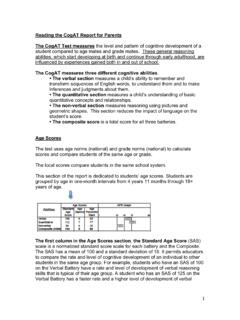
www.scusd.eduThe first column in the Age Scores section, the Standard Age Score (SAS) scale is a normalized standard score scale for each battery and the Composite. The SAS has a mean of 100 and a standard deviation of 16. It permits educators to compare the rate and level of cognitive development of an individual to other students in the same age group.

Making Sense of Your Child’s Test Scores
www.wrightslaw.comStandard scores are raw scores that have been converted so they have a Mean and Standard Deviation. Most test scoring systems have a Mean of 100 and a Standard Deviation of ±15. Scores between 85 and 115 capture the middle two-thirds of the children tested. If your child earns a standard score (SS) of 100, this score is zero deviations from the