
Steps for Implementation: Functional Behavior Assessment
Module: Functional Behavior Assessment Functional Behavior Assessment: Steps for Implementation Page 3 of 12 National Professional Development Center on ASD 10/2010 d. if the interfering behavior might occur because learners are being asked to demonstrate a skill that they cannot perform (e.g., language/ communication, social).
Download Steps for Implementation: Functional Behavior Assessment

Information
Domain:
Source:
Link to this page:
Documents from same domain
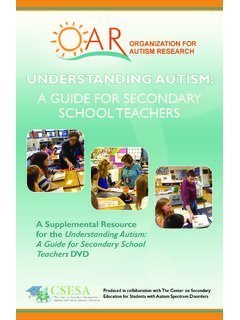
A GUIDE FOR SECONDARY SCHOOL TEACHERS - …
csesa.fpg.unc.eduA Supplemental Resource for the Understanding Autism: A Guide for Secondary School Teachers DVD ORGANIZATION FOR AUTISM RESEARCH UNDERSTANDING AUTISM: A GUIDE FOR SECONDARY

VISUAL SUPPORTS - csesa.fpg.unc.edu
csesa.fpg.unc.eduPicture Exchange Communication System ... •Organizational system - school . Examples of Visual Supports •Script

Overview of Picture Exchange Communication System (PECS)
csesa.fpg.unc.eduThe Picture Exchange Communication System (PECS) was developedat the Delaware Autistic Program (DAP) and was designed to teach young children to communicate in a social context Bondy
Tips for Guardianship and Alternatives - csesa.fpg.unc.edu
csesa.fpg.unc.eduBelow we provide an overview of obtaining guardianship and its alternatives. Refer to your local legal services for more information as it applies to you and your family. You can also learn more with the Special Needs Alliance, which is a national organization comprised of attorneys
Community and School Resource Mapping - csesa.fpg.unc.edu
csesa.fpg.unc.eduIntroduction to Community and School Resource Mapping: Module 1 6 ... component is a critical component of the full CSESA model. Student-centered planning for a youth’s future beyond high school that is built on input from the student, family, and various professionals familiar with the student is important to a young ... course, the student ...
Overview of Time Delay - CSESA
csesa.fpg.unc.eduTime delay is a practice that focuses on fading the use of prompts during instructional activities. This practice is always used in conjunction with prompting procedures such as least-to-most prompting, simultaneous prompting, and graduated guidance.
at-a-glance
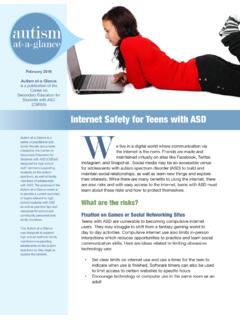
csesa.fpg.unc.edu• Teach the teen how to block “friends” on social networking sites like Facebook so they know how to get rid of a bully • Encourage the teen to seek out a responsible adult to help them handle the situation Teens with ASD can also engage in cyberbullying without understanding the consequences of their actions.
A GUIDE FOR SECONDARY SCHOOL TEACHERS
csesa.fpg.unc.eduThis guide reviews common characteristics associated with autism and provides teachers with practical tips and strategies for supporting their students with autism in the classroom setting. It is also designed to supplement the Understanding Autism: A Guide for Secondary School Teachers DVD, a training resource developed by
Steps for Implementation: Extinction - University of North ...
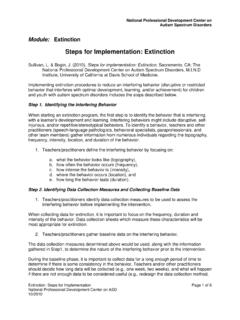
csesa.fpg.unc.eduStep 2. Identifying Data Collection Measures and Collecting Baseline Data 1. Teachers/practitioners identify data collection measures to be used to assess the interfering behavior before implementing the intervention. When collecting data for extinction, it is important to focus on the frequency, duration and intensity of the behavior.
Steps for Implementation: Positive Reinforcement
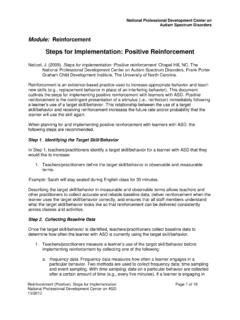
csesa.fpg.unc.eduDuration data are used to record how long a learner engages in a particular behavior. For example, a teacher might collect data on how long a learner with ASD stays in his seat or how long a young child stays engaged in parallel play. Table 3 provides an example duration data collection sheet. Blank data sheets are available in a separate document.
Related documents
(Section 619) Example Case Study: at 35 Months of Age
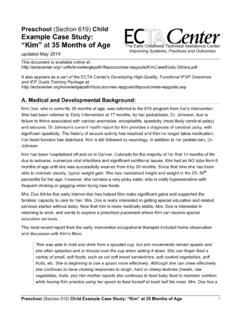
ectacenter.orgPreschool (Section 619) Child Example Case Study: “Kim” at 35 Months of Age 2 list of foods she is gradually introducing in small bites to increase Kim’s ability to accept the foods the family typically eats. Kim was able to assist with dressing (raise an arm, step into a pants leg when held).
Reviewed Summer 2021 - Kentucky
education.ky.gov• Functional Hearing, Listening and Communication Assessments • Functional Vision and Learning Media Assessments • assistive technology evaluations • reports from outside agencies • Individual Family Service Plan (IFSP) data (for students from birth to age 3 transitioning from Part C) • progress reports from First Steps providers

Assessments of Functional Skills: Occupational Therapy and ...
www.fldoe.orginput to assist the IEP, EP, or IFSP team when the educational need for occupational or physical therapy as a related service is being determined, and when an IEP, EP, or IFSP for a student who is receiving occupational or physical therapy as a related service is being reviewed by the IEP, EP, or IFSP team. (5) Plan of treatment.
Early Childhood Disabilities and Special Education
www.nasponline.orgfunctional skills that very young children need to participate in daily routines and family life, such as eating, sleeping, moving about, interacting, and playing. ... An Individualized Family Service Plan (IFSP) combines family priorities with child assessment results …
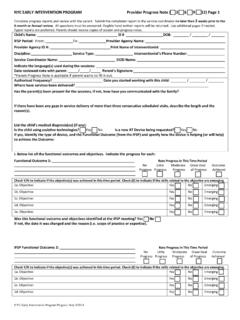
NYC EARLY INTERVENTION PROGRAM Provider Progress …
www1.nyc.govthe IFSP functional outcomes have already been met. Example: An additional objective was added to IFSP functional outcome to build upon Ida’s progress and achievement of the functional outcome: Objective 1c: Ida will pick up a Cheerio with tip of finger and thumb while her arm is on the table. iii.

Child’s Name: DOB: / / Sex: ˜ Male ˜ Female EI ...
www1.nyc.govnew functional outcomes or strategies. Any other information about the session the interventionist wants to record. 2. IFSP Functional Outcome(s) and Objective(s) addressed during this session: Document the IFSP functional outcome(s) and objective(s) that was worked on in this session with the child and parent/caregiver.