
SULFUR DIOXIDE 6004
b. (Back cassette) cellulose filter (Whatman 40 or equivalent) which has been saturated with fixative solution and dried 20 to 30 min at 100 °C, supported by a porous plastic support pad. 2. Personal sampling pump, 0.5 to 1.5 L/min, with flexible connecting tubing. 3. Vials, glass, 20-mL, screw-cap, such as scintillation vials.** 4.
Download SULFUR DIOXIDE 6004

Information
Domain:
Source:
Link to this page:
Documents from same domain
School Chemistry Laboratory Safety Guide
www.cdc.govSchool Chemistry Laboratory Safety Guide. October 2006. U.S. Consumer Safety Product Commission DEPARTMENT OF HEALTH AND HUMAN SERVICES. Centers for Disease Control and Prevention
Biosafety in Microbiological and Biomedical …
www.cdc.goviii. Foreword. Biosafety in Microbiological and Biomedical Laboratories (BMBL) quickly became the cornerstone of biosafety practice and policy in the United States upon first
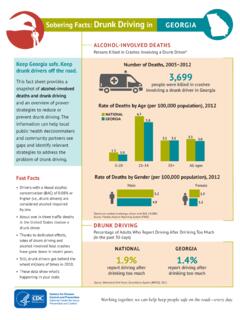
Sobering Facts: Drunk Driving in Georgia
www.cdc.govSobering Facts: Drunk Driving in GEORGIA Keep Georgia safe. Keep drunk drivers off the road. This fact sheet provides a snapshot of alcohol-involved deaths and drunk driving
ALCOHOLS III 1402
www.cdc.govALCOHOLS III: METHOD 1402, Issue 2, dated 15 August 1994 - Page 3 of 4 a. Remove and discard back sorbent section of a media blank sampler. b. Inject a known amount of analyte or DE stock solution directly onto front sorbent section
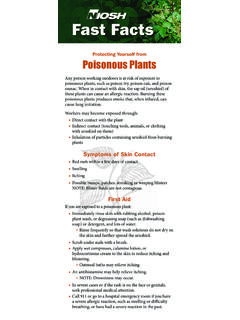
Fast Facts
www.cdc.govAny person working outdoors is at risk of exposure to poisonous plants, such as poison ivy, poison oak, and poison sumac. When in contact with skin, the sap oil (urushiol) of
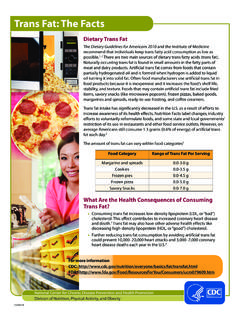
Trans Fat: The Facts
www.cdc.gov• Read the Nutrition Facts label and ingredient list to compare foods. » Choose products with 0 grams trans fat. » Check the Ingredient List to see if there is any partially hydrogenated oil in the product.

ANTIBIOTIC RESISTANCE THREATS
www.cdc.govApr 23, 2013 · 6. ANTIBIOTIC RESISTANCE THREATS IN THE UNITED STATES, 2013. Executive Summary. Antibiotic Resistance Threats in the United States, 2013. is a snapshot of the complex problem
Chlorine Residual Testing
www.cdc.govChlorine Residual Testing Fact Sheet, CDC SWS Project 4 Methods to Test Free Chlorine in the Field in Developing Countries There are three main methods to test free chlorine residual in drinking water in the field
2018 Combined Recommended Immunization …
www.cdc.govRecommended Immunization Schedule for Children and Adolescents Aged 18 Years or Younger, UNITED STATES, 2018 Approved by the Advisory Committee on …
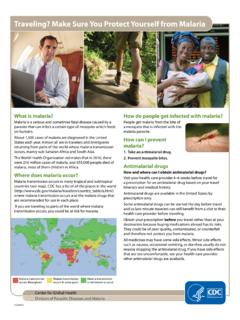
Traveling? Make Sure You Protect Yourself from …
www.cdc.govCS26201 Malaria transmission occurs throughout Malaria transmission occurs in some parts Malaria transmission is not known to occur Center for Global Health
Related documents
SAMPLE COLLECTION, HANDLING, AND PRESERVATION
ccal.oregonstate.eduWhatman GF/C filter papers showed that ammonia appeared to be adsorbed in the first 50 ml filtered through the GF/C filters while no adsorption was observed for the membrane filters (Riemann and Shierup 1978). In both cases, it is advisable to remove leachable materials from all filter papers (Eaton et al. 1969) by either soaking them in distilled

Forensic Detection of Semen I. The Acid Phosphatase Test
courseresources.mit.usf.eduWhatman #3 filter paper was moistened and a cotton-tipped swab containing 25 units of acid phosphatase was pressed to 5 areas of the paper (following the procedure described previously). The same procedure was followed with 17 units of acid phosphatase. SERI ap spot test reagent (fresh, 1 day, 2 days, 3 days, 4 days and 5 days old) was added
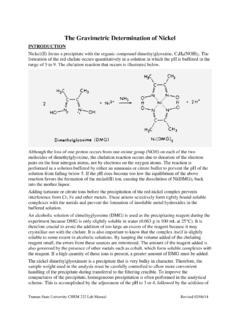
The Gravimetric Determination of Nickel
chemlab.truman.eduWhatman No. 40 filter paper; medium porosity Unknown Ni ore sample Nitric Acid (concentrated) Hydrochloric Acid (concentrated) 20% Tartaric Acid solution (prepared by student) 1:1 Ammonium Hydroxide solution (prepared by student) 1% alcoholic …

Características de las aguas residuales
cidta.usal.esTara del filtro Whatman (FV/C) = 1,5433 g Residuo en el filtro Whatman (FV/C) tras secado a 105 ºC = 1,5553 g Residuo en el filtro Whatman (FV/C) tras combustión a 550 ºC = 1,5531 g Solución: 1. Determinación de los sólidos totales: 2. Determinación de los sólidos volátiles: 3. Determinación de los sólidos en suspensión: 4.
STANDARD OPERATING PROCEDURE NO. 30 ICP-OES ANALYSIS
geoinfo.nmt.edu• Whatman ashless filters (grade 40) • Polypropylene funnels • Funnel holders • 50-mL graduated centrifuge tubes • 14-mL graduated centrifuge tubes • 60-place plastic centrifuge tube rack • National Institute of Standards and Technology (NIST) Standard Reference Material (SRM) 2780 (Appendix 2), Hard Rock Mine Waste

SDS-PAGE of protein - IIT Guwahati
iitg.ac.inand filter through whatman No1 filter and store in amber bottle at 4°c. (CARE: Acrylamide monomer is a neurotoxin. Take care in handling acrylamide (wear gloves)and avoid breathing). 2. Buffers: a) Separating gel buffer: 1.875M Tris-cl, pH 8.8 b) Stacking gel buffer : 0.6M Tris-Cl. pH 6.8 3. 10% w/v Ammonium persulfate. Make fresh. Store at 4°c.
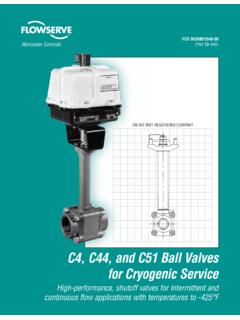
C4, C44, and C51 Ball Valves for Cryogenic Service
www.flowserve.comWipe Test – All wetted components are wipe tested using Whatman® #44 paper. Helium Leak Test – Valves are dry tested, internally pressurized with 80 psi helium and checked with a helium leak detector (Helium Mass Spectrometer sensitive to 1 x 10⁻⁵ cc/sec.). Vacuum Sealed – After all testing has been completed, cryogenic

SEPARATION OF AMINO ACIDS BY PAPER CHROMATOGRAPHY
www.penguinprof.comCAUTION: Wearing gloves, handle the paper (Whatman no. 1) only along the narrow edges. Use paper towels to protect the paper from the desk surface and from your hands. Remember that your skin contains amino acids and therefore you must avoid any contact with the part of the paper to be used in the analysis.