
TEACHING TECHNIQUES - Oneonta
will improve word order and pronunciation through closer and closer approximation of what they hear. 99. TEACHING TECHNIQUES 3. As students become more proficient, the instructor can add substitution drills, ... Present tense... “I have a cold.” Past tense..... “I cut my leg”. 101. TEACHING TECHNIQUES 1. How are you? 1. Ouch! you're ...
Download TEACHING TECHNIQUES - Oneonta

Information
Domain:
Source:
Link to this page:
Documents from same domain

THE SYNTHESIS OF POTASSIUM ALUMINUM …
employees.oneonta.eduTHE SYNTHESIS OF POTASSIUM ALUMINUM SULFATE (Alum) FROM ALUMINUM SCRAP The Chemical Recycling of Scrap Aluminum This experiment has the following objectives:
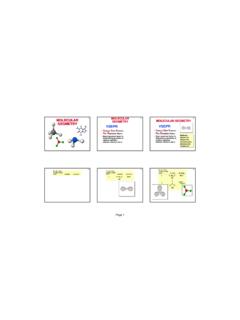
MOLECULAR 1 MOLECULAR GEOMETRY VSEPR …
employees.oneonta.eduPage 3 13 Structure Determination by VSEPR Structure Determination by VSEPR Formaldehyde, CH 2O 1. Draw electron dot structure …

COORDINATION COMPLEXES OF COBALT - Oneonta
employees.oneonta.eduCOORDINATION COMPLEXES OF COBALT Introduction In this lab, you will synthesize two cobalt coordination complexes, [Co(NH3)5(NO2)]Cl2 and [Co(NH3)5(ONO)]Cl2, and investigate linkage isomerism.

Psyc 345: Psychology of Adulthood and Aging Dr …
employees.oneonta.eduPsyc 345: Psychology of Adulthood and Aging Dr. vom Saal Disk file: D: \office zip \handouts \interview -on -relationships.doc , 03 /19 /01 8 :34 PM pa ge 1 of 2
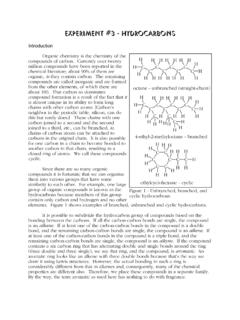
Experiment #3 - Hydrocarbons
employees.oneonta.eduExperiment #3 Hydrocarbons Page 4 C 3H 8 + 5 O 2 3 CO 2 + 4 H 2O H 3CCH CHCH 3 H 3CCH CHCH 3 Br Br + H 3CC CCH 3 + H 3CC CCH 3 Br Br Br Br 2 Br 2 Br 2 Natural gas is composed of alkanes; it is about 90% methane with small amounts

Chem 226 — Problem Set #2 — edition, John …
employees.oneonta.eduH2CCHCH2CH2CH2CH2CH3 CC H C CCC C H H H H H H H H H H H H H This is one possible isomer. This Lewis structure can be condensed in a number of ways as shown here. H2CCH(CH2)4CH3 Some other isomers --Note: The boxed structures are identical; they are the same molecule.
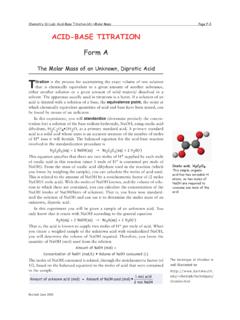
AB titration expt - Oneonta
employees.oneonta.eduACID-BASE TITRATION Form A The Molar Mass of an Unknown, Diprotic Acid Titration is the process for ascertaining the exact volume of one solution that is chemically equivalent to a given amount of another substance,

Chapter 4 Chemical Reactions and Solution Stoichiometry
employees.oneonta.eduChapter 4 Chemical Reactions and Solution Stoichiometry - 3 - Interactive Figure 4.1.2 Explore combination reactions. Zinc reacts with iodine to form zinc iodide.

Minitab@Oneonta.Manual
employees.oneonta.eduThe inclusion of Minitab Statistical Software input and output contained in this manual is done with permission of Minitab, Inc. Screen shots were taken from Minitab version 13.0. For additional documentation, FAQ’s, etc. go to Minitab’s web

Experiment #6 – Isolation of Caffeine from Tea Leaves
employees.oneonta.eduExperiment #6 Isolation of Caffeine from Tea Leaves Page 4 Hirsh funnel Micro filter flask Filter paper Fritted polyethylene disk 6. Allow the contents of the separatory funnel to settle.
Related documents
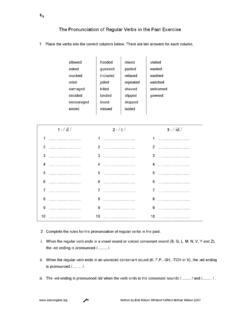
The Pronunciation of Regular Verbs in the Past Exercise
www.autoenglish.org2 Complete the rules for pronunciation of regular verbs in th e past. i. The ed ending for verbs whose infinitive ends in a vowel sound or voiced consonant (e.g. the letter M) is pronounced /d/. ii.
William Strunk, Jr. The Elements of Style - GitHub Pages
daoyuan14.github.io8. Divide words at line-ends, in accordance with their formation and pronunciation. 10 III ELEMENTARY PRINCIPLES OF COMPOSITION 13 9. Make the paragraph the unit of composition: one paragraph to each topic. 13 10. As a rule, begin each paragraph with a topic sentence; end it in conformity with the beginning. 15 11. Use the active voice. 18 12.
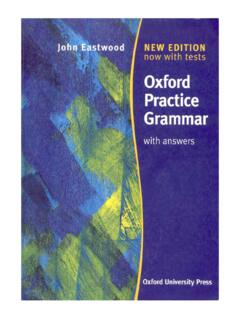
John Eastwood -- Oxford Practice Grammar with Answers
e-l.unifi.itThe infinitive and the ing-form 60 Verb + to-infinitive 144 61 Verb + ing-form 146 62 Verb + to-infinitive or verb + ing-form? 148 63 Like, start, etc 150 64 Remember, regret, try, etc 152 Test 12: Verb + to-infinitive or ing-form 154 65 Verb + object + to-infinitive or ing-form 156 66 Question word + to-infinitive 158 67 Adjective + to-infinitive 160
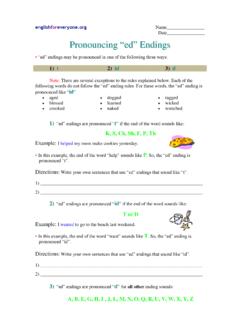
Prroon noouunnccii nn gg eedd”” EEnddiingss
englishforeveryone.orgDirections: Read the following passage using the correct pronunciation for “ed” endings. Write (T) for a “t” sound, (ID) for an “id” sound, and (D) for a “d” sound in the space provided. The bear jumped ( ) out of its cage and into the crowd. She must have realized ( ) that this was her best chance to escape.
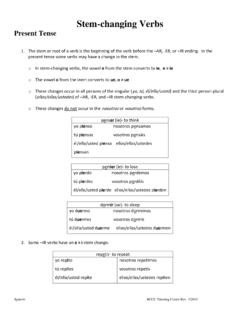
Stem-changing Verbs - Bucks
www.bucks.eduPresent Tense 1. The stem or root of a verb is the beginning of the verb before the –AR, -ER, or –IR ending. In the present tense some verbs may have a change in the stem. o In stem-changing verbs, the vowel e from the stem converts to ie, e > ie o …

About Middle English Grammar - California State University ...
www.csun.eduThe past tense is generally indicated, as in modern English, with an ending containing –t, -d, or – ed. Verbs of this type have similar past participle forms (see point 3 above). The past tense and past participle may also be indicated by a change in the root vowel of the word, as in Modern English sing, sang, sung. Middle English possessed ...

Lesson 14. Sociolinguistics - University of Pennsylvania
www.ling.upenn.eduKids don’t realize that there’s a past-tense -ed on semiweak verbs at all – they think the past tense of keep is just /kεp/ Much later in life – perhaps well past the critical period – speakers learn that semiweak verbs do have a -ed suffix. Speakers then apply t/d deletion at the same (low) rates as with the regular past-tense -ed.

PRONUNCIATION - University of Technology Sydney
www.uts.edu.auIntensive Pronunciation Program Overview Objectives: • to develop an awareness of the important features of pronunciation • to identify common problems for both individual and groups of students • to practise listening for pronunciation features and incorporating them into dialogues, role plays and presentations