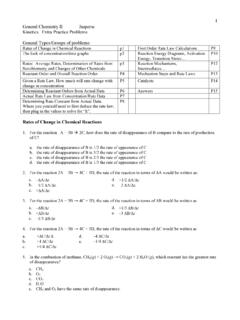
Test1 ch15 Kinetics Practice Problems
6 Determining Reactant Orders from Actual Data 23. Given the following data, determine the order of the reaction with respect to Cl 2. 2NO(g) + Cl2(g) → 2NOCl(g) Experiment [NO] (M) [Cl 2] (M) Rate (M/s) 1 0.0300 0.0100 3.4 × 10⁻⁴ 2 –0.0150 0.0100 8.5 × …
Download Test1 ch15 Kinetics Practice Problems

Information
Domain:
Source:
Link to this page:
Documents from same domain
Chapter 4: Energy from Combustion The primary …
web.mnstate.eduChapter 4: Energy from Combustion The primary means of generating energy for human endeavors is the combustion of fuels. Fuels: Coal -burned in power plants Gasoline -burned in automobiles
Mass Spectroscopy
web.mnstate.edu1 Mass Spectroscopy Mass Spectroscopy is a technique causing the formation of the gaseous ions with or without fragmentation; the gas phase ions are then

African Environmental Issues - Minnesota State …
web.mnstate.eduAfrican Environmental Issues . Environment in Africa: continuity & change. •Important to consider geological age of Africa & its tropical location. •Both affect
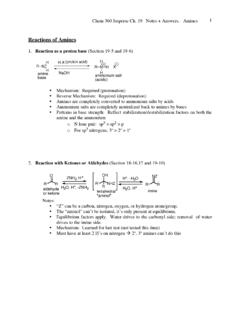
Reactions of Amines - Minnesota State University …
web.mnstate.eduChem 360 Jasperse Ch. 19 Notes + Answers. Amines 1 Reactions of Amines 1. Reaction as a proton base (Section 19-5 and 19-6) RN H H N H R H H X …

Test3 ch17b Buffer-Titration-Equilibrium Practice …
web.mnstate.edu4 Preparation and Recognition of Buffer Systems 14. Which of the following is not a buffer system? A solution containing roughly equal concentrations of _____ a.
Standardization of a Hydrochloric Acid Solution
web.mnstate.eduPage 1 Spring 2011 Standardization of a Hydrochloric Acid Solution The purpose of this experiment is to test your lab technique and examine potential sources of error in

Some Arrow-Pushing Guidelines (Section 1.14)
web.mnstate.eduOrganic Chemistry I Review: Highlights of Key Reactions, Mechanisms, and Principles 1 Some Arrow-Pushing Guidelines (Section 1.14) 1. Arrows follow electron movement.

Recrystallization I 9 Chem 355 Jasperse RECRYSTALLIZATION
web.mnstate.eduRecrystallization I 9 Chem 355 Jasperse RECRYSTALLIZATION Background: Impurities often contaminate organic compounds, whether they have been synthesized in

1. Given the relation R (1 1) (1 3) (1 4) (2 2) (3 1) (3 4 ...
web.mnstate.edu9. For each of the following collections of subsets of A= {1,2,3,4,5}, determine whether of not the collection is a partition. If it is, list the ordered pairs in the equivalence relation determined by the partition.
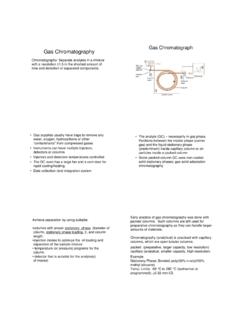
Gas Chromatograph Gas Chromatography
web.mnstate.eduColumn selection GC: Select a stationary phase that would retain (‘dissolve’) the analytes of interest. Stationary phase polarity ~ analyte polarity; (like dissolves like). Selectivity to individual analytes determines the quality of separation (ability to discern the
Related documents

ORDER OF REACTION - PharmaQuesT
pharmaquest.weebly.comMETHODS TO DETERMINE ORDER OF REACTION 1. SUBSTITUTION METHOD 2. INITIAL RATE METHOD 3. DATA PLOTTING METHOD 4. HALF-LIFE DETERMINATION METHOD SUBSTITUTION METHOD: The data accumulated in a kinetic study may be substituted in the integrated form of the equations which describes the various orders. When the equation is …

Experiment 1 The Iodine “Clock” Reaction
proffenyes.weebly.comm is the Reaction Order with respect to Reactant A, and n: is the Reaction Order with respect to Reactant B. The values of the reaction orders (“m” and “n”) determine the dependence of the reaction rate on concentration of the respective reactants. Reaction orders commonly have one of the following values: 0, 1, -1, or 0.5.
Chapter 17
websites.umich.eduorders of magnitude in [H3O +]. Part 2. Calculate the pH change upon adding 10.0 mL 0.10 M NaOH to 90 mL buffer containing 1.0 M NH3 and 1.0 M NH4Cl. The key reaction with the buffer will be: NH4 + + OH-Æ H 2O + NH3 The strong base will react with the ammonium cation in the buffer and completely convert it to ammonia. The number of moles of ...

EXPERIMENT 13: THE IODINE CLOCK REACTION
intro.chem.okstate.eduThis can be done to determine the order of the reaction between I– and S2O82–. From your plots (attach your graphs) determine the order of the reactions with respect to I– and S2O82–. Once the orders are determined use the rate law to determine the rate constant for each of experiments. Exp. # [I–] added [S2O82–] rate rate constant ...

Sample Exercise 14.1 Calculating an Average Rate of Reaction
www.austincc.eduThe overall reaction order is the sum of the exponents in the rate law. The units for the rate constant, k, are found by using the normal units for rate (M /s) and concentration (M) in the rate law and applying algebra to solve for . k. Solve: (a) The rate of the reaction in Equation 14.9 is first order in N. 2. O. 5. and first order overall ...

TIPS, TRICKS & BEST PRACTICES The Ultimate qPCR Assay ...
www.bio-rad.comreaction conditions. How to avoid Always validate a new qPCR assay to verify its efficiency under your specific conditions • Determine efficiency using a standard curve spanning 5 orders of magnitude (5- or 10-fold dilutions) and run in triplicate to determine the efficiency, linear dynamic range, and reproducibility of the assay

Chapter 8, Acid-base equilibria - bu.edu
www.bu.edureaction of the acid and base as a limiting reagent problem, but then equilibration of the products is ... this road map of acid-base equilibria when you approach such an equilibrium as a two step process: First (always!), determine which regime applies. Then, ... (orders of magnitude), and so it is convenient to measure [H3O