
Test2 ch17a Acid-Base Practice Problems
a. nitric acid, HNO 3 d. hydrochloric acid, HCl b. sulfuric acid, H 2SO 4 e. perchloric acid, HClO 4 c. carbonic acid, H 2CO 3 16. Which of the following compounds cannot be a Brønsted–Lowry base? a. OH– d. NH 4 + b. H 2O e. SH – c. NH 3 17. Each of the following pairs contains one strong acid and one weak acid EXCEPT: a. H 2SO 4 and H ...
Download Test2 ch17a Acid-Base Practice Problems

Information
Domain:
Source:
Link to this page:
Documents from same domain
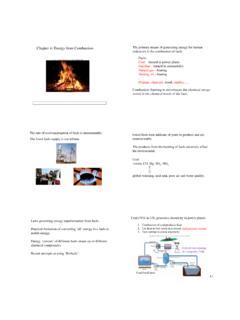
Chapter 4: Energy from Combustion The primary …
web.mnstate.eduChapter 4: Energy from Combustion The primary means of generating energy for human endeavors is the combustion of fuels. Fuels: Coal -burned in power plants Gasoline -burned in automobiles
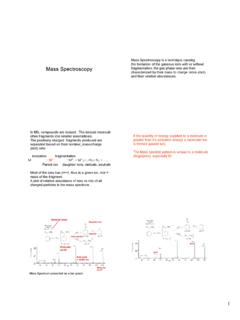
Mass Spectroscopy
web.mnstate.edu1 Mass Spectroscopy Mass Spectroscopy is a technique causing the formation of the gaseous ions with or without fragmentation; the gas phase ions are then

African Environmental Issues - Minnesota State …
web.mnstate.eduAfrican Environmental Issues . Environment in Africa: continuity & change. •Important to consider geological age of Africa & its tropical location. •Both affect
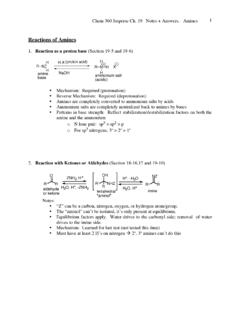
Reactions of Amines - Minnesota State University …
web.mnstate.eduChem 360 Jasperse Ch. 19 Notes + Answers. Amines 1 Reactions of Amines 1. Reaction as a proton base (Section 19-5 and 19-6) RN H H N H R H H X …

Test3 ch17b Buffer-Titration-Equilibrium Practice …
web.mnstate.edu4 Preparation and Recognition of Buffer Systems 14. Which of the following is not a buffer system? A solution containing roughly equal concentrations of _____ a.
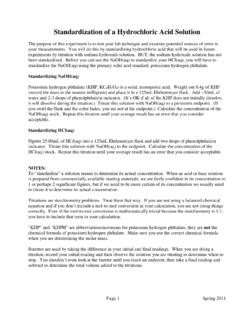
Standardization of a Hydrochloric Acid Solution
web.mnstate.eduPage 1 Spring 2011 Standardization of a Hydrochloric Acid Solution The purpose of this experiment is to test your lab technique and examine potential sources of error in

Some Arrow-Pushing Guidelines (Section 1.14)
web.mnstate.eduOrganic Chemistry I Review: Highlights of Key Reactions, Mechanisms, and Principles 1 Some Arrow-Pushing Guidelines (Section 1.14) 1. Arrows follow electron movement.

Recrystallization I 9 Chem 355 Jasperse RECRYSTALLIZATION
web.mnstate.eduRecrystallization I 9 Chem 355 Jasperse RECRYSTALLIZATION Background: Impurities often contaminate organic compounds, whether they have been synthesized in

1. Given the relation R (1 1) (1 3) (1 4) (2 2) (3 1) (3 4 ...
web.mnstate.edu9. For each of the following collections of subsets of A= {1,2,3,4,5}, determine whether of not the collection is a partition. If it is, list the ordered pairs in the equivalence relation determined by the partition.
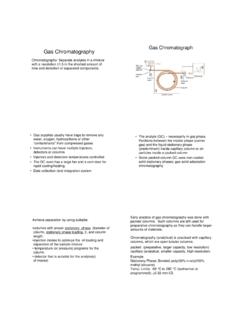
Gas Chromatograph Gas Chromatography
web.mnstate.eduColumn selection GC: Select a stationary phase that would retain (‘dissolve’) the analytes of interest. Stationary phase polarity ~ analyte polarity; (like dissolves like). Selectivity to individual analytes determines the quality of separation (ability to discern the
Related documents
Acid-Base Titration Curves Using a pH Meter
web.gccaz.edu1. Obtain about 15 mL of hydrochloric acid and 50 mL of NaOH in separate beakers. 2. Calculate the volume of base needed for your titration and show your professor the answer. Note: you should assume that 10.00 mL of acid is present for the titration since that is the amount you pipet into the titration beaker. 3.

CHM 130 Stoichiometry Worksheet - Welcome to …
web.gccaz.edu2. Consider the reaction of zinc metal with hydrochloric acid, HCl(aq). A. Write the equation for this reaction, then balance the equation. B. Calculate the moles of HCl needed to react completely with 8.25 moles of zinc. C. Calculate the grams of zinc chloride produced if 0.238 grams of zinc react completely.
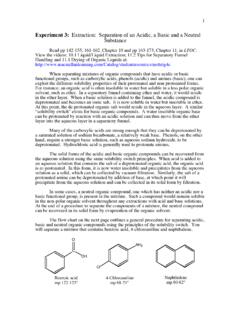
Experiment 3: Extraction: Separation of an Acidic, a Basic ...
www.bc.edudeprotonated. Hydrochloric acid is generally used to protonate amines. The solid forms of the acidic and basic organic compounds can be recovered from the aqueous solution using the same solubility switch principles. When acid is added to an aqueous solution that contains the salt of a deprotonated organic acid, the organic acid is re-protonated.

EXPERIMENT 1 ACID BASE TITRATION - UM
kimia.um.edu.mymoles hydrochloric acid. Hence, the concentration of the hydrochloric acid solution is v 1000 × 1000 2×25c = v 25 2× c mol dm-3 (or M) 3.1.3 Standardization of sodium hydroxide solution (i) Pipette 10 mL of hydrochloric acid that has been standardized into a 250 mL conical flask.

6 Determination of Hypochlorite in Bleach W10
www.kbcc.cuny.edubleach solution (4-6% hypochlorite), 10% potassium iodide solution (KI), 2 M hydrochloric acid solution (HCl), ~0.26 M sodium thiosulfate solution (Na2S2O3), starch solution. Discussion An aqueous solution of sodium hypochlorite (NaOCl) is a clear, slightly yellow liquid, and is commonly known as bleach.
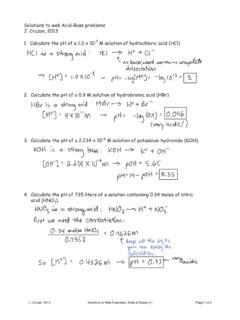
1. Calculate the pH of a 1.0 x 10⁻³ M solution of ...
www.xaktly.com8. Calculate the pH and pOH of a solution that was made by adding 400 ml of water to 350 ml of a 5.0 x 10⁻³ M NaOH solution. 5. Calculate the pH of a 2.0 liter solution containing 0.005 g of HCl. 6. Calculate the pH and pOH of a solution with a volume of 5.4 liters that contains 15 g of hydrochloric acid (HCl) and 25 g of nitric acid (HNO 3). 7.

EXPERIMENT: CALORIMETRY AND HEAT OF NEUTRALIZATION ...
faculty.cbu.caacid and a base. The heat of reaction or neutralization, q neut, is the negative of the heat gained by the calorimeter which includes the 100.0 g of water. - q neutralization = q cal The heat of neutralization is the heat evolved (released) when 1 mole of water is produced by the reaction of an acid and base. The heat gained by the calorimeter, q

Determination of iron by thiocyanate colorimetry
www.canterbury.ac.nz1 mol L−1 hydrochloric acid and stir for 5 minutes, making sure that all the ash is soaked. 4. Add 5 mL of distilled water and then filter the solution into a 100 mL conical flask to remove the ash. This filtered solution will be used for colorimetric analysis. Colorimetric analysis 1. Accurately measure 10 mL of your sample solution