
Test3 ch17b Buffer-Titration-Equilibrium Practice Problems
1. A solution that contains a weak acid and its conjugate base in roughly equal concentrations is _____ a. neither acidic or basic. d. a heterogeneous mixture. b. a half-acid solution. e. neutral. c. a buffer. 2. Explain how a buffer solution manages to stabilize the pH against the addition of acid, base, or additional solvent (dilution).
Download Test3 ch17b Buffer-Titration-Equilibrium Practice Problems

Information
Domain:
Source:
Link to this page:
Documents from same domain
Chapter 4: Energy from Combustion The primary …
web.mnstate.eduChapter 4: Energy from Combustion The primary means of generating energy for human endeavors is the combustion of fuels. Fuels: Coal -burned in power plants Gasoline -burned in automobiles
Mass Spectroscopy
web.mnstate.edu1 Mass Spectroscopy Mass Spectroscopy is a technique causing the formation of the gaseous ions with or without fragmentation; the gas phase ions are then

African Environmental Issues - Minnesota State …
web.mnstate.eduAfrican Environmental Issues . Environment in Africa: continuity & change. •Important to consider geological age of Africa & its tropical location. •Both affect
Reactions of Amines - Minnesota State University …
web.mnstate.eduChem 360 Jasperse Ch. 19 Notes + Answers. Amines 1 Reactions of Amines 1. Reaction as a proton base (Section 19-5 and 19-6) RN H H N H R H H X …
Standardization of a Hydrochloric Acid Solution
web.mnstate.eduPage 1 Spring 2011 Standardization of a Hydrochloric Acid Solution The purpose of this experiment is to test your lab technique and examine potential sources of error in

Some Arrow-Pushing Guidelines (Section 1.14)
web.mnstate.eduOrganic Chemistry I Review: Highlights of Key Reactions, Mechanisms, and Principles 1 Some Arrow-Pushing Guidelines (Section 1.14) 1. Arrows follow electron movement.

Recrystallization I 9 Chem 355 Jasperse RECRYSTALLIZATION
web.mnstate.eduRecrystallization I 9 Chem 355 Jasperse RECRYSTALLIZATION Background: Impurities often contaminate organic compounds, whether they have been synthesized in

1. Given the relation R (1 1) (1 3) (1 4) (2 2) (3 1) (3 4 ...
web.mnstate.edu9. For each of the following collections of subsets of A= {1,2,3,4,5}, determine whether of not the collection is a partition. If it is, list the ordered pairs in the equivalence relation determined by the partition.
Gas Chromatograph Gas Chromatography
web.mnstate.eduColumn selection GC: Select a stationary phase that would retain (‘dissolve’) the analytes of interest. Stationary phase polarity ~ analyte polarity; (like dissolves like). Selectivity to individual analytes determines the quality of separation (ability to discern the

Acute Stress Response Spectrum Adaptationist Perspectives ...
web.mnstate.edurecent literature, freeze, flight, fight, fright, faint provides a more complete description of the human acute stress response sequence than current descriptions.
Related documents
EXPERIMENT – 1 Estimation of Hardness of Water by EDTA …
www.bspublications.netDisodium salt of ehtylenediamine tetraacetic acid: (Na2H2Y) where Y = deprotonated agent. In aqueous solution EDTA ionises to give 2Na+ ions and act as a strong chelating agent. The indicator used is a complex organic compound (sodium – 1 – (1-hydroxy 2-naphthylazo)-6-nitro-2-naphthol-4-sutphonate), commonly known as Eriochrome black T(EBT).
The Determination of Acid Content in Vinegar
www.kbcc.cuny.eduSometimes equation 1 is used because of its simplicity. To determine the amount of acetic acid in vinegar (typically 4-5% by mass) we will use an acid-base titration (neutralization reaction). In this experiment we titrate acetic acid with sodium hydroxide (a strong base). The reaction of acetic acid with sodium hydroxide is shown below ...
Potentiometry: The pH Electrode and Potentiometric …
www.edaq.compotentiometric titrations, investigate the acid-base properties of the bicarbonate buffer system, and determine the pKa values of L-histidine. 1. Aims 1.1 Investigate the Nernstian response of a pH electrode by comparing a standard two point calibration of a pH electrode with a wide pH range multipoint calibration of the same electrode.

Titrations worksheet W 336 - Everett Community College
www.everettcc.eduTitrations worksheet W 336 Everett Community College Tutoring Center Student Support Services Program 1) It takes 83 mL of a 0.45 M NaOH solution to neutralize 235 mL of an HCl solution. What is the concentration of the HCl solution? 2) You are titrating an acid into a base to determine the concentration of the base. The
Common Apparatus and Procedures - Chem Lab
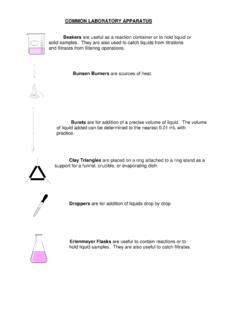
chemlab.truman.eduamount of acid equals the amount of base. The experimenter is aware of this condition by the change in pH that occurs. The change in pH is indicated by a color change of an indicator or by a pH meter. In other types of reactions, the completion of the reaction is usually also indicated by a color change. Titrations are often accomplished using ...

Ch. 11: EDTA Titrations
chem320.cs.uwindsor.caanalogous to plotting pH versus volume of titrant in an acid-base titration. There are three natural regions of the titration curve. Three regions in an EDTA titration illustrated for reaction of 50.0 mL of 0.0500 M Mn+ with 0.0500 M EDTA, assuming K fʹ = 1.15 × 10¹⁶. The concentration of free Mn+ decreases as the titration proceeds.

ACID BASE TITRATION OBJECTIVES INTRODUCTION
www.augusta.eduACID BASE TITRATION OBJECTIVES 1. To demonstrate the basic laboratory technique of titration 2. To learn to calculate molarity based on titrations INTRODUCTION Molarity (M) or molar concentration is a common unit for expressing the concentration of solutions.
Experiment 7 - Acid-Base Titrations
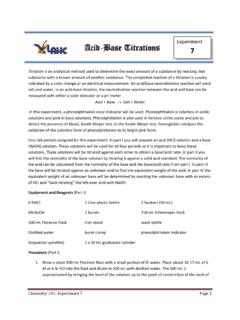
www.lahc.eduAcid-Base Titrations 7. Chemistry 101: Experiment 7 Page 2 the flask. Stopper the flask and shake to mix. The solution should be approximately 0.2 N HCl. Label the flask with tape. 2. Rinse a clean 1 L plastic bottle with distilled water. Place about 32-34 mL of 6 M or 6 N NaOH