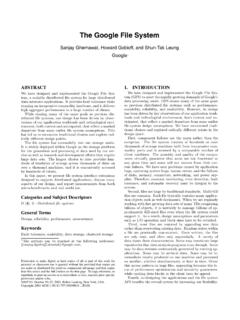
The Google File System
Moreover, GFS has snapshot and record append opera-tions. Snapshot creates a copy of a file or a directory tree at low cost. Record append allows multiple clients to ap-pend data to the same file concurrently while guaranteeing the atomicity of each individual client’s append. It is use-ful for implementing multi-way merge results and producer-
Download The Google File System

Information
Domain:
Source:
Link to this page:
Documents from same domain
A TUTORIAL ON POINTERS AND ARRAYS IN C
pdos.csail.mit.eduA TUTORIAL ON POINTERS AND ARRAYS IN C ... If you want to be proficient in the writing of code in the C programming language, ... of this tutorial is to provide an ...

Understanding the Linux Virtual Memory Manager
pdos.csail.mit.eduLibrary of Congress Cataloging-in-Publication Data Gorman, Mel. Understanding the Linux Virtual Memory Manager / Mel Gorman. p. cm.—(Bruce Perens’ Open source series)

PC Assembly Lanugage - Distributed operating system
pdos.csail.mit.eduOther PC assembly language books still teach how to program the 8086 processor that the original PC used in 1980! The 8086 processor only supported real mode. In this mode, any program may address any memory or device in the computer. This mode is not suitable for a secure, multitasking operating system. This book instead

PC Assembly Lanugage - Distributed operating system
pdos.csail.mit.eduOther PC assembly language books still teach how to program the 8086 processor that the original PC used in 1980! This book instead discusses how to program the 80386 and later processors in protected mode (the mode that Windows runs in). There are several reasons to do this: 1. It is easier to program in protected mode than in the 8086 real mode
xv6 - DRAFT as of September 4, 2018
pdos.csail.mit.eduContents 0 Operating system interfaces 7 1 Operating system organization 17 2 Page tables 29 3 Traps, interrupts, and drivers 39 4 Locking 51 5 Scheduling 61 6 File system 75 7 Summary 93 A PC hardware 95 B The boot loader 99 Index 105 DRAFT as of September 4, 2018 3 https://pdos.csail.mit.edu/6.828/xv6
Russ Cox Frans Kaashoek Robert Morris August 31, 2020
pdos.csail.mit.eduxv6 kernel provides a subset of the services and system calls that Unix kernels traditionally offer. Figure 1.2 lists all of xv6’s system calls. The rest of this chapter outlines xv6’s services—processes, memory, file descriptors, pipes, and a file system—and illustrates them with code snippets and discussions of how the shell, Unix’s
A TUTORIAL ON POINTERS AND ARRAYS IN C
pdos.csail.mit.eduOne is the value of the integer stored there (2 in the above example) and the other the "value" of the memory location, i.e., the address of k. Some texts refer to these two values with the nomenclature rvalue (right value, pronounced "are value") and lvalue (left value, pronounced "el value") respectively.
Russ Cox Frans Kaashoek Robert Morris September 6, 2021
pdos.csail.mit.eduderstanding xv6 is a good start toward understanding any of these systems and many others. As Figure 1.1 shows, xv6 takes the traditional form of a kernel, a special program that provides services to running programs.
In Search of an Understandable Consensus Algorithm ...
pdos.csail.mit.eduMay 20, 2014 · the algorithm to facilitate the development of intuitions that areessential forsystembuilders.It was importantnot justforthealgorithmtowork,butforittobeobviouswhy it works. The result of this work is a consensus algorithm called Raft. In designing Raft we applied specific techniques to improveunderstandability,includingdecomposition(Raft
MapReduce: Simplified Data Processing on Large Clusters
pdos.csail.mit.eduhardware. (5) Users submit jobs to a scheduling system. Each job consists of a set of tasks, and is mapped by the scheduler to a set of available machines within a cluster. 3.1 Execution Overview The Map invocations are distributed across multiple machines by automatically partitioning the input data
Related documents
Merge/Append using Stata - Princeton University
www.princeton.eduappend using mydata8 mydata7 mydata8 • Make sure one dataset is loaded into Stata (in this case mydata7), then use append. • Make sure to map where the using data is located (in this case mydata2, for example “c: \folders\data\mydata8.dta”)*. *To set the working directory see here

Getting Started in Data Analysis using Stata
dss.princeton.edulog using mylog.log, append . To replace a log file add the option replace, type: log using mylog.log, replace . Note that the option replace will delete the contents of the previous version of the log. First steps: memory allocation . Stata 12+ will automatically allocate the necessary memory to open a file. It is recommended to

Using outreg2 to report regression output, descriptive ...
www.princeton.eduUsing outreg2 to report regression output, descriptive statistics, frequencies and basic crosstabulations (v1.6 draft) Oscar Torres-Reyna otorres@princeton.edu
Using R: Frequency Distributions, Histograms, Scatterplots ...
cosmosweb.champlain.eduHere we have R create a frequency table and then append a relative and cumulative table to it. Everything in red is typed by the user.Everything in blue is output to the console. { The classes are de ned by creating a list of class boundaries.

5.7 Appendix: Using R for Sampling Distributions
pages.stat.wisc.edu5.7.1 Simulations using a Discrete Distribution Let us first consider a simulation example that illustrates Var(X¯) = σ2/n. Consider a discrete random variable with probability function given by the following. x p(x) 1 0.6 3 0.3 5 0.1 By using the methods from Sections 3.6 and 3.7, we find that E(X) = 2.0 and Var(X) = 1.8.

7.6.2 Appendix: Using R to Find Confidence Intervals
pages.stat.wisc.edu7.6.2 Appendix: Using R to Find Confidence Intervals by EV Nordheim, MK Clayton & BS Yandell, October 30, 2003 The tinterval command of R is a useful one for finding confidence intervals for the mean when the data are normally distributed with unknown variance. We illustrate the use of this command for the lizard tail length data.

Booth Multiplier Implementation of Booth’s Algorithm using ...
www.vlsiip.comevaluate MxR using the algorithm explained above. Given that R = 10011, we append Z to R to make the new R as 10011Z, where Z = 0, so new R = 1 0 0 1 1 0, now, clearly C4 = 10, S4 = -1 C3 = 00, S3 = 0 C2 = 01, S2 = +1 C1 = 11, S1 = 0 C0 = 10, S0 = -1 pp0 = M*S0 pp1 = M*S1 pp2 = M*S2 pp3 = M*S3 pp4 = M*S4 now to obtain the final product, we ...

A QUICK STATA GUIDE: APPEND, MERGE, AND COLLAPSE 2. …
jearl.faculty.arizona.eduappend using dataset.dta The append command combines the dataset in memory, known as the master dataset, with a dataset on disk, known as the using dataset. Typically, a user would implement the append command when they would like to add observations to an existing dataset with the same or

Title stata.com append — Append datasets
www.stata.comWe will append the even data to the end of the odd data. Because the odd data are already in memory (we just used them above), we type append using even. The result is. append using even. list number odd even 1. 1 1 . 2. 2 3 . 3. 3 5 . 4. 4 7 . 5. 5 9 . 6. 6 . 12 7. 7 . 14 8. 8 . 16