
The SURVEYSELECT Procedure
The random number seed is 39647. PROC SURVEYSELECTuses this number as the initial seed for random number generation. Since the SEED= option is not specified in the PROC SURVEYSELECT statement, the seed value is obtained using the time of day from the computer’s clock. You can specify SEED=39647 to reproduce this sample. Customer Satisfaction ...
Download The SURVEYSELECT Procedure

Information
Domain:
Source:
Link to this page:
Documents from same domain

Chapter 18 The BOXPLOT Procedure
www.math.wpi.eduEXAMPLES ... The following statements create a SAS data ... 400 Chapter 18. The BOXPLOT Procedure Table 18.1. (continued) Option Description
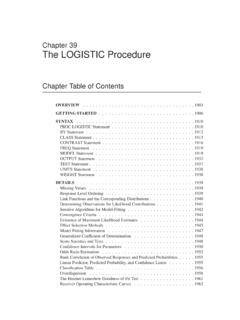
The LOGISTIC Procedure - Worcester Polytechnic …
www.math.wpi.eduEXAMPLES .....1974 Example 39.1 Stepwise Logistic ... The SAS System The LOGISTIC Procedure Model Information Data Set …
The FREQ Procedure - Worcester Polytechnic Institute
www.math.wpi.eduChapter 28 The FREQ Procedure Overview The FREQ procedure produces one-way to n-way frequency and crosstabulation (contingency) tables. For two-way tables, PROC FREQ computes tests and measures
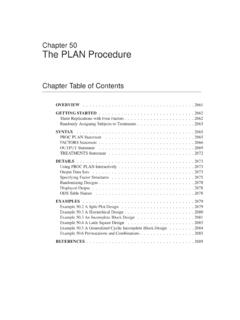
The PLAN Procedure - Worcester Polytechnic Institute
www.math.wpi.eduChapter 50 The PLAN Procedure Overview The PLAN procedure constructs designs and randomizes plans for factorial exper-iments, especially nested and crossed experiments and randomized block designs.

Chapter 14 Introduction to Structural Equations with ...
www.math.wpi.eduIntroduction to Structural Equations with Latent Variables with values that are determined outside the system, that is, in a manner separate from the process described by the system of equations, are called exogenous variables.

Introduction to Categorical Data Analysis Procedures
www.math.wpi.eduChapter 5 Introduction to Categorical Data Analysis Procedures Overview Several procedures in SAS/STAT software can be used for the analysis of categorical
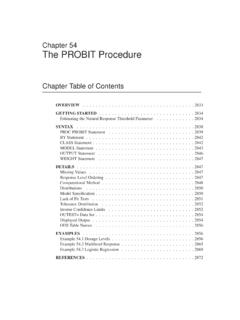
The PROBIT Procedure - Worcester Polytechnic Institute
www.math.wpi.eduThe PROBIT procedure fits a common slopes cumulative model, which is a parallel lines regression model based on the cumulative probabilities of the response categories rather than on …

CHAPTER 21
www.math.wpi.edu804 About Plotswith TwoVertical Axes 4 Chapter 21 axis with the name of its variable or an associated label and displays the value of each major tick mark. Figure 21.3 BubblePlot(GR21N01) The program for this plot is in Example 1 on page 834.

Chapter 11 Nonlinear Optimization Examples
www.math.wpi.edusubroutines can also be obtained by using the NLP procedure in the SAS/OR product. The advantages of the IML procedure are as follows: You can use matrix algebra to specify the objective function, nonlinear con-straints, and their derivatives in IML modules. The IML procedure offers several subroutines that can be used to specify the
The PHREG Procedure - Worcester Polytechnic Institute
www.math.wpi.eduCox proportional hazards model. Cox’s semiparametric model is widely used in the analysis of survival data to explain the effect of explanatory variables on survival times. The survival time of each member of a population is assumed to follow its own hazard function, h i (t), expressed as h i
Related documents
A.1 SAS EXAMPLES
users.stat.ufl.eduPROC FREQ forms the table with the TABLES statement, ordering row and column categories alphanumerically. To use instead the order in which the categories appear in the data set (e.g., to treat the variable properly in an ordinal anal-ysis), use the ORDER = DATA option in the PROC statement. The WEIGHT state-

The FREQ Procedure - SAS
support.sas.comPROC FREQ uses the Output Delivery System (ODS), a SAS subsystem that provides capabilities for displaying and controlling the output from SAS procedures. ODS enables you to convert any of the output from PROC FREQ into a SAS data set. See the section “ODS Table Names” on page 2773 for more

Basics of Proc Tabulate - SAS: Analytics, Artificial ...
www.sas.comproc means data=sashelp.class; var age height; run; proc means data=sashelp.class; class sex; var age height; run; “I want summary stats on students’ ages and heights, overall and by gender.”

SUGI 27: PROC FORMAT in Action - SAS Support
support.sas.comthe “code” in the application – the PROC FREQ in our simple example – from the “data” – that is, the input data set and translation data which de-references the coded values of sex. For example, we can easily modify our initial definition of SEX. to include a translation

Identifying Duplicate Values
www.lexjansen.comPROC FREQ may produce voluminous output, however, depending on the number of IDs. Output the frequency counts to a SAS data set, and run PROC FREQ on the Frequency variable to summarize duplicates: proc freq data=test noprint; tables id/out=freqs; run; The NOPRINT option on the PROC FREQ statement suppresses printed output.

線形モデルにおける - SAS
www.sas.comorder=data|formated|freq|internal •data:データセットに出力した順 •formatted:format順(デフォルト) •freq:数が多い順 •internal:フォーマットされていない値順 descending •降順にする 基準値の設定 param=effect ref=‘label’|first|last