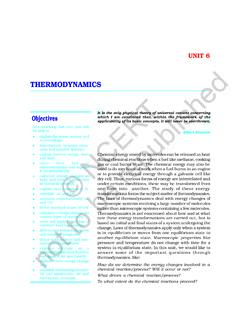
THERMODYNAMICS
2. Closed System In a closed system, there is no exchange of matter, but exchange of energy is possible between system and the surroundings [Fig. 6.2 (b)]. The presence of reactants in a closed vessel made of conducting material e.g., copper or steel is an example of a closed system. Fig. 6.2 Open, closed and isolated systems.
Download THERMODYNAMICS

Information
Domain:
Source:
Link to this page:
Documents from same domain
ntse exam notification - National Council Of …
ncert.nic.inExamination: The tentative pattern of written examination will be as follows: Stage-I & Il : examination at the State/UT level will comprise of three papers i.e.
14 Effects Electric Current and Its - National …
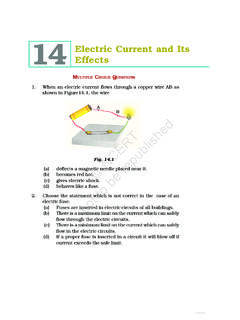
ncert.nic.in76 EXEMPLAR PROBLEMS 3. Three bulbs A, B, C are connected in a circuit as shown in Figure 14.2. When the switch is ‘ON’ (a) bulb C will glow first. (b) bulb B and C will glow simulaneously and bulb A will

SEMICONDUCTOR AND SIMPLE CIRCUITSnot to be …
ncert.nic.in469 Semiconductor Electronics: Materials, Devices and Simple Circuits semiconductors. However , after 1990, a few semiconductor devices using organic semiconductors and semiconducting polymers have been
ENVIRONMENTAL CHEMISTRY - National Council …
ncert.nic.in400 CHEMISTRY (c) Hydrocarbons: Hydrocarbons are composed of hydrogen and carbon only and are formed by incomplete combustion of fuel …
LAWS OF MOTION
ncert.nic.inLAWS OF MOTION 91 In practice, the ball does come to a stop after moving a finite distance on the horizontal plane, because of the opposing force of friction which
DESIGN OF THE QUESTION PAPER Mathematics …
ncert.nic.inDESIGN OF THE QUESTION PAPER, SET-I 207 (A) 18 5 (B) 17 5 (C) 17 8 (D) 1 7. In the adjoining figure, PA and PB are tangents from a point P to a circle with centre O.
CHAPTER 10
ncert.nic.in(A) Main Concepts and Results Circle, radius, diameter , chord, segment, cyclic quadrilateral. • Equal chords of a circle (or of congruent circles) subtend equal angles at the
INDIA : CLIMATE, VEGETATION AND WILDLIFE
ncert.nic.inINDIA : CLIMATE, VEGETATION AND WILDLIFE 59 year. Therefore, they always appear gr een and are called evergreen forest as you may notice in Figure
Objectives Polymers - National Council of …
ncert.nic.in427 Polymers C:\Chemistry-12\Unit-15.pmd 28.02.07 Polymers can also be classified on the basis of mode of polymerisation into two sub groups.
TEXTBOOK IN GEOGRAPHY FOR CLASS IX
ncert.nic.inFOREWORD The National Curriculum Framework, (NCF) 2005, recommends that children’s life at school must be linked to their life outside the school. This principle
Related documents
FLUID MECHANICS TUTORIAL 9 COMPRESSIBLE FLOW
www.freestudy.co.ukYou should already be familiar with the theory of work laws in closed systems. You should know that the area under a pressure-volume diagram for a reversible expansion or compression gives the work done during the process. In thermodynamics there are two forms of energy transfer, work (W) and heat (Q). By
HEAT AND MASS TRANSFER - UPM
webserver.dmt.upm.es• A temperature increase in a closed system is not necessarily due to a heat input; it can be due to a work input (e.g. ∆E=mc∆T=W for Q=0 in (1)), either with dissipation (e.g. internal stirring), or without (isentropic compression). • The First Law (1) shows that, for a steady state without work exchange,the heat loss by a system
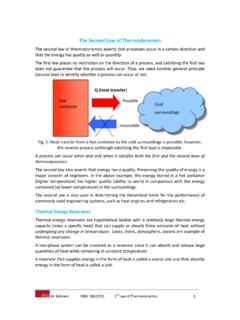
Second Law of Thermodynamics - Simon Fraser University
www.sfu.caThe second law of thermodynamics asserts that processes occur in a certain direction and that the ... commonly used engineering systems, such as heat engines and refrigerators etc. ... (closed system).
UNIT 61: ENGINEERING THERMODYNAMICS
www.freestudy.co.uk2. THE FIRST LAW OF THERMODYNAMICS When you have completed section two, you should be able to explain and use the following terms. The First Law of Thermodynamics. Closed systems. The Non-Flow Energy Equation. Open systems. The Steady Flow Energy Equation. 2.1 THERMODYNAMIC SYSTEMS
3 CHEMICAL THERMODYNAMICS
www.geo.utexas.eduThermodynamics is the study of energy in systems, and the distribution of energy among components. In chemical systems, it is the study of chemical potential, reaction potential, reaction direction, and reaction extent 3.2.1 First Law of Thermodynamics: dU=dq + dw where U is the internal energy, q is the heat transferred to a system from the
Thermodynamics Fundamentals for Energy Conversion …
esc.fsu.eduThis law is the basis of temperature measurement. First Law of Thermodynamics: The change in internal energy of a closed system is equals to the heat added to the system (or absorbed from the environment) minus the work done by the system (or on the environment). This law is a consequence of conservation of energy.
Chapter 4 The First Law of Thermodynamics
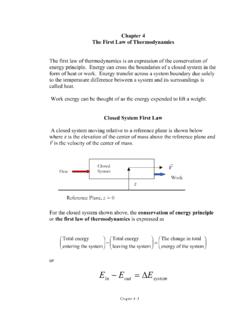
resources.saylor.orgThe First Law of Thermodynamics The first law of thermodynamics is an expression of the conservation of energy principle. Energy can cross the boundaries of a closed system in the form of heat or work. Energy transfer across a system boundary due solely to the temperature difference between a system and its surroundings is called heat.
THERMODYNAMICS, HEAT TRANSFER, AND FLUID FLOW …
sites.ntc.doe.gov1.25 STATE the Second Law of Thermodynamics. 1.26 Using the Second Law of Thermodynamics, DETERMINE the maximum possible efficiency of a system. 1.27 Given a thermodynamic system, CONDUCT an analysis using the Second Law of Thermodynamics. 1.28 Given a thermodynamic system, DESCRIBE the method used to determine: a. The …
Thermodynamics: First Law, Calorimetry, Enthalpy Calorimetry
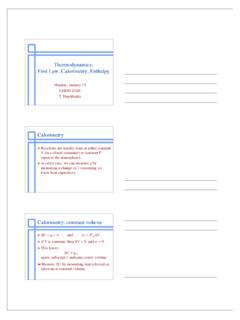
www.chem.tamu.eduThermodynamics: First Law, Calorimetry, Enthalpy Monday, January 23 CHEM 102H T. Hughbanks Calorimetry Reactions are usually done at either constant V (in a closed container) or constant P (open to the atmosphere). In either case, we can measure q by measuring a change in T (assuming we know heat capacities). Calorimetry: constant volume
THERMODYNAMICS
www.ncert.nic.in12.3 Zeroth law of Thermodynamics 12.4 Heat, internal energy and work 12.5 First law of thermodynamics 12.6 Specific heat capacity 12.7 Thermodynamic state variables and equation of state 12.8 Thermodynamic processes 12. 9 Heat engines 12.10 Refrigerators and heat pumps 12.11 Second law of thermodynamics 12.12 Reversible and irreversible ...