THERMODYNAMICS
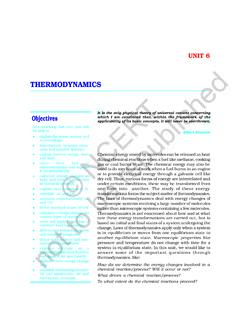
Thermodynamics is not concerned about how and at what rate these energy transformations are carried out, but is based on initial and final states of a system undergoing the change. Laws of thermodynamics apply only when a system is in equilibrium or moves from one equilibrium state to another equilibrium state. Macroscopic properties like
Download THERMODYNAMICS

Information
Domain:
Source:
Link to this page:
Documents from same domain
ntse exam notification - National Council Of …
ncert.nic.inExamination: The tentative pattern of written examination will be as follows: Stage-I & Il : examination at the State/UT level will comprise of three papers i.e.
14 Effects Electric Current and Its - National …
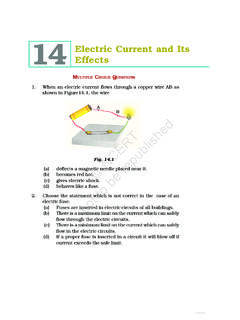
ncert.nic.in76 EXEMPLAR PROBLEMS 3. Three bulbs A, B, C are connected in a circuit as shown in Figure 14.2. When the switch is ‘ON’ (a) bulb C will glow first. (b) bulb B and C will glow simulaneously and bulb A will

SEMICONDUCTOR AND SIMPLE CIRCUITSnot to be …
ncert.nic.in469 Semiconductor Electronics: Materials, Devices and Simple Circuits semiconductors. However , after 1990, a few semiconductor devices using organic semiconductors and semiconducting polymers have been
ENVIRONMENTAL CHEMISTRY - National Council …
ncert.nic.in400 CHEMISTRY (c) Hydrocarbons: Hydrocarbons are composed of hydrogen and carbon only and are formed by incomplete combustion of fuel …
LAWS OF MOTION
ncert.nic.inLAWS OF MOTION 91 In practice, the ball does come to a stop after moving a finite distance on the horizontal plane, because of the opposing force of friction which
DESIGN OF THE QUESTION PAPER Mathematics …
ncert.nic.inDESIGN OF THE QUESTION PAPER, SET-I 207 (A) 18 5 (B) 17 5 (C) 17 8 (D) 1 7. In the adjoining figure, PA and PB are tangents from a point P to a circle with centre O.
CHAPTER 10
ncert.nic.in(A) Main Concepts and Results Circle, radius, diameter , chord, segment, cyclic quadrilateral. • Equal chords of a circle (or of congruent circles) subtend equal angles at the
INDIA : CLIMATE, VEGETATION AND WILDLIFE
ncert.nic.inINDIA : CLIMATE, VEGETATION AND WILDLIFE 59 year. Therefore, they always appear gr een and are called evergreen forest as you may notice in Figure
Objectives Polymers - National Council of …
ncert.nic.in427 Polymers C:\Chemistry-12\Unit-15.pmd 28.02.07 Polymers can also be classified on the basis of mode of polymerisation into two sub groups.
TEXTBOOK IN GEOGRAPHY FOR CLASS IX
ncert.nic.inFOREWORD The National Curriculum Framework, (NCF) 2005, recommends that children’s life at school must be linked to their life outside the school. This principle
Related documents
Chapter 20: Entropy and the Second Law of Thermodynamics
astro1.panet.utoledo.eduThe Second Law of Thermodynamics For the free expansion, we have ΔS > 0. It is an irreversible process in a closed system. For the reversible isothermal process, for the gas ΔS > 0 for expansion and ΔS < 0 for compression. However, the gas itself is not a closed system. It is only a closed system if we include both the gas and the reservoir.
Thermodynamics - NJCTL
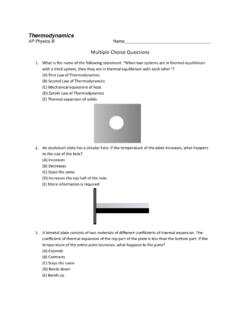
content.njctl.orgMay 07, 2012 · (A) First Law of Thermodynamics (B) Second Law of Thermodynamics (C) Mechanical equivalent of heat (D) Zeroth Law of Thermodynamics (E) Thermal expansion of solids 2. An aluminum plate has a circular hole. If the temperature of the plate increases, what happens to the size of the hole? (A) Increases (B) Decreases (C) Stays the same
Thermodynamics Volume 1 - Steam Tables Online
www.steamtablesonline.comThe Thermodynamics, Heat Transfer, and Fluid Flow Fundamentals Handbook was developed to assist nuclear facility operating contractors provide operators, maintenance personnel, and the technical staff with the necessary fundamentals training to ensure a basic understanding of the thermal sciences. The handbook includes information on thermodynamics
Statistical Physics - DAMTP
www.damtp.cam.ac.uk4. Classical Thermodynamics 108 4.1 Temperature and the Zeroth Law 109 4.2 The First Law 111 4.3 The Second Law 113 4.3.1 The Carnot Cycle 115 4.3.2 Thermodynamic Temperature Scale and the Ideal Gas 117 4.3.3 Entropy 120 4.3.4 Adiabatic Surfaces 123 4.3.5 A History of Thermodynamics 126 4.4 Thermodynamic Potentials: Free Energies and Enthalpy 128
Second Law of Thermodynamics - Simon Fraser University
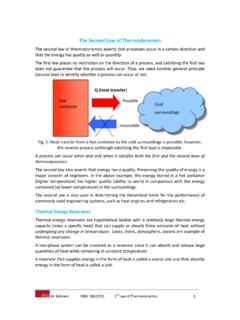
www.sfu.cathe reveres process (although satisfying the first law) is impossible. A process can occur when and only when it satisfies both the first and the second laws of thermodynamics. The second law also asserts that energy has a quality. Preserving the …
Chapter 4 The First Law of Thermodynamics
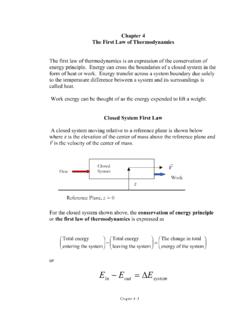
resources.saylor.orgThe First Law of Thermodynamics The first law of thermodynamics is an expression of the conservation of energy principle. Energy can cross the boundaries of a closed system in the form of heat or work. Energy transfer across a system boundary due solely to the temperature difference between a system and its surroundings is called heat.
THERMODYNAMICS
www.ncert.nic.in12.11 Second law of thermodynamics 12.12 Reversible and irreversible processes 12.1 3 Carnot engine Summary Points to ponder Exercises 304 PHYSICS Thermodynamics is the branch of physics that deals with the concepts of heat and temperature and the inter -conversion of heat and other for ms
Spontaneous Processes and Spontaneity, Entropy, Free Energy
ww2.odu.eduEntropy and the Second Law of Thermodynamics • The second law of thermodynamics addresses questions about spontaneity in terms of a quantity called entropy. • Entropy, S, is a thermodynamic quantity that is a measure of the randomness or disorder or the “available arrangements” for the system or surroundings.
ENTROPY AND THE SECOND LAW OF THERMODYNAMICS
www.smallscalechemistry.colostate.eduSecond Law of Thermodynamics and can be stated as follows: For combined system and surroundings, en-tropy never decreases. Actually, it always increases. This is really what makes things happen. The fi rst law of thermodynamics, that energy is conserved, just ells us what can happen; it is the second law that makes things go.

CHAPTER 7 THE FIRST AND SECOND LAWS OF …
astrowww.phys.uvic.ca1 CHAPTER 7 THE FIRST AND SECOND LAWS OF THERMODYNAMICS 7.1 The First Law of Thermodynamics, and Internal Energy The First Law of thermodynamics is: The increase of the internal energy of a system is equal to the sum of the heat added to the system plus the work done on the system. In symbols: dU = dQ + dW.7.1.1 You may regard this, according to taste, …