THERMODYNAMICS: COURSE INTRODUCTION
THERMODYNAMICS CONCEPTS I. Thermodynamics (VW, S & B: Chapter 1) A. Describes processes that involve changes in temperature, transformation of energy, relationships between heat and work. B. It is a science, and more importantly an engineering tool, that is necessary for describing the performance of propulsion systems,
Download THERMODYNAMICS: COURSE INTRODUCTION

Information
Domain:
Source:
Link to this page:
Documents from same domain

Wireless Communications and Networks
web.mit.edu4 MIT Physical layer •The physical layer plays a very important role in wireless network because it has severe limitation on transmissions Uplink with respect to downlink
The Aleph - MIT
web.mit.eduThe Aleph by Jorge Luis Borges O God! ... He read me many other stanzas, each of which also won his own approval and elicited his lengthy explications.
Finite Element Method
web.mit.eduRobert Cook, Finite Element Modeling For Stress Analysis, John Wiley & Sons, 1995 Introduction to Finite Element Method, http://210.17.155.47 (in Korean)
Finite Element Analysis
web.mit.eduFinite Element Analysis David Roylance Department of Materials Science and Engineering Massachusetts Institute of Technology Cambridge, MA 02139 February 28, …

TECHNICAL & SERVICE MANUAL - MIT
web.mit.eduwhen wiring electrical shock can cause severe personal injury or death. only a qualified, experienced electrician should attempt to wire this system.
Chapter 21 Rigid Body Dynamics: Rotation and …
web.mit.eduChapter 21 Rigid Body Dynamics: Rotation and ... patience to the establishment of the laws of rotation of the solid ... general treatment of mechanics, ...
5.33 Lecture Notes: Introduction To Polymer …
web.mit.edu5.33 Lecture Notes: Introduction To Polymer Chemistry Polymer: A large molecule (macromolecule) built up by repetitive bonding (covalent) of smaller molecules (monomers) • Generally not a well defined structure, or molecular weight.
UNDERSTANDING, FINDING, & ELIMINATING …
web.mit.edua Senior Member of the Institute of Electrical and Electronic Engineers. CEDIA EST016 UNDERSTANDING, ... GROUNDING, AC POWER, AND SAFETY ...
PRESENTED AT THE 2004 AMERICAN CONTROL …
web.mit.eduPRESENTED AT THE 2004 AMERICAN CONTROL CONFERENCE 1 Internal and External Op-Amp Compensation: A Control-Centric Tutorial ... circuit operational …
Frank and Lillian Gilbreth and the Manufacture and ...
web.mit.eduFrank and Lillian Gilbreth and the Manufacture ... time study, despite its ... publicizing micro-motion study as an advance over time study and as an
Related documents
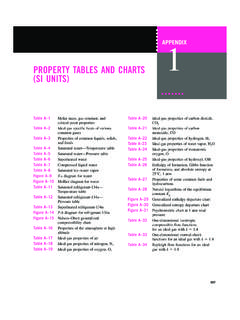
PROPERTY TABLES AND CHARTS (SI UNITS)
homepages.wmich.eduSource:Kenneth Wark, Thermodynamics,4th ed. (New York: McGraw-Hill, 1983), p. 783, Table A–4M. Originally published in Tables of Thermal Properties of Gases,NBS Circular 564, 1955. 910 PROPERTY TABLES AND CHARTS cen2932x_ch18-ap01_p907-956.qxd 12/18/09 10:05 AM Page 910
Chapter 20: Entropy and the Second Law of Thermodynamics
astro1.panet.utoledo.eduThermodynamics That direction is set by a quantity called entropy Only one of these scenarios happens, so something must be controlling the direction of energy flow. Consider putting some ice into a glass of water. Conservation of energy would allow: • ice getting colder and water getting hotter. • ice getting warmer and water getting cooler.
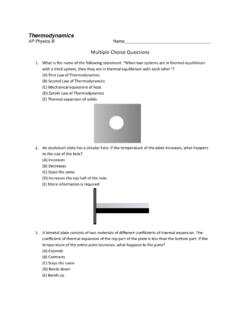
Thermodynamics - NJCTL
content.njctl.orgMay 07, 2012 · Thermodynamics AP Physics B Name_____ Multiple Choice Questions 1. What is the name of the following statement: “When two systems are in thermal equilibrium with a third system, then they are in thermal equilibrium with each other”? (A) First Law of Thermodynamics (B) Second Law of Thermodynamics
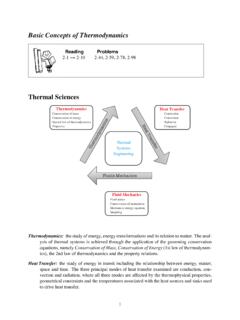
Basic Concepts of Thermodynamics - University of Waterloo
www.mhtl.uwaterloo.caThermodynamics: the study of energy, energy transformations and its relation to matter. The anal-ysis of thermal systems is achieved through the application of the governing conservation equations, namely Conservation of Mass, Conservation of Energy (1st law of thermodynam-ics), the 2nd law of thermodynamics and the property relations.
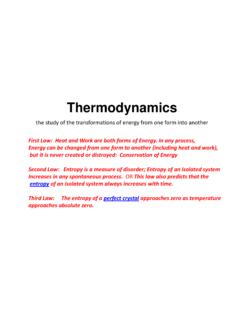
Thermodynamics - Texas A&M University
www.chem.tamu.eduThermodynamics the study of the transformations of energy from one form into another First Law: Heat and Work are both forms of Energy. in any process, Energy can be changed from one form to another (including heat and work), but it is never …

Chapter 2 Thermodynamics of Combustion
www.nrc.govThermodynamics of Combustion 2.1 Properties of Mixtures The thermal properties of a pure substance are described by quantities including internal energy, u, enthalpy, h, specific heat, c p, etc. Combustion systems consist of many different gases, so the thermodynamic properties of a mixture result from a