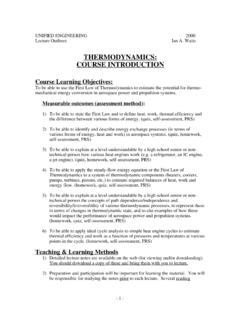
THERMODYNAMICS: COURSE INTRODUCTION
COURSE INTRODUCTION Course Learning Objectives: To be able to use the First Law of Thermodynamics to estimate the potential for thermo-mechanical energy conversion in aerospace power and propulsion systems. Measurable outcomes (assessment method) : 1) To be able to state the First Law and to define heat, work, thermal efficiency and
Download THERMODYNAMICS: COURSE INTRODUCTION

Information
Domain:
Source:
Link to this page:
Documents from same domain

Wireless Communications and Networks
web.mit.edu4 MIT Physical layer •The physical layer plays a very important role in wireless network because it has severe limitation on transmissions Uplink with respect to downlink

The Aleph - MIT
web.mit.eduThe Aleph by Jorge Luis Borges O God! ... He read me many other stanzas, each of which also won his own approval and elicited his lengthy explications.
Finite Element Method
web.mit.eduRobert Cook, Finite Element Modeling For Stress Analysis, John Wiley & Sons, 1995 Introduction to Finite Element Method, http://210.17.155.47 (in Korean)
Finite Element Analysis
web.mit.eduFinite Element Analysis David Roylance Department of Materials Science and Engineering Massachusetts Institute of Technology Cambridge, MA 02139 February 28, …

TECHNICAL & SERVICE MANUAL - MIT
web.mit.eduwhen wiring electrical shock can cause severe personal injury or death. only a qualified, experienced electrician should attempt to wire this system.
Chapter 21 Rigid Body Dynamics: Rotation and …
web.mit.eduChapter 21 Rigid Body Dynamics: Rotation and ... patience to the establishment of the laws of rotation of the solid ... general treatment of mechanics, ...
5.33 Lecture Notes: Introduction To Polymer …
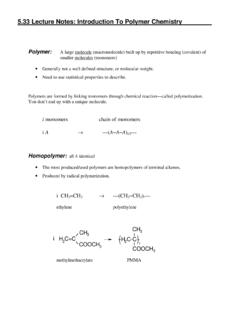
web.mit.edu5.33 Lecture Notes: Introduction To Polymer Chemistry Polymer: A large molecule (macromolecule) built up by repetitive bonding (covalent) of smaller molecules (monomers) • Generally not a well defined structure, or molecular weight.
UNDERSTANDING, FINDING, & ELIMINATING …
web.mit.edua Senior Member of the Institute of Electrical and Electronic Engineers. CEDIA EST016 UNDERSTANDING, ... GROUNDING, AC POWER, AND SAFETY ...
PRESENTED AT THE 2004 AMERICAN CONTROL …
web.mit.eduPRESENTED AT THE 2004 AMERICAN CONTROL CONFERENCE 1 Internal and External Op-Amp Compensation: A Control-Centric Tutorial ... circuit operational …

Frank and Lillian Gilbreth and the Manufacture and ...
web.mit.eduFrank and Lillian Gilbreth and the Manufacture ... time study, despite its ... publicizing micro-motion study as an advance over time study and as an
Related documents
7. Transonic Aerodynamics of Airfoils and Wings
www.dept.aoe.vt.edu7.1 Introduction Transonic flow occurs when there is mixed sub- and supersonic local flow in the same flowfield (typically with freestream Mach numbers from M = 0.6 or 0.7 to 1.2). Usually the supersonic region of the flow is terminated by a shock wave, allowing the flow to slow down to subsonic speeds.

Introduction to Airplane Design - Virginia Tech
www.dept.aoe.vt.eduAerospace and Ocean Engineering Example: the F-22 • Initially 750 airplanes • Then 331, goal 380 • Now 295 - nope 183! – Claim to be finding ways to reduce cost in manufacturing, –But: » R&D for 750 a/c spread over 295 almost triples per/plane burden » Gov’t stretches programs, then minimizes current year spending at

Mechanical Engineering Courses Syllabi
me.columbia.eduMECE E4305: Mechanics and Thermodynamics of Propulsion MECE4306: Introduction to Aerodynamics MECE E4312: Solar Thermal Engineering MECE E4314: Energy Dynamics of Green Buildings MECH E4320: Introduction to Combustion MECE E4330: Thermofluid Systems Design MECE 4431: Space Vehicle Dynamics MECE-E4520: Data Science for Mechanical …

Microelectronics Reliability: Physics-of-Failure Based ...
nepp.nasa.govJet Propulsion Laboratory 4800 Oak Grove Drive Pasadena, CA 91109 ... The military, aerospace, medical, and especially the telecommunications industries cannot afford to depend on custom parts for their most sophisticated circuit designs. Hence, we have developed this guideline document as an approach for system designers and ... 1 Introduction ...
NASA Electric Vertical Takeoff and Landing (eVTOL ...
ntrs.nasa.govAug 20, 2021 · propulsion units relying on complex internal combustion machines (turbines, piston engines, for example), and complex mechanical arrangements (gearboxes, shafts, variable pitch propeller). By contrast, electric VTOL aircraft (eVTOL)1 rely on simpler propulsion units (electric motors and in some cases fixed-pitch propellers).
Verification and Validation in Computational Fluid Dynamics1
www.southampton.ac.uk1Accepted for publication in the review journal Progress in Aerospace Sciences. 3. ... Introduction 1.1 Background During the last three or four decades, computer simulations of physical processes have been ... aircraft, automobiles, propulsion systems, and consumer products, where the need to decrease the