THERMODYNAMICS: COURSE INTRODUCTION
COURSE INTRODUCTION Course Learning Objectives: To be able to use the First Law of Thermodynamics to estimate the potential for thermo-mechanical energy conversion in aerospace power and propulsion systems. Measurable outcomes (assessment method) : 1) To be able to state the First Law and to define heat, work, thermal efficiency and
Download THERMODYNAMICS: COURSE INTRODUCTION

Information
Domain:
Source:
Link to this page:
Documents from same domain

Wireless Communications and Networks
web.mit.edu4 MIT Physical layer •The physical layer plays a very important role in wireless network because it has severe limitation on transmissions Uplink with respect to downlink

The Aleph - MIT
web.mit.eduThe Aleph by Jorge Luis Borges O God! ... He read me many other stanzas, each of which also won his own approval and elicited his lengthy explications.
Finite Element Method
web.mit.eduRobert Cook, Finite Element Modeling For Stress Analysis, John Wiley & Sons, 1995 Introduction to Finite Element Method, http://210.17.155.47 (in Korean)
Finite Element Analysis
web.mit.eduFinite Element Analysis David Roylance Department of Materials Science and Engineering Massachusetts Institute of Technology Cambridge, MA 02139 February 28, …

TECHNICAL & SERVICE MANUAL - MIT
web.mit.eduwhen wiring electrical shock can cause severe personal injury or death. only a qualified, experienced electrician should attempt to wire this system.
Chapter 21 Rigid Body Dynamics: Rotation and …
web.mit.eduChapter 21 Rigid Body Dynamics: Rotation and ... patience to the establishment of the laws of rotation of the solid ... general treatment of mechanics, ...
5.33 Lecture Notes: Introduction To Polymer …
web.mit.edu5.33 Lecture Notes: Introduction To Polymer Chemistry Polymer: A large molecule (macromolecule) built up by repetitive bonding (covalent) of smaller molecules (monomers) • Generally not a well defined structure, or molecular weight.
UNDERSTANDING, FINDING, & ELIMINATING …
web.mit.edua Senior Member of the Institute of Electrical and Electronic Engineers. CEDIA EST016 UNDERSTANDING, ... GROUNDING, AC POWER, AND SAFETY ...
PRESENTED AT THE 2004 AMERICAN CONTROL …
web.mit.eduPRESENTED AT THE 2004 AMERICAN CONTROL CONFERENCE 1 Internal and External Op-Amp Compensation: A Control-Centric Tutorial ... circuit operational …

Frank and Lillian Gilbreth and the Manufacture and ...
web.mit.eduFrank and Lillian Gilbreth and the Manufacture ... time study, despite its ... publicizing micro-motion study as an advance over time study and as an
Related documents

EXPERIMENT: CALORIMETRY AND HEAT OF …
faculty.cbu.caINTRODUCTION Heat is defined as the transfer of energy from or into a system because of a temperature difference between the system and its surroundings. Heat is often considered, inaccurately, as a form of energy existing as the result of the random motion of molecules.

PREVENTION OF HEAT AND COLD CASUALTIES
adminpubs.tradoc.army.milyear. Although the definition of “heat season” as 1 May through 30 September each year is generally appropriate at most US Army installations, exertional heat illnesses (EHI) are a year-round problem, with varying severity depending on the installation; approximately 17% of all EHI occur outside of the heat season (see appendix I). e.

Heat Exchanger Fundamentals
d6s74no67skb0.cloudfront.netIntroduction. A heat exchanger is a component that allows the transfer of heat from one fluid (liquid or gas) to another fluid. Reasons for heat transfer include the following: 1. To heat a cooler fluid by means of a hotter fluid 2. To reduce the temperature of a hot …
INTRODUCTION: HVAC BASICS
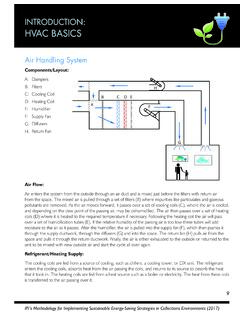
s3.cad.rit.eduINTRODUCTION: Air Handling System Components/Layout: Dampers Filters Cooling Coil Heating Coil Humidifier Supply Fan Diffusers Return Fan Air Flow: Air enters the system from the outside through an air duct and is mixed just before the filters with return air ... the coil will heat air for a specific space just before it is discharged from the ...

Introduction to Heat Pipes - NASA
tfaws.nasa.govIntroduction – Why Heat Pipes? • Heat pipe is a capillary two-phase heat transfer device. – Transports heat from a heat source to a heat sink – Works as an isothermalizer • Why two-phase thermal system? – Efficient heat transferEfficient heat transfer – boiling and condensationboiling and condensation – Small temperature difference between the heat source and

PHYS 1401 General Physics I EXPERIMENT 12 SPECIFIC HEAT I ...
www.austincc.eduSPECIFIC HEAT I. INTRODUCTION The objective of this experiment is to measure the specific heat of several different substances. This will be done by mixing two different substances and measuring their initial temperatures and then measuring their final temperature as they come to thermal equilibrium. II. BASIC CONCEPTS 1.
INTRODUCTION TO WELDING
www.globalsecurity.orgINTRODUCTION TO WELDING In the Navy as well as private industry, welding is ... heat, characteristic of arc welding, is an advantage be-cause …

Introduction to Pinch Technology-LinhoffMarch
www.ou.edugiven process heat and material balance. Figure 2(a) shows an example process flow-sheet involving a two stage reactor and a distillation column. The process already has heat recovery, represented by the two process to process heat exchangers. The hot utility demand