Thermodynamics - NJCTL
May 07, 2012 · (A) First Law of Thermodynamics (B) Second Law of Thermodynamics (C) Mechanical equivalent of heat (D) Zeroth Law of Thermodynamics (E) Thermal expansion of solids 2. An aluminum plate has a circular hole. If the temperature of the plate increases, what happens to the size of the hole? (A) Increases (B) Decreases (C) Stays the same
Download Thermodynamics - NJCTL

Information
Domain:
Source:
Link to this page:
Documents from same domain
Genes DNA Replication - Center For Teaching & Learning
content.njctl.orgwww.njctl.org Biology Genes Genes DNA Replication Classwork 1. Explain why it is necessary to be able to replicate DNA in order to sustain life. 2. What is the appropriate scientific term used to describe ‘a series of bases ... www.njctl.org Biology Genes .
Multiple Choice Review- Photosynthesis and Cellular ...
content.njctl.orgMultiple Choice Review- Photosynthesis and Cellular Respiration 1. Oxidation is a. The addition of electrons to a molecule b. The addition of protons to a molecule c. The loss of electrons from a molecule d. The loss of protons from a molecule 2. What molecules are necessary for aerobic cellular respiration? a. Glucose and Oxygen b.

Atomic Structure and Electron Configurations Multiple ...
content.njctl.orgAtomic Structure and Electron Configurations Multiple Choice PSI Chemistry Name:_____ 1. Rutherford’s Nuclear Model of the atom A. is the currently accepted atomic model. B. explains the unique emission spectra of different elements. C. does not account for the stability of most atoms since accelerating electrons

Periodic Trends Multiple Choice Review PSI Chemistry Name
content.njctl.orgJul 13, 2012 · Electronegativity 23)The ability of an atom in a molecule to attract electrons is best quantified by the _____. A) paramagnetism B) diamagnetism C) electronegativity D) first ionization potential E) electron change-to-mass ratio 24)Electronegativity _____ from left to right within a period and _____ from top to bottom within a group.

PSI AP Physics 2 Electric Potential and Capacitors ...
content.njctl.orgA Dielectric can do which of the following in capacitors? Select two answers. A. Decrease capacitance B. The electric field between plates is reduced. C. Increase capacitance ... How long a capacitor is connected to a power source . Answers 1. C 2. D 3. D 4. A 5. B 6. C 7. C 8. A 9. A 10. A 11. B 12. D 13. B 14. A 15. B 16. D 17. D 18. C 19. A ...

PSI Physics - Kinematics Multiple Choice Questions
content.njctl.orgOct 13, 2013 · PSI Physics - Kinematics Multiple Choice Questions 1. An object moves at a constant speed of 6 m/s. This means that the object: A. Increases its speed by 6 m/s every second B. Decreases its speed by 6 m/s every second . Doesn’t move D. Has a positive acceleration E. Moves 6 meters every second 2. A toy car moves 8 m in 4 s at the constant ...

Fluids Practice Problems - NJCTL
content.njctl.orgMay 13, 2009 · Fluids Practice Problems PSI AP Physics B Name_____ Multiple Choice Questions 1. Two substances mercury with a density 13600 kg/m3 and alcohol with a density 0.8 kg/m3 are selected for an experiment. If the experiment requires equal masses of each liquid, what is the ratio of alcohol volume to the mercury volume?

PSI Physics Simple Harmonic Motion (SHM) Multiple-Choice ...
content.njctl.org14. An object with a mass M is suspended from an elastic spring with a spring constant k. The object oscillates with period T on the surface of Earth. If the oscillating system is moved to the surface of Moon, how it will change the period of oscillations? Acceleration due to gravity on moon= 1.6 m/s 2 A. The period is increased by factor √6 B.

Covalent Bonding & Molecular Compounds Multiple Choice ...
content.njctl.orgMar 01, 2013 · A) boron chloride B) boron trichloride C) monoboron chloride D) trichloro boron E) monoboron trichloride 22) The name of the binary compound CS 2 is _____. A) carbon sulfide B) monocarbon disulfide C) carbon disulfide D) carbon …

PSI AP Physics 1 Circular Motion - NJCTL
content.njctl.orgball just clears the ground. Air resistance is negligible. Express all answers in terms of M, L, and g. a. Determine the magnitude and direction of the net force on the ball when it is at the top. b. Determine the speed v o of the ball at the top. After a few circles, the string breaks when the ball is at the highest point.
Related documents
Chapter 20: Entropy and the Second Law of Thermodynamics
astro1.panet.utoledo.eduThe Second Law of Thermodynamics For the free expansion, we have ΔS > 0. It is an irreversible process in a closed system. For the reversible isothermal process, for the gas ΔS > 0 for expansion and ΔS < 0 for compression. However, the gas itself is not a closed system. It is only a closed system if we include both the gas and the reservoir.
Handout 7. Entropy
micro.stanford.eduThe composition law states that we should be able to quantify the uncertainty at each step and add them together. The uncertainty in 1st step is simply S(A) = S(p 1; ;p n). The uncertainty in 2nd step depends on the outcome of the 1st step. When basket k is selected, let the uncertainty of 2nd step be S(BjA k).
First Law of Thermodynamics Control Volumes
www.sfu.cast Law of Thermodynamics: Control Volumes 2 m V dA (kg/s) A n Assuming one‐dimensional flow, a uniform (averaged or bulk) velocity can be defined: m°= ρ V A (kg/s) where V (m/s) is the fluid velocity normal to the cross sectional area. The volume of the
UNIT 61: ENGINEERING THERMODYNAMICS
www.freestudy.co.uk2. THE FIRST LAW OF THERMODYNAMICS When you have completed section two, you should be able to explain and use the following terms. The First Law of Thermodynamics. Closed systems. The Non-Flow Energy Equation. Open systems. The Steady Flow Energy Equation. 2.1 THERMODYNAMIC SYSTEMS
THERMODYNAMICS
ncert.nic.inThermodynamics is not concerned about how and at what rate these energy transformations are carried out, but is based on initial and final states of a system undergoing the change. Laws of thermodynamics apply only when a system is in equilibrium or moves from one equilibrium state to another equilibrium state. Macroscopic properties like
Thermodynamics - Basic Concepts
durhamcollege.caIdeal Gas Law This law combines the relationships between p, V, T and mass, and gives a number to the constant! The ideal gas law is: pV = nRT , where n is the number of moles, and R is universal gas constant. The value of R depends on the units involved, but is usually stated with S.I. units as: R = 8.314 J/mol·K .
ENGINEERING THERMODYNAMICS
uowa.edu.iqIntended as an introductory textbook for “applied” or engineering thermodynamics, or for use as an up-to-date reference for practicing engineers, this book provides extensive in-text, solved examples to cover the basic properties of thermodynamics.
Chapter 5 The Second Law of Thermodynamics - CPP
www.cpp.edulaw to this system we obtain, DE cycle = Q cycle + W cycle 0 = 1000 + (- 1000) = 0 The first law of thermodynamics is satisfied, and all would seem to be well. However, it is a fact that no one has ever succeeded in creating a device that will produce 1000 kJ of work from 1000 kJ of heat.
Chapter 1: Basic Concepts of Thermodynamics
www.mhtl.uwaterloo.caFirst law of thermodynamics: one of the most fundamental laws of nature is the conservation of energy principle. It simply states that during an interaction, energy can change from one form to another but the total amount of energy remains constant. Second law of thermodynamics: energy has quality as well as quantity, and actual processes occur ...
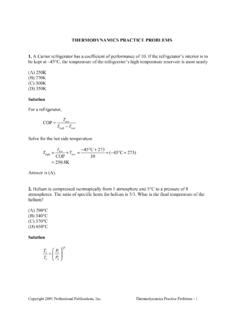
THERMODYNAMICS PRACTICE PROBLEMS 1.
faculty.utrgv.eduTitle: Topic VIII - Page 6 Author: Gregg Wagener Created Date: 6/4/2001 12:10:18 PM