Thermodynamics - NJCTL
May 07, 2012 · (B) Conduction (C) Convection (D) Radiation (E) Emission 22. The process of heat transfer from object to another because of molecular motion and interaction is called: (A) Convection (B) Conduction (C) Radiation (D) Induction (E) None of the above 23. A hot object with a temperature T 1 is connected to a cool object with a temperature of T 2. The
Download Thermodynamics - NJCTL

Information
Domain:
Source:
Link to this page:
Documents from same domain
Genes DNA Replication - Center For Teaching & Learning
content.njctl.orgwww.njctl.org Biology Genes Genes DNA Replication Classwork 1. Explain why it is necessary to be able to replicate DNA in order to sustain life. 2. What is the appropriate scientific term used to describe ‘a series of bases ... www.njctl.org Biology Genes .
Multiple Choice Review- Photosynthesis and Cellular ...
content.njctl.orgMultiple Choice Review- Photosynthesis and Cellular Respiration 1. Oxidation is a. The addition of electrons to a molecule b. The addition of protons to a molecule c. The loss of electrons from a molecule d. The loss of protons from a molecule 2. What molecules are necessary for aerobic cellular respiration? a. Glucose and Oxygen b.

Atomic Structure and Electron Configurations Multiple ...
content.njctl.orgAtomic Structure and Electron Configurations Multiple Choice PSI Chemistry Name:_____ 1. Rutherford’s Nuclear Model of the atom A. is the currently accepted atomic model. B. explains the unique emission spectra of different elements. C. does not account for the stability of most atoms since accelerating electrons

Periodic Trends Multiple Choice Review PSI Chemistry Name
content.njctl.orgJul 13, 2012 · Electronegativity 23)The ability of an atom in a molecule to attract electrons is best quantified by the _____. A) paramagnetism B) diamagnetism C) electronegativity D) first ionization potential E) electron change-to-mass ratio 24)Electronegativity _____ from left to right within a period and _____ from top to bottom within a group.

PSI AP Physics 2 Electric Potential and Capacitors ...
content.njctl.orgA Dielectric can do which of the following in capacitors? Select two answers. A. Decrease capacitance B. The electric field between plates is reduced. C. Increase capacitance ... How long a capacitor is connected to a power source . Answers 1. C 2. D 3. D 4. A 5. B 6. C 7. C 8. A 9. A 10. A 11. B 12. D 13. B 14. A 15. B 16. D 17. D 18. C 19. A ...

PSI Physics - Kinematics Multiple Choice Questions
content.njctl.orgOct 13, 2013 · PSI Physics - Kinematics Multiple Choice Questions 1. An object moves at a constant speed of 6 m/s. This means that the object: A. Increases its speed by 6 m/s every second B. Decreases its speed by 6 m/s every second . Doesn’t move D. Has a positive acceleration E. Moves 6 meters every second 2. A toy car moves 8 m in 4 s at the constant ...

Fluids Practice Problems - NJCTL
content.njctl.orgMay 13, 2009 · Fluids Practice Problems PSI AP Physics B Name_____ Multiple Choice Questions 1. Two substances mercury with a density 13600 kg/m3 and alcohol with a density 0.8 kg/m3 are selected for an experiment. If the experiment requires equal masses of each liquid, what is the ratio of alcohol volume to the mercury volume?

PSI Physics Simple Harmonic Motion (SHM) Multiple-Choice ...
content.njctl.org14. An object with a mass M is suspended from an elastic spring with a spring constant k. The object oscillates with period T on the surface of Earth. If the oscillating system is moved to the surface of Moon, how it will change the period of oscillations? Acceleration due to gravity on moon= 1.6 m/s 2 A. The period is increased by factor √6 B.

Covalent Bonding & Molecular Compounds Multiple Choice ...
content.njctl.orgMar 01, 2013 · A) boron chloride B) boron trichloride C) monoboron chloride D) trichloro boron E) monoboron trichloride 22) The name of the binary compound CS 2 is _____. A) carbon sulfide B) monocarbon disulfide C) carbon disulfide D) carbon …

PSI AP Physics 1 Circular Motion - NJCTL
content.njctl.orgball just clears the ground. Air resistance is negligible. Express all answers in terms of M, L, and g. a. Determine the magnitude and direction of the net force on the ball when it is at the top. b. Determine the speed v o of the ball at the top. After a few circles, the string breaks when the ball is at the highest point.
Related documents
Heat Transfer: Conduction, Convection, and Radiation
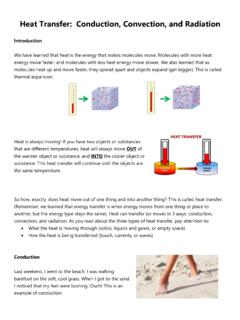
alkisites.vansd.orgHeat Transfer: Conduction, Convection, and Radiation Introduction We have learned that heat is the energy that makes molecules move. Molecules with more heat energy move faster, and molecules with less heat energy move slower. We also learned that as molecules heat up and move faster, they spread apart and objects expand (get bigger). This is ...
HEAT AND MASS TRANSFER - UPM
webserver.dmt.upm.esThese three heat-flux models can also be viewed as: heat transfer within materials (conduction), heat transfer within fluids (convection), and heat transfer through empty space (radiation). Notice that heat (related to a path integral in a closed control volume in thermodynamics) has the positive
Heat transfer and thermal modelling - UPM
webserver.dmt.upm.esThese three heat-flux models can also be viewed as: heat transfer within materials (conduction, Fourier’s law), heat transfer at fluid-bathed walls (convection, Newton’s law of cooling), and heat transfer through empty space (radiation, Stefan-Boltzmann’s law of cooling for a body in a large environment). An
Engine Heat Transfer - MIT
web.mit.edu3. Convective heat transfer depends on gas temperature, heat transfer coefficient, which depends on charge motion, and transfer area, which depends on flame/combustion chamber geometry 4. Radiative heat transfer is smaller than convective one, and it is only significant in diesel engines 27

PHYSICS IGCSE 2012 EXAM REVISION NOTES
mrtremblaycambridge.weebly.com2.3 Transfer of thermal energy a. Conduction b. Convection c. Radiation d. Consequences of energy transfer 3. Properties of waves, including light and sound 3.1 General wave properties 3.2 Light a. Reflection of light b. Refraction of light c. Thin converging lens d. Dispersion of light e. Electromagnetic spectrum 3.3 Sound 4.

Heat Transfer conduction and convection
www.csun.eduSteady Heat Transfer February 14, 2007 ME 375 – Heat Transfer 1 Steady Heat Transfer with Conduction and Convection Larry Caretto Mechanical Engineering 375 Heat Transfer February 14, 2007 2 Outline • Review last lecture • Equivalent circuit analyses – Review basic concept – Application to series circuits with conduction and convection

How does basic refrigeration cycle work?
cdn.ymaws.comof heat transfer. They are conduction, convection, and radiation or any combination of the three methods. Heat transfer is the movement of heat from solid, liquid or gas materials to other solid, liquid and gas materials. According to the second law of thermodynamics, heat always flows from a material at a high temperature to a

Energy Conservation Building Code (ECBC) - S3WaaS
cdnbbsr.s3waas.gov.inHeat Transfer Mode of Heat Transfer Affected By ECBC’s role in regulating Heat Transfer CONDUCTION Thermal Properties of Materials & Effectiveness of Insulation U‐factors/ R‐values of roofs & walls CONVECTION Air movement at the surface Building Envelope Sealing Requirements RADIATION Indirect and direct solar
Lecture 2. BASICS OF HEAT TRANSFER - University of …
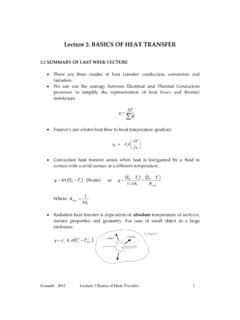
documents.uow.edu.auThere are three modes of heat transfer: conduction, convection and radiation. We can use the analogy between Electrical and Thermal Conduction processes to simplify the representation of heat flows and thermal resistances. R T q

Convection, Conduction & Radiation
faculty.ric.eduConvection, Conduction & Radiation There are three basic ways in which heat is transferred: convection, conduction and radiation. In gases and liquids, heat is usually transferred by convection, in which the motion of the gas or liquid itself carries heat from one place to another. Another way to transfer heat is by conduction, which does not ...
Related search queries
Heat Transfer: Conduction, Convection, and Radiation, Heat, Transfer, Heat Transfer, Conduction, Convection, RADIATION, PHYSICS, Heat Transfer CONDUCTION, Refrigeration, And radiation, ECBC, Lecture 2. BASICS OF HEAT TRANSFER, Heat transfer: conduction, convection and radiation, Convection, Conduction & Radiation, Conduction and radiation, Transfer heat