Thin layer chromatography TLC
1 Thin Layer Chromatography. Thin layer chromatography, or TLC, is a method for analyzing mixtures by separating the compounds in the mixture. TLC can be used to help determine the number of components in a
Download Thin layer chromatography TLC

Information
Domain:
Source:
Link to this page:
Documents from same domain

Esters. An Introduction.
people.chem.umass.eduof mixtures, albeit not as complex as their natural counterparts. One example is an artificial pineapple mixture – 7 esters, 3 carboxylic acids, and 7 essential oils (other natural extracts). In some cases even an individual ester smells similar to a natural aroma. Some examples include O O O O O O O O chocolate vanilla honey caramel

Distillation - BMB & Chemistry IT
people.chem.umass.eduFamiliar examples include the distillation of crude fermentation broths into alcoholic spirits such as gin and vodka, and the fractionation of crude oil into useful products such as gasoline and heating oil. ... It shows only the basic pieces that exemplify the process.) If we placed the 1:1 mixture of cyclohexane and toluene into the ...

The Synthesis of Phenacetin from Acetaminophen Introduction
people.chem.umass.eduScheme 2 shows the reaction that will be performed i n this experiment . Acetaminophen is treated ... via syringe followed by the football-shaped magnetic stir bar. 3. Turn the stirrer on to low. The stir bar should be allowed to spin at a rate to sufficiently mix ... Reaction Work Up: 1. Add 4 mL water to the RBF and allow the solid to ...
Thin layer chromatography TLC
people.chem.umass.eduThin Layer Chromatography. Thin layer chromatography, or TLC, is a method for analyzing mixtures by separating the compounds in the mixture. TLC can be used to help determine the number of components in a mixture, the identity of compounds, and the purity of a compound.
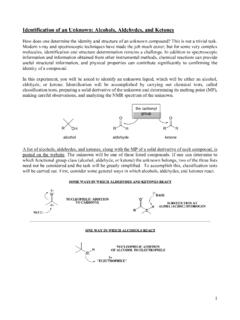
Identification of an Unknown – Alcohols, Aldehydes, and ...
people.chem.umass.edu2,4-Dinitrophenylhydrazine : Aldehydes and ketones react with 2,4-dinitrophenylhydrazine reagent to form yellow, orange, or reddish-orange precipitates, whereas alcohols do not react. Formation of a precipitate therefore indicates the presence of an aldehyde or ketone. The precipitate from this test also serves as a solid derivative.

Acid-Base Extraction - University of Massachusetts Amherst
people.chem.umass.edusalt of carboxylic acid - low solubility in ether - high solubility in water In the experiment done in this lab, a mixture of a carboxylic acid (stronger acid), a phenol (weaker acid), and a neutral compound will be separated by acid-base extractions. The separated compounds

Synthesis of Cyclohexene The Dehydration of Cyclohexanol
people.chem.umass.eduSet up a fractional distillation apparatus in the same way as in the distillation experiment (remember the boiling chips). Be sure to use the distillation column (in some rare cases a slightly longer narrower glass tube that looks a lot like the distillation column may have inadvertently gotten mixed in to some of the lockers. Be sure to
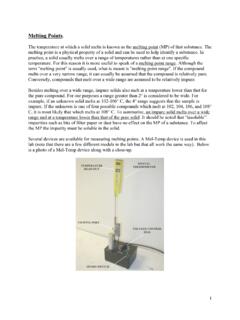
Melting Points - University of Massachusetts Amherst
people.chem.umass.eduMelting Points. The temperature at which a solid melts is known as the melting point (MP) of that substance. The melting point is a physical property of a solid and can be used to help identify a substance. In practice, a solid usually melts over a range of temperatures rather than at one specific temperature.

A Brief Discussion of Color - BMB & Chemistry IT
people.chem.umass.eduA Brief Discussion on Color. Because several tests in the Alcohol, Aldehyde, and Ketone experiment involve color changes or produce colored compounds, a modest understanding of color will be helpful in the interpretation of the test results. What causes a compound to appear as being colored? The answer to this
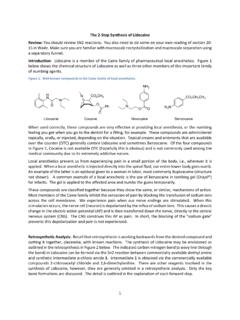
The 2-Step Synthesis of Lidocaine Review: Introduction
people.chem.umass.eduabove for the proper hook-up of a water-cooled condenser). Turn water on very slowly. Your water going to the drain should just trickle out, not flow like white-water rapids! Lower assembly close to the hot plate and reflux for 90 minutes (note any and all observations). Cool to room temperature, unaided. Transfer to a separatory funnel and ...
Related documents

An Introduction to Organic Chemistry
www.cnm.manchester.ac.ukAn Introduction to Organic Chemistry 82 Organic Chemistry Organic chemistry is the study of compounds containing carbon with the exception of simple compounds e.g. carbonates (CO 3 2-), carbon dioxide (CO 2) and carbon monoxide (CO). Nomenclature There are over 6 million known organic compounds. Nomenclature is therefore very important.

Structure Determination of Organic Compounds
bionmr.unl.eduLaboratory of Organic Chemistry Wolfgang-Pauli-Str. 10 8093 Zurich¨ Switzerland badertscher@org.chem.ethz.ch Prof. Dr. Philippe Buhlmann¨ University of Minnesota Dept. of Chemistry 209 Pleasant Street SE., Minneapolis, MN 55455 USA buhlmann@umn.edu ISBN 978-3-540-93809-5 e-ISBN 978-3-540-93810-1 DOI 10.1007/978-3-540-93810-1
A INTRODUCTION TO THE GLOBAL CARBON C
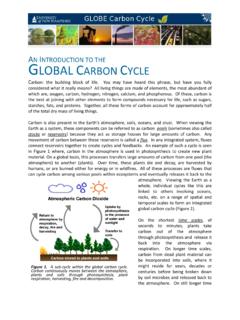
globecarboncycle.unh.eduorganic matter) into shale over geological time, or by the collection of calcium carbonate particles, from the shells and skeletons of marine organisms, into limestone and other carbon-containing sedimentary rocks. Together all sedimentary rocks on Earth store 100,000,000 PgC (Petagrams of carbon).
Chapter 12 Introduction to Organic Chemistry: Hydrocarbons
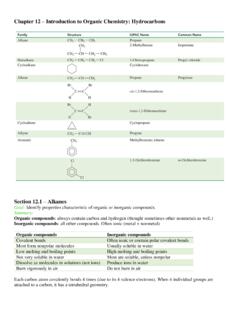
ion.chem.usu.eduChapter 12 – Introduction to Organic Chemistry: Hydrocarbons Section 12.1 – Alkanes Goal: Identify properties characteristic of organic or inorganic compounds. Summary: Organic compounds: always contain carbon and hydrogen (thought sometimes other nonmetals as well.) Inorganic compounds: all other compounds.Often ionic (metal + nonmetal) Organic …
CHAPTER 1 INTRODUCTION TO ORGANIC CHEMISTRY 1.1 …
www.siue.eduINTRODUCTION TO ORGANIC CHEMISTRY 1.1 Historical Background of Organic Chemistry Organic chemistry is the area of chemistry that involves the study of carbon and its compounds. Carbon is now known to form a seemingly unlimited number of compounds. The uses of organic compounds impact our lives daily in medicine, agriculture, and general life.
Experiment 3 An Introduction to Functional Groups in ...
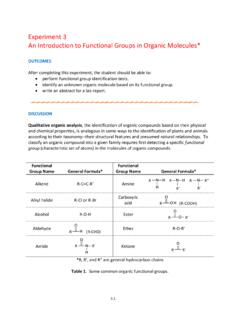
webs.anokaramsey.eduAn Introduction to Functional Groups in Organic Molecules* OUTCOMES After completing this experiment, the student should be able to: perform functional group identification tests. identify an unknown organic molecule based on its functional group. …
Introduction to Organic Practices
www.ams.usda.govIntroduction to Organic Practices. USDA is an equal opportunity employer and provider. USDA National Organic Program Agricultural Marketing Service September 2015 crops are harvested must have defined boundaries and buffer zones, such as …
Introduction To Activated Sludge Study Guide
dnr.wi.govIntroduction To Activated Sludge Study Guide Subclass C Wisconsin Department of Natural Resources Bureau of Science Services, Operator Certification Program P.O. Box 7921, Madison, WI 53707 ... Organic loading is the amount of biodegradable material that exerts an …