Thin layer chromatography TLC
Thin Layer Chromatography. Thin layer chromatography, or TLC, is a method for analyzing mixtures by separating the compounds in the mixture. TLC can be used to help determine the number of components in a mixture, the identity of compounds, and the purity of a compound.
Download Thin layer chromatography TLC

Information
Domain:
Source:
Link to this page:
Documents from same domain

Esters. An Introduction.
people.chem.umass.eduof mixtures, albeit not as complex as their natural counterparts. One example is an artificial pineapple mixture – 7 esters, 3 carboxylic acids, and 7 essential oils (other natural extracts). In some cases even an individual ester smells similar to a natural aroma. Some examples include O O O O O O O O chocolate vanilla honey caramel
Thin layer chromatography TLC
people.chem.umass.eduMost organic compounds will form a dark-colored complex with iodine. It is good practice to use at least two visualization techniques in case a compound does not show up with one particular method. The Rf value is used to quantify the movement of the materials along the plate. Rf is …

Distillation - BMB & Chemistry IT
people.chem.umass.eduFamiliar examples include the distillation of crude fermentation broths into alcoholic spirits such as gin and vodka, and the fractionation of crude oil into useful products such as gasoline and heating oil. ... It shows only the basic pieces that exemplify the process.) If we placed the 1:1 mixture of cyclohexane and toluene into the ...

The Synthesis of Phenacetin from Acetaminophen Introduction
people.chem.umass.eduScheme 2 shows the reaction that will be performed i n this experiment . Acetaminophen is treated ... via syringe followed by the football-shaped magnetic stir bar. 3. Turn the stirrer on to low. The stir bar should be allowed to spin at a rate to sufficiently mix ... Reaction Work Up: 1. Add 4 mL water to the RBF and allow the solid to ...
Identification of an Unknown – Alcohols, Aldehydes, and ...
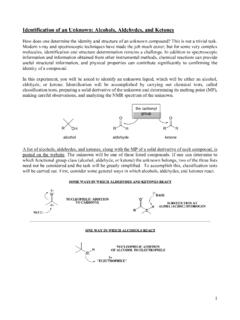
people.chem.umass.edu2,4-Dinitrophenylhydrazine : Aldehydes and ketones react with 2,4-dinitrophenylhydrazine reagent to form yellow, orange, or reddish-orange precipitates, whereas alcohols do not react. Formation of a precipitate therefore indicates the presence of an aldehyde or ketone. The precipitate from this test also serves as a solid derivative.

Acid-Base Extraction - University of Massachusetts Amherst
people.chem.umass.edusalt of carboxylic acid - low solubility in ether - high solubility in water In the experiment done in this lab, a mixture of a carboxylic acid (stronger acid), a phenol (weaker acid), and a neutral compound will be separated by acid-base extractions. The separated compounds

Synthesis of Cyclohexene The Dehydration of Cyclohexanol
people.chem.umass.eduSet up a fractional distillation apparatus in the same way as in the distillation experiment (remember the boiling chips). Be sure to use the distillation column (in some rare cases a slightly longer narrower glass tube that looks a lot like the distillation column may have inadvertently gotten mixed in to some of the lockers. Be sure to
Melting Points - University of Massachusetts Amherst
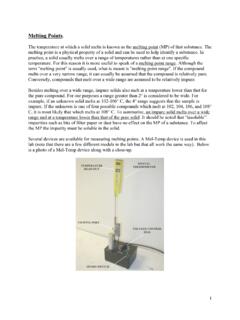
people.chem.umass.eduMelting Points. The temperature at which a solid melts is known as the melting point (MP) of that substance. The melting point is a physical property of a solid and can be used to help identify a substance. In practice, a solid usually melts over a range of temperatures rather than at one specific temperature.

A Brief Discussion of Color - BMB & Chemistry IT
people.chem.umass.eduA Brief Discussion on Color. Because several tests in the Alcohol, Aldehyde, and Ketone experiment involve color changes or produce colored compounds, a modest understanding of color will be helpful in the interpretation of the test results. What causes a compound to appear as being colored? The answer to this
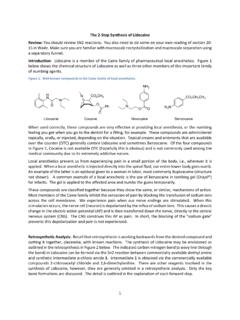
The 2-Step Synthesis of Lidocaine Review: Introduction
people.chem.umass.eduabove for the proper hook-up of a water-cooled condenser). Turn water on very slowly. Your water going to the drain should just trickle out, not flow like white-water rapids! Lower assembly close to the hot plate and reflux for 90 minutes (note any and all observations). Cool to room temperature, unaided. Transfer to a separatory funnel and ...
Related documents

Gas Chromatography-Mass Spectroscopy
cires1.colorado.eduGas chromatography-mass spectroscopy (GC-MS) is one of the so-called hyphenated analytical techniques. As the name implies, it is actually two techniques that are combined to form a single method of analyzing mixtures of chemicals. Gas chromatography separates the components of a mixture and

SEPARATION TECHNIQUES - Sepali's Chemistry Guide
chemguide.net• Mixtures that are suitable for separation by chromatography include inks, dyes and colouring agents in food. Method 1. Simple chromatography is carried out on paper. 2. A spot of the mixture is placed near the bottom of a piece of chromatography paper and the paper is then placed upright in a suitable solvent, eg water. 3.
Flash Column Chromatography Guide - MIT OpenCourseWare
ocw.mit.edu- Flash Column Chromatography Guide Overview: Flash column chromatography is a quick and (usually) easy way to separate complex mixtures of compounds. We will be performing relatively large scale separations in 5.301, around 1.0 g of compound. Columns are often smaller in scale than this and some of you will

Gel Permeation Chromatography (GPC) - Waters Corporation
www.waters.comChromatography (GPC) [ GPC Capabilities ] 2 In 1964 John C. Moore, of the Dow Chemical Company, published his work on the preparation of Gel Permeation Chromatography ... These innovations allow size-exclusion techniques to expand …

Thin Layer Chromatography (TLC) - Boston College
www.bc.eduboth paper and thin layer chromatography, you will work with a variety of developing solvents, and you will use several different techniques to visualize the spots of a chromatogram. Paper chromatography, which will be used to separate amino acids, is a form of partition chromatography (see LTOC page 253). Water, a component of the developing

Experiment 6 — Thin-Layer Chromatography
www.amherst.eduThin-layer chromatography (TLC) is an extremely valuable analytical technique in the organic lab. It provides a rapid separation of compounds, and thereby gives an indication of the number and nature of the components of a mixture. TLC can also be used to identify compounds

Thin Layer Chromatography (TLC) Guide
ocw.mit.edu– Thin Layer Chromatography (TLC) Guide Overview: Thin Layer Chromatography (TLC) is an extremely useful technique for monitoring reactions. It is also used to determine the proper solvent system for performing separations using column chromatography. TLC uses a stationary phase, usually alumina or silica, that is highly

Paper Chromatography of Pigments in a Spinach Leaf
weissman.baruch.cuny.eduthe simplest of chromatography techniques called paper chromatography. Chromatography is an analytical method permitting the separation of a mixture into its molecular components. In this technique, a concentrated spot of the pigment mixture is deposited at one end of a …
Affinity Chromatography Principles and Methods Handbook
b3p.it.helsinki.fiAffinity chromatography in brief Affinity chromatography separates proteins on the basis of a reversible interaction between a protein (or group of proteins) and a specific ligand coupled to a chromatography matrix. The technique is ideal for a capture or intermediate step in a purification protocol and can be used