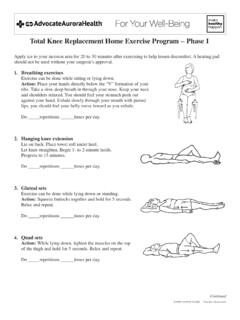
Total Knee Replacement Home Exercise Program Phase I
Supine hip abduction Action: Lie down. Keep knees straight and toes pointed . up to the ceiling. Slide involved leg out as far as possible and return to the starting position. (May need the assistance of another person for this exercise.) Do repetitions times per day. 8. Terminal knee extension Action: Lie down. Place rolled towel under knee ...
Download Total Knee Replacement Home Exercise Program Phase I

Information
Domain:
Source:
Link to this page:
Documents from same domain

Lower Extremity Strengthening Exercises in Supine
ahc.aurorahealthcare.orgLower Extremity Strengthening Exercises in Supine, Page 2 X19572bc (Rev. 04/10) ©AHC Lower Extremity The information presented is intended for general information and educational purposes.

Relaxation Exercises - Aurora Health Care
ahc.aurorahealthcare.orgX26017 (07/06) ©AHC Breathing/Relaxation Relaxation Exercises The information presented is intended for general information and educational purposes. It is not intended to replace the advice of your health care provider. Contact your health care provider if you believe you have a health problem.

Hip: Straight Leg Raise – Supine 4-Way - Aurora Health Care
ahc.aurorahealthcare.orgHip: Straight Leg Raise – Supine 4-Way Straight leg raise – flexion 1. Lie on your back. 2. Bend uninvolved knee and put foot on floor. 3. Slowly tighten the thigh muscle of the involved leg, performing a quad set. 4. Flex foot of involved leg toward nose. 5. Slowly lift entire leg 12 to 18 inches off floor.
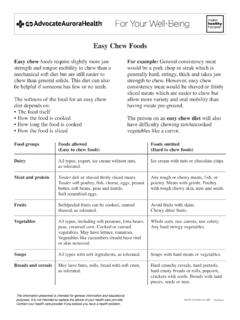
Easy Chew Foods - Aurora Health Care
ahc.aurorahealthcare.orgEasy Chew Foods. Easy chew foods require slightly more jaw strength and tongue mobility to chew than a mechanical soft diet but are still easier to chew than general solids. This diet can also be helpful if someone has few or no teeth. The softness of the food for an easy chew

“D (Rh) Type” and “D Variant” Antigen
ahc.aurorahealthcare.org“D (Rh) Type” and “D Variant” Antigen What is the D antigen? D antigen is a protein with many parts, found on the surface of red blood cells. The D antigen is also known as the “Rh factor” and it tells us your blood type. People are either D (Rh) negative or D (Rh) positive. If your blood type is D negative, your red

Vestibular Rehabilitation Exercises – Level 1
ahc.aurorahealthcare.orgVestibular Rehabilitation Exercises – Level 1, page 3 X20521 (Rev. 12/2019) ©AAHC Vertigo/Vestibular. The information presented is intended for general information and educational purposes. It is not intended to replace the advice of your health care provider. Contact your health care provider if you believe you have a health problem. 6.

Shoulder: Rotator Cuff Isometric Program – Standing
ahc.aurorahealthcare.orgX08252 (Rev. 11/2019) ©AAHC \OT Shoulder/Scapula Shoulder: Rotator Cuff Isometric Program – Standing. Isometric exercises are muscle tightening exercises performed with no joint movement. Their action is to increase circulation for healing and strengthening muscles with minimal joint irritation.
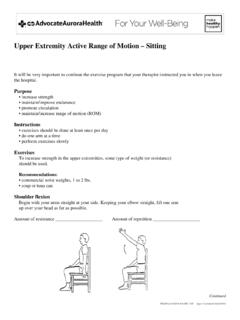
Upper Extremity Active Range of Motion – Sitting
ahc.aurorahealthcare.orgTo increase strength in the upper extremities, some type of weight (or resistance) should be used. Recommendations: • commercial wrist weights, 1 to 2 lbs. • soup or tuna can . Shoulder flexion Begin with your arms straight at your side. Keeping your elbow straight, lift one arm . up over your head as far as possible.
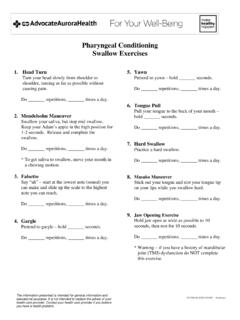
Pharyngeal Conditioning Swallow Exercises
ahc.aurorahealthcare.orgSwallow your saliva, but stop mid swallow. Keep your Adam’s apple in the high position for 1-2 seconds. Release and complete the swallow. Do _____ repetitions, _____ times a day. * To get saliva to swallow, move your mouth in a chewing motion. 3. Falsetto 8. Say “ah” – start at the lowest note (sound) you

Cervical Range of Motion and Isometrics Home Exercise …
ahc.aurorahealthcare.org3. Neck Flexion. Slowly bend your head forward, return to the starting position. Hold . Perform . seconds. Repeat times per day. times. 4. Neck Sidebending. Slowly tilt your head toward one shoulder, then slowly repeat . to the opposite side while keeping your face straight ahead. Hold . Perform . seconds. Repeat times per day. times. 5. Neck ...
Related documents
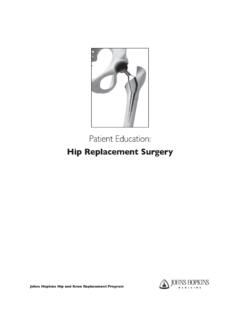
Hip Replacement Surgery Patient Education Guide
www.hopkinsmedicine.orgYour hip joint works like a ball and socket, with the upper portion of your femur (thigh bone) as ... Supine Lying on your back with knees straight, slide the affected heel towards your buttock as you bend ... raise your leg out to the side. Keep your knee straight and point your toes
Rehabilitation Protocol for Anterior Cruciate Ligament ...
www.massgeneral.org• NMES high intensity (2500 Hz, 75 bursts) supine knee extended 10 sec/50 sec, 10 contractions, 2x/wk during sessions—use of clinical stimulator during session, consider home units distributed immediate post op • Straight leg raise o **Do not perform straight leg raise if you have a knee extension lag • Hip abduction

Rehabilitation Guidelines for Knee Multi-Ligament Repair ...
www.uwhealth.org• Leg lifts in standing with brace on for balance and hip strength – avoid hip extension secondary to hamstring restrictions • Straight leg raise (SLR) with brace locked ... • Flexion: Use gravity or assistance to maximize hamstring activity, including supine wall slides or seated knee flexion; if flexion needs to be forced then continue to
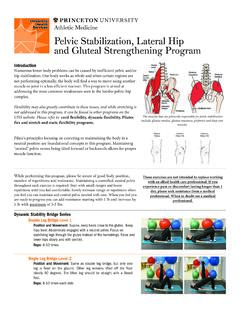
Athletic Medicine Pelvic Stabilization, Lateral Hip and ...
uhs.princeton.eduTop leg is crossed over bottom leg so that feet are in a straight line. Top hand rests on hip. Lift pelvis. Reps: 4: hold for 10-15 seconds, alternate sides to avoid overload to upper extremity Sets: 2-4 each side Raised Sideplank with Static Abduction Leg Lift Holds Position and Movement: Sidelying with arm extended under shoulder.

Total Knee Arthroplasty (TKA) POST-OP REHABILITATION ...
universityorthopedics.com• If 0 (Knee straight) – 90 degrees (Knee over toes) is not achieved by 6 weeks then a patient would need ... • Knee Extension Strength >/= 4/5 • Independent straight leg raise without extensor lag • Independent with ambulation using least ... Short arc quads supine, supine hip flexion, Squats with assist as needed